

- World Food Day Observed Today Amid Global Hunger Crisis |
- World Lost More Than 7 Million Hectares of Forest in 2025 |
- Bangladesh Ranks 84th in Global Hunger Index 2026 |
- 10 Die of Dengue in Bangladesh, 1,943 Hospitalised |
- 28 Killed as School Roof Collapses in Northwest Pakistan |
Medicinal Plant Farming Turns Lucrative as Demand Soars
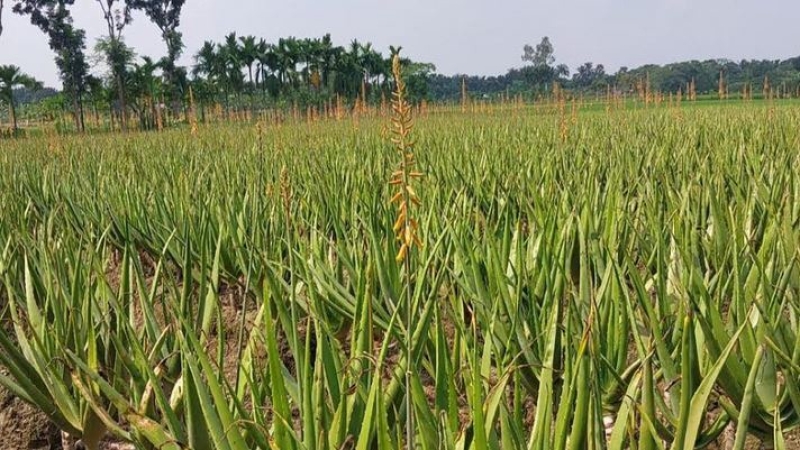
Filed of medicianl plants at Kholabaria in Natore
The cultivation and commercial use of medicinal plants in Bangladesh is witnessing a steady revival, driven by rising demand from pharmaceutical industries, renewed public interest in traditional healing, and growing awareness of the economic value of herbal resources. From rural homesteads to organised farming clusters, what was once a neglected sector is gradually emerging as a viable source of income and a critical component of the country’s healthcare ecosystem.
Across the country, thousands of farmers are now turning to medicinal plant cultivation, seeing it as more profitable and sustainable than many conventional crops. A striking example is Kholabaria Union in Natore, where around 5,000 farmers are directly engaged in cultivating a wide range of medicinal plants. The area, comprising 15 villages, has earned the nickname “Oushudi Gram” or the village of herbal medicine, reflecting its transformation into a thriving hub for herbal cultivation and trade.
The shift did not happen overnight. Just a few decades ago, medicinal plants were largely overlooked, and many species were at risk due to deforestation and changing land use patterns. However, a combination of grassroots initiatives, government encouragement, and market demand has reversed that trend. Today, farmers who once cut down trees for fuel or timber are actively planting and nurturing species known for their healing properties.
Local farmers say medicinal plant farming offers both financial stability and lower production risks. Unlike seasonal crops, many medicinal plants can be grown year-round and require relatively less intensive care. Popular varieties include aloe vera, tulsi (holy basil), ashwagandha, kalmegh, shotomul, basok, and shimul. These plants are widely used in Ayurvedic and Unani medicines, as well as modern pharmaceutical formulations.
According to the Bangladesh Agricultural Research Institute (BARI), the country is home to at least 722 species of medicinal plants, with around 700 used for therapeutic purposes. Of these, 255 species are commonly utilised in Ayurvedic and Unani medicine. By comparison, neighbouring India has nearly 4,000 medicinal plant species, highlighting the potential for Bangladesh to expand its resource base.
Despite this rich biodiversity, supply continues to fall short of demand. Pharmaceutical companies, herbal medicine producers, and cosmetic manufacturers rely heavily on imported raw materials due to insufficient local production. Industry insiders say this gap presents a significant opportunity for domestic farmers and entrepreneurs.
Bangladesh's formal medicinal plant and herbal medicine market is estimated to be worth around US$60 million or Taka7.5 billion, according to recent newspaper reports. However, specific agricultural hubs like Kholabaria village in Natore, known as a "village of herbs," generate significant revenue, with sales reaching approximately Tk 1.25 billion ($9-10 million USD) annually.
According to reports, while the total formal herbal market is estimated at $60 million, older studies have placed the wholesale medicinal plant market value around US$14 million or Taka 1.75 billion. The industry includes over 550 manufacturers of traditional, Ayurvedic, and Unani medicines. Roughly 90 per cent of raw materials are imported, with local supply contributing 70% by volume and 40% by value.
“Cultivating medicinal plants is easy and it’s more profitable than traditional vegetable farming,” said a farmer of Kholabaria, pointing to the growing interest among villagers in switching to herbal crops.
The demand is not limited to local markets. There is growing international interest in Bangladesh’s medicinal plants, particularly those with proven therapeutic properties. Farmers in Kholabaria report visits from foreign buyers and researchers who collect samples and explore potential export opportunities.
At the heart of Kholabaria’s success story is a grassroots movement led by local practitioners of traditional medicine. One such figure is a village healer whose early efforts to cultivate medicinal plants in the mid-1990s inspired others to follow suit. Initially planting herbs for personal use, he soon began selling surplus to neighbouring healers, sparking a wave of interest across the community.
Over time, this small initiative grew into a full-fledged local industry. Farmers began cultivating medicinal plants on a larger scale, while nurseries emerged to supply saplings to both local growers and buyers from other regions.
Nursery owners have also found success in this sector. Many have diversified their operations by growing hundreds of plant species and supplying them nationwide. These nurseries not only support commercial farming but also contribute to conservation by preserving rare and endangered species.
Joynal Abedin, 60, owner of Halima Bheshoj Nursery in Kholabaria, said he has been cultivating around 631 species of medicinal plants since 2001 and receiving buyers from across the country almost every day. “Alhamdulillah, I am able to support my family through this nursery. People from different pharmaceutical companies and herbal medicine manufacturers come here regularly to collect plants,” he said, adding that even foreign visitors have shown interest in his collection.
The Department of Agricultural Extension (DAE) of the government has been promoting medicinal plant cultivation as part of broader efforts to bring fellow land under productive use. Officials say that in Natore alone, around 140 species are cultivated on approximately 140 hectares of land, with production expected to reach significant levels each year.
“People are now growing medicinal plants in backyards and unused spaces. This shows increasing awareness about their commercial value,” said a DAE official in Natore.
The appeal of medicinal plants extends beyond rural areas. Urban households are increasingly growing herbs in pots for personal use, reflecting a broader shift towards natural and preventive healthcare. For many, using tulsi leaves for coughs or aloe vera for skin care is both convenient and cost-effective. “There is now a growing interest in traditional or alternative medicine. People even in urban areas are planting herbs at home for daily use,” the DAE official said.
Globally, the importance of traditional medicine is well recognised. The World Health Organization (WHO) estimates that 88 percent countries use traditional medicine in some form, while more than 40 percent of pharmaceutical products are derived from natural sources. Many widely used drugs, including aspirin and artemisinin, have origins in traditional medicinal practices. Experts say Bangladesh is well positioned to tap this growing global market.
“There is not enough supply compared to the demand for medicinal plants in the country,” said Tusher Kumer Ray, senior research officer of the Minor Forest Product Division at the Bangladesh Forest Research Institute.
There are also concerns about the sustainability of certain species. Researchers warn that some valuable medicinal plants are becoming rare due to overharvesting and habitat loss.
“Species like ritha and chalmugra are gradually disappearing. We are working on conservation and developing improved nursery techniques to protect these plants,” Ray added.
Efforts are underway to address these challenges. Dedicated research stations have been established to preserve genetic resources and promote sustainable practices.
In addition, digital initiatives such as the Medicinal Plants Database of Bangladesh is helping compile and disseminate information on plant species, their uses, and their distribution. This database serves as a valuable resource for researchers, farmers, and industry stakeholders, bridging the knowledge gap that has long hindered the sector’s development.
Traditional healers, known locally as Kaviraj or Hekim, continue to play a crucial role in maintaining and passing on knowledge of medicinal plants. In many rural areas, they remain the first point of contact for healthcare, offering affordable remedies based on locally available resources.
The economic impact of medicinal plant cultivation is becoming increasingly evident. Farmers report steady incomes, while traders and transporters benefit from the growing market. The sector also creates employment opportunities in nurseries, processing units, and distribution networks.
However, stakeholders say more coordinated efforts are needed to unlock the full potential of this industry. “Better policy support, access to credit, and stronger market linkages are essential to expand this sector,” said a leader of the Kholabaria Medicinal Village Development Cooperative Society Ltd.
There is also a need to promote value addition within the country. Instead of exporting raw materials, Bangladesh could develop its own herbal products, ranging from medicines to cosmetics and wellness items.
As interest in natural and sustainable products continues to grow worldwide, the prospects for Bangladesh’s medicinal plant sector appear promising. With the right mix of policy support, research, and community engagement, the country could transform its rich botanical heritage into a major economic asset.
For now, the fields of Kholabaria stand as a testament to what is possible. Rows of aloe vera, tulsi, and ashwagandha plants stretch across the landscape, tended by farmers who have embraced a new way of farming. What began as a local experiment has evolved into a model for rural development, blending tradition with innovation.
The revival of medicinal plant cultivation is not just about economic gain. It is also about preserving knowledge, protecting biodiversity, and offering people a closer connection to nature. (This story has been published in the April print edition of the GreenWatch)