

- Bangladesh Targets 8.5-Fold Rise in Cotton Output by 2050 |
- India Jails Two 'Cockroach' Movement Leaders for Five Days |
- Iran Says Cargo Ship Sank After Hitting Mine in Hormuz |
- No Plan for Operation Clean Heart-Style Drive Now: Home Minister |
- Bangladesh Eyes $10b in UK Exports Through Diversification |
Bangladesh sees no existence of militancy now: Home Minister
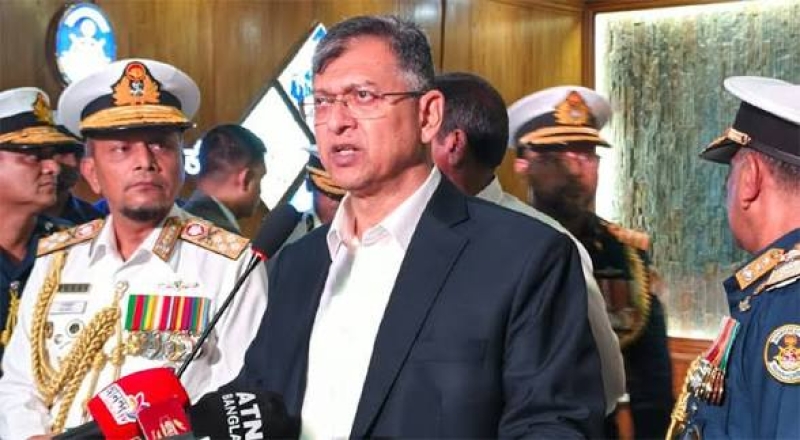
Home Minister Salahuddin Ahmed on Tuesday said that there is currently no existence of militancy in Bangladesh, alleging that the term had been used as a political tool by the previous “fascist” government.
Some extremist or radical groups exist in every country, but the government has remained vigilant to keep them under control, he said.
The minister made the remarks while responding to a question from reporters after attending a programme marking the 31st Raising Day of the Bangladesh Coast Guard at its headquarters in the city's Agargaon on Tuesday.
Replying to another question, Salahuddin Ahmed said the process of gradually withdrawing army personnel deployed under “In Aid to Civil Power” has already begun.
“We are in a phase of gradual withdrawal. It is not possible to withdraw the entire force suddenly,” he said, adding that the number of deployed troops will soon be reduced to a very limited level.
He also said that necessary precautionary measures, in line with standard operating procedures (SOPs), will remain in place to ensure the security of key point installations (KPIs).
On increasing the members' number of the Coast Guard, the minister said a policy decision has been taken to raise its manpower from the present 5,000 to 10,000 to ensure security in coastal and riverine areas.
He added that the force will be further strengthened with modern logistics, advanced training and necessary facilities.
Highlighting evolving challenges, the minister said criminals are increasingly using digital technologies to carry out their activities, making it essential for the Coast Guard to enhance its technological capabilities.
“To face these threats, the force must be equipped with modern assets and improved technical skills,” he said, adding that steps will be taken to increase budgetary allocation and implement structural reforms.
Responding to a query about misconduct within law enforcement agencies, he said allegations against any member are investigated through the respective force’s internal intelligence wing, and actions are taken under existing military or departmental laws. “This is a regular process,” he added.
Senior officials from the Ministry of Home Affairs and the Coast Guard were present at the briefing, reports UNB.