

- Dhaka ranks world’s second most polluted city this morning |
- Dhaka ranks world’s second most polluted city on Monday |
- February polls bring new stability of policy in BD: Japan Envoy |
Tk 9.38 lakh crore national budget passed in JS
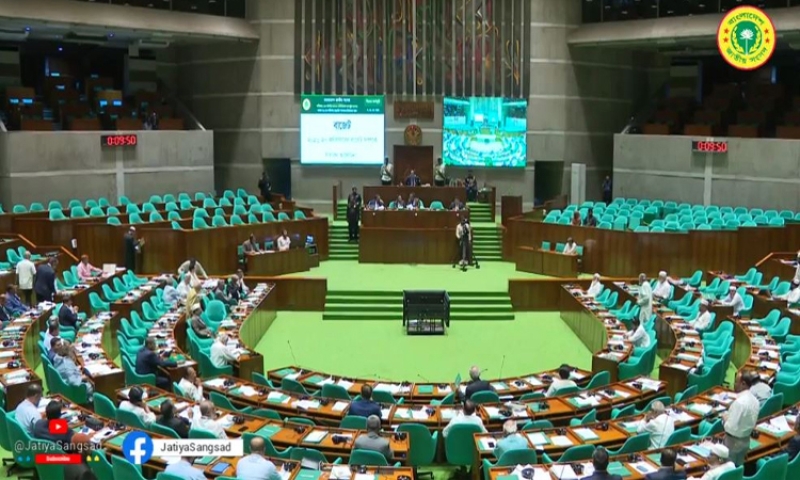
The Jatiya Sangsad on Tuesday passed a Tk 9.38 lakh crore national budget for the 2026-27 fiscal year, approving the first full-year budget of the BNP government. The budget will take effect from July 1 with increased allocations for development, social safety nets, education, healthcare, local government and infrastructure.
The budget was approved through the passage of the Appropriation Bill, 2026 during a sitting of Parliament chaired by Speaker Hafiz Uddin Ahmed Bir Bikrom. Finance Minister Amir Khasru Mahmud Chowdhury placed the proposal, which was adopted by a voice vote.
Before the final approval, lawmakers took part in the debate and voted on 59 demands for grants covering various ministries and divisions. A total of 43 members of Parliament submitted 1,342 cut motions, which were rejected by voice vote after several days of discussion on government expenditure, budget allocations and policy issues.
Parliament earlier passed the Finance Bill, 2026 on Monday, incorporating 64 amendments proposed by lawmakers. The changes raised the tax-free income threshold for individual taxpayers from Tk 375,000 to Tk 400,000.
The revised Finance Bill also set a 5 percent income tax rate for private universities, medical, dental and engineering colleges, and information technology-based educational institutions. It withdrew proposals to make Taxpayer Identification Number (TIN) mandatory for opening bank accounts, property mutation and deed registration, while also scrapping the provision allowing disclosure of the actual value of flats and plots without questioning the source of funds. VAT on digital advertising was reduced from 15 percent to 5 percent.
Finance Minister Amir Khasru Mahmud Chowdhury had unveiled the budget on June 11 under the theme, "Journey Towards a Democratic, Humane and Inclusive Economy." The budget is about 19 percent larger than the revised budget for FY2025-26 and equals 13.73 percent of the country's Gross Domestic Product (GDP).
The budget earmarks Tk 316,075 crore for development expenditure, including a Tk 300,000 crore Annual Development Programme (ADP), while operating expenditure has been set at Tk 605,740 crore. Interest payments on domestic and foreign loans will account for Tk 127,000 crore, while nearly Tk 89,380 crore has been allocated for salaries and allowances of government employees.
The government has set a revenue collection target of Tk 695,000 crore, including Tk 604,000 crore through the National Board of Revenue (NBR). The largest share is expected to come from Value Added Tax (VAT), followed by income tax and taxes on profits.
The budget projects an overall deficit of Tk 243,000 crore, equivalent to 3.6 percent of GDP. To finance the gap, the government plans to borrow Tk 127,000 crore from domestic sources and Tk 155,850 crore from foreign sources.
For the next fiscal year, the government has set a GDP growth target of 6.5 percent and aims to bring inflation down to 7.5 percent. The targets come after economic growth slowed to 4.14 percent and inflation remained above 9 percent in the outgoing fiscal year.
Among sectoral allocations, the Finance Division received the largest share, followed by the Economic Relations Division, Secondary and Higher Education Division, Health Services Division, Primary and Mass Education Ministry, Defence Ministry, Local Government Division, Road Transport and Highways Division, Planning Division, Food Ministry, Home Ministry, Social Welfare Ministry and Agriculture Ministry.