

- Bangladesh Urges India to Begin Ganges Treaty Talks |
- COP31: A Failure of Climate Leadership in a Warming World |
- UN Climate Talks collapse over fossil fuel phaseout, warming limit deadlock |
- Bangladesh Plans Major Changes to Bank Board Rules |
- HC Orders Guidelines on Social Media Use by Children |
COP31: A Failure of Climate Leadership in a Warming World
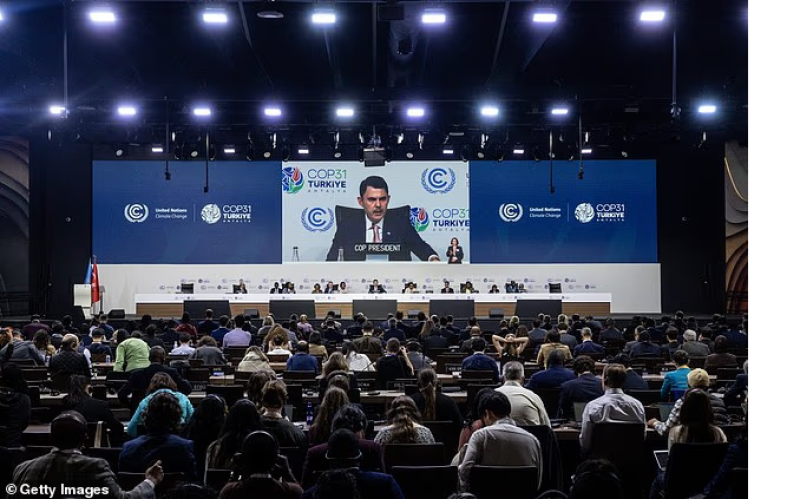
At the closing plenary of COP31, its President, Murat Kurum, announces, a deal is not possible in the absence of consensus on the final draft.
Mostafa Kamal Majumder
The collapse of the COP31 climate summit in Antalya, Türkiye, after more than two weeks of difficult negotiations, marks one of the most significant setbacks in international climate diplomacy since the Copenhagen conference in 2009. What was expected to be a critical moment to strengthen global climate action instead ended in deadlock, with delegates leaving without a consensus agreement and without a clear roadmap for addressing the accelerating climate crisis.
The failure comes at a time when the world is experiencing unprecedented heatwaves, devastating floods, prolonged droughts, worsening air pollution, and greater climate-related disasters. Scientists have repeatedly warned that rapid reductions in greenhouse gas emissions are essential if humanity is to limit global warming and avoid the most catastrophic consequences of climate change. Yet in Antalya, political divisions, fossil fuel interests, and disagreements over climate finance once again prevented meaningful progress.
At the center of the dispute was the controversial removal of explicit language calling for a transition away from fossil fuels. Earlier negotiations had sought to build on previous commitments to move away from coal, oil, and gas, the primary sources of greenhouse gas emissions driving climate change. However, as negotiations proceeded, direct references to fossil fuel phase-out disappeared from revised drafts of the proposed agreement.
This omission triggered strong opposition from the European Union, small island states, climate-vulnerable countries, scientists, and civil society organizations. Many delegates viewed the removal of fossil fuel language as a retreat from commitments already made in previous conferences. Environmental advocates argued that any climate agreement that fails to address fossil fuels ignores the fundamental cause of global warming.
The Antalya talks highlighted the growing influence of the fossil fuel lobby within international climate negotiations. Oil-producing nations and industry groups resisted attempts to include stronger commitments on phasing out fossil fuels, preferring language focused on clean energy expansion and electrification without directly restricting continued fossil fuel use. Critics warned that electrification alone would be insufficient if electricity generation continues to depend heavily on coal, oil, and gas.
One of the most symbolic moments of the conference came when climate activists staged a campaign featuring missing-cat posters bearing the name "Ambition." The campaign reflected widespread frustration that political ambition had once again disappeared from climate negotiations. Activists argued that governments were failing to respond to the urgency demanded by climate science and the growing suffering already being experienced by vulnerable communities around the world.
The absence of the world's two largest greenhouse gas emitters further weakened hopes for a meaningful outcome. The United States was absent for a second consecutive year, while China also remained largely outside the central political negotiations. Together, these two countries account for a significant share of global greenhouse gas emissions and play a crucial role in determining whether international climate agreements can succeed.
Their absence created a leadership vacuum that was impossible to ignore. Without active participation from Washington and Beijing, negotiations lost much of the political momentum necessary to bridge differences between developed and developing countries. Many observers questioned how the world could realistically advance global climate goals when the two most influential emitters were not fully engaged in the talks.
Equally contentious was the issue of climate finance. Developing countries argued that those most responsible for causing climate change must provide substantially greater financial support to poorer nations suffering its consequences. The debate reflected the long-standing "polluter pays" principle, which holds that countries that contributed the most to greenhouse gas emissions should bear a larger share of the costs of mitigation, adaptation, and loss and damage.
Climate-vulnerable nations expressed deep frustration over the continued inadequacy of climate financing. Many developing countries face severe challenges in adapting to extreme weather, protecting communities, and transitioning to cleaner energy systems. Yet funding commitments remain far below actual needs.
Representatives from vulnerable regions argued that adaptation finance is not a luxury but a necessity for survival. For communities already facing rising seas, desertification, stronger storms, and shifting rainfall patterns, climate finance represents the difference between resilience and catastrophe. The failure of negotiators to resolve the dispute over funds further contributed to the collapse of the talks.
The breakdown of COP31 is particularly alarming as it comes against the backdrop of worsening climate indicators. Scientific reports presented at the conference underscored the reality that the world is on track to exceed the Paris Agreement's goal of limiting warming to 1.5°C above pre-industrial levels. The discussions in Antalya were among the first to openly acknowledge that overshooting the 1.5°C threshold appears increasingly inevitable.
However, many countries pushed for language emphasizing that any overshoot must be as small and as brief as possible. Such language requires rapid reductions in emissions, accelerated investment in renewable energy, protection of forests, and a gradual but definitive transition away from fossil fuels. The failure to reach agreement on these measures leaves the international community without a coordinated plan for limiting the duration and magnitude of any overshoot.
The consequences of inaction are becoming increasingly visible across every region of the world. Heatwaves are becoming more frequent, intense, and deadly. Large parts of Asia, Africa, Europe, and North America have experienced temperatures that threaten human survival, particularly for outdoor workers, the elderly, and vulnerable populations. In some regions, heat has surpassed thresholds beyond which long-term outdoor labor becomes dangerous.
At the same time, prolonged droughts are threatening food production and water security. Farmers across many developing countries are witnessing declining crop yields due to irregular rainfall, rising temperatures, and soil degradation. Crop failures are increasing food insecurity and driving up prices, disproportionately affecting poor households that already struggle to meet basic needs.
Floods are becoming more destructive and more frequent. Across Asia and Africa, communities have endured repeated flooding events that destroy homes, schools, roads, and agricultural land. In East Africa, concerns over El Niño-related flooding have raised fears of further displacement and economic loss. For millions of people, climate change is no longer a future threat but a daily reality.
Another growing crisis is air pollution, which remains closely linked to fossil fuel combustion. Beyond its role in driving climate change, burning coal, oil, and gas releases pollutants that contribute to respiratory illnesses, cardiovascular disease, and premature death. Millions of people worldwide continue to breathe unhealthy air, particularly in densely populated urban areas and industrial centers.
Air pollution imposes enormous public health costs. Research has shown that prolonged exposure to polluted air can reduce life expectancy, increase hospital admissions, worsen asthma, trigger heart disease, and elevate the risk of stroke and other serious illnesses. Children, older adults, and individuals with pre-existing health conditions are particularly vulnerable.
The connection between climate change and public health is becoming increasingly clear. Rising temperatures facilitate the spread of certain infectious diseases, intensify the effects of air pollution, and increase illnesses. Extreme weather events also disrupt healthcare systems and create conditions that heighten disease risks. Every year of delayed climate action translates into growing human suffering and economic losses.
Yet despite mounting evidence, COP31 concluded without the consensus necessary to accelerate global action. Instead of delivering a stronger commitment to reduce emissions and phase out fossil fuels, negotiators departed Antalya divided over responsibilities, funding, and the pace of transition.
The collapse of COP31 should serve as a wake-up call for the international community. Climate change does not pause when negotiations fail. Greenhouse gases continue to accumulate in the atmosphere, temperatures continue to rise, and vulnerable communities continue to bear the burdens of inaction.
Looking ahead to COP32, world leaders face a stark choice. They can continue geopolitical tensions, short-term economic interests, and fossil fuels to delay meaningful action, or they can embrace the scientific reality that rapid emissions reductions are essential for preserving a livable planet.
History is unlikely to judge COP31 kindly. At a moment when science demanded urgency and communities demanded protection, the world failed to agree on the measures needed to confront the defining challenge of our age. Antalya may be remembered not only as the summit where negotiations collapsed, but as a warning of the costs of political failure in an increasingly warming world.