

- World Lost More Than 7 Million Hectares of Forest in 2025 |
- Bangladesh Ranks 84th in Global Hunger Index 2026 |
- 10 Die of Dengue in Bangladesh, 1,943 Hospitalised |
- 28 Killed as School Roof Collapses in Northwest Pakistan |
- Bangladesh Targets 8.5-Fold Rise in Cotton Output by 2050 |
Threats and attacks on journalists should not come again
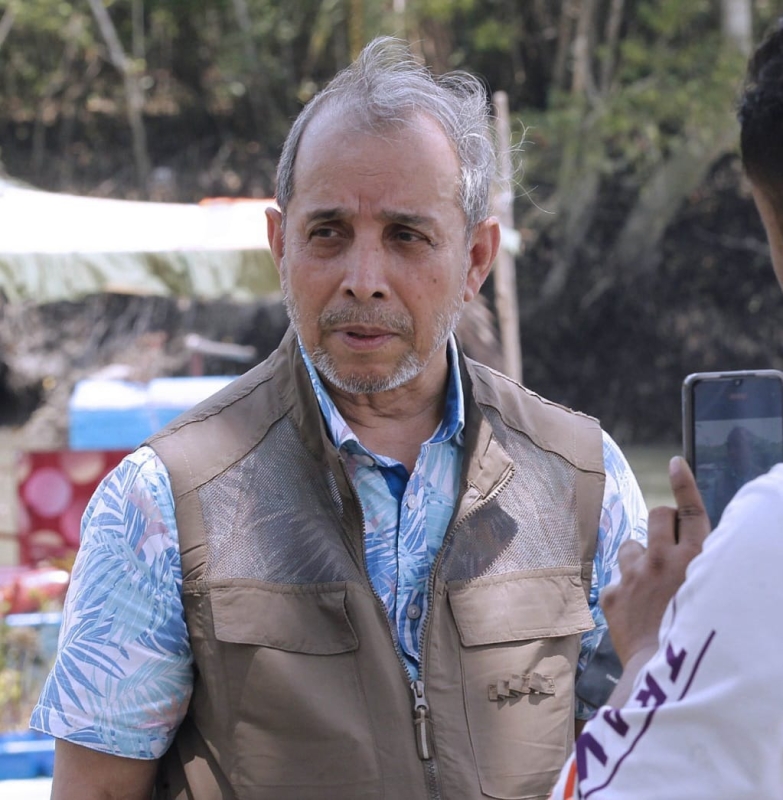
Mostafa Kamal Majumder, Editor of GreenWatch
A journalist who witnessed the Awami League's rise to power after its nine-year movement in the 1980s and its victory in the 1996 elections, I was invited to a reception of a foreign mission in Dhaka in January 2009. At one point in the exchange of courtesy, a leader of the ruling party called me close and held my right hand for quite some time. One by one, leaders of other parties came and exchanged greetings. I also replied. But the leader did not let go of my hand. What an uncomfortable thing. I have had a long association with him in street protests. In the previous term, when his party came to power, he was a minister. He would talk instantly in person or on mobile. During the rule of Fakhruddin-Moinuddin, he was tortured and was ill in prison for several days.
Finally, I felt like he let go of my hand. It seemed that his intention was to bring me to someone's attention. The guest at the reception was Uttar Pradesh Congress leader and then Indian Foreign Minister Salman Khurshid. I had met him at a function in Delhi. As I got closer, it became clear that the security personnel of that country were not taking it lightly. After exchanging a couple of seemingly trivial sentences, I went to the other side and focused on eating and drinking. The High Commissioner at that time was Dipankar Chakraborty. There was a minister who hailed from Odisha. I knew both of them well. At the reception held here that year after the change of 1-11, the said minister suggested cooperation with the Moinuddin-Fakhruddin government.
Before coming to the 2009 reception, two incidents happened. A threat came in a short message on the mobile phone. Written in English, the language of which was of very high standard. But the message was harsh and frightening. 'A white bird was flying in the sky. Den a gunman shoted bird. And a white rose turned into a red rose.' Why this threat? I was then the editor of the English daily The New Nation. The newspaper was doing well under my leadership. Both circulation and income were increasing. New Nation was becoming financially self-sufficient after overcoming the loss-making situation. The working environment was also good with the cooperation of the chairman of the editorial board, Barrister Mainul Hossain, and the chairman of the Robbar Group, Madam Saju Hossain. However, I was not the favourite of those who won the December 2008 elections.
The second incident was more terrifying. After finishing office work, after midnight, on my way back from the Motijheel Commercial Area to the Mirpur Journalist Residential Area, my car was attacked. I was driving myself. Just before turning right near the Mirpur Purabi Cinema Hall, another car hit the back of my car. I drove very slowly. I didn't brake suddenly, that the driver behind me couldn't handle the speed and hit my car.
I thought I'd get out of the car and sort it out. Then I remembered it was 12:30 at night. And I was alone. In this situation, it wouldn't be appropriate to show the heroism of a journalist. Whatever happened, I left. But as I pulled the car forward, I saw two people standing in front of me. I understood that the attack was planned. I am a military-trained man. In March 1971, I gave training for the Liberation War at the Kachua Pilot High School ground in Chandpur under the leadership of MNA Abdul Awal. I decided in my mind that no matter what, I would pull the car straight over them. And so, I did. The two people standing in front moved to either side. One of them hit the car's windscreen hard with a steel folding chair. The laminated windscreen broke and remained hanging on the polethene. Since the car was moving, the man hit the car again with the folding chair. The glass screen on the left side of the back seat shattered and fell on the seat. I was not injured. I drove away the broken car. The matter did not escape the attention of Farooq, the head guard of the Journalist Residential Area. He walked to my house and reported his reaction. The next day, the mechanic Sheikh Anisur Rahman said that the two rear tires of the car were punctured. Those had either been stabbed with a sharp knife or shot. He also said that I was lucky, the tires were tubeless, so I was able to continue. Otherwise, the car would have shaken left and right because of the tube and the attackers could have caught me.
But why this attack? Why this threat? Some of those who later learned about the matter said that this was a model of a kidnapping and murder attack. Which had been applied in other cases as well. From then on, on the advice of people close to me, I used to drive a different route every day with my car.
After a few days, sending threats or warning messages on my mobile phone started again. From May of the same year. One message said, 'It is really painful that some senior army officers have been arrested. But such activities started during the BNP period.' The message mentioned the names of some retired officers and said that unfair action had been taken against them. The last part of the message sent in English threatened to refrain from immoral activities.
The next short message came in Bengali, but written in English font. There was no elegance in it. Direct insults. It is clear that this message was sent to many people. The then editor of the daily Dinkal, Amanullah Kabir (now deceased), slightly edited the message sent to him and published it in the newspaper.
The beginning of the message was like this, 'Shala Razakarrer Bacchara. Jatiyatabad ..... . ........don’t go further. Or else we will pack you to Pakistan.'
Analyzing the threats in these short messages, it is understood that the senders of the messages had already determined their target and were trying to divert dissenting journalists from their freedom of expression. There was another step in these initiatives. All emails received by the target journalists were scanned, without any reservations. The emails that were scanned were marked with “Disarmed”.
This write-up on the pattern of journalist torture that I witnessed would remain incomplete if I did not mention another incident. Two inspectors were sent from the then DGFI, Dhaka City Wing and asked to meet me there. They left without telling me the reason. I went there on the specified day and time. Some people led by a Lieutenant Colonel spoke to me. They asked me to allow the dish traders to continue their business in the journalist residential area in Mirpur. I was then the president of this residential area and the editor of the Daily New Nation. Taking advantage of their association with the military, the dish traders started behaving strangely after the 1/11 changes. For more than a decade, they used to pay the association some royalties every month in return for doing business in that area. When I asked about increasing the royalty, they told me what kind of extortion. They would take action against it. Extortion was considered a big crime by the then post-1/11 caretaker government. In that meeting at DGFI, I replied that the Journalists' Residential Area Association is a legal entity. It would not be right to curtail its rights. A major with a mustache present held his nose high with a thumb and said, 'His nose is a little high'. I came to know that it was a joint forces meeting. Among the others was a very well-bodies Assistant Commissioner of Police. The Lieutenant Colonel asked me to come back another day. In response, I said, I will bring 12 members of our committee. He said your presence will do.
Later, on the appointed day, I went to Kachukhet Market with five executive committee members of the Journalists' Housing Cooperative Society and informed Lieutenant Colonel Sahib on his mobile that we had come. He replied, "Why so many? There is no need to come." We decided that since we had come this far, we should meet them. But Colonel Sahib did not meet us. While getting off the elevator, we were shocked to see a scene. A former general secretary of our residential area was wearing a suit and tie with the dish businessmen. The dish businessmen were tenants on the ground floor of his house. We did not feel the need to tell him anything. After our meeting was cancelled, I learned that a senior officer had asked Lieutenant Colonel Sahib why a newspaper editor was being repeatedly summoned. He said that if he came today, he would not hold another meeting with him and would bring him directly to me. Lieutenant Colonel Sahib avoided that instruction on the pretext of illness. We are grateful to that senior officer, a Colonel. But another senior, a Brigadier General, who was aware of the initial phase of this development, advised me to respond to the call of the Lieutenant Colonel.
Any way. I was called to the DGFI office also because some news item was printed in the New Nation. I was interrogated by some junior officers. There, they first showed me the relevant copy of the New Nation and asked why I had printed this news. They wasted my time that day. When I came out, my stomach was rumbling with hunger.
Despite all this harassment and torture, those who did not give up the path of free expression were dismissed from their jobs after negotiating with the owners of their newspapers or media. Many were arrested and some journalists were even disappeared. More than 55 journalists were killed during the fascist period. May such difficult times never come again in the lives of journalists in Bangladesh. This is my earnest hope. (This story has been published in the April print edition of the GreenWatch)