

- Dhaka's air 5th worst in the world this morning |
- Around 7,500 Bangladeshis imprisoned in Saudi Arabia: Shama Obaed |
- Bangladesh Outperforms India in Global Hunger Index 2026 |
- Covered van hits Gazipur police patrol team, killing SI, BNP leader |
- Korean City scrambles to rescue dusky shark after it returns to canal |
Grossman Says Israel’s Gaza War Amounts to Genocide
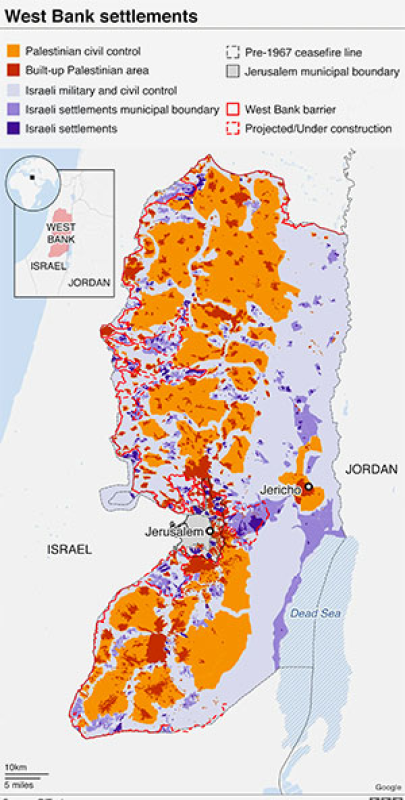
Israeli presence on the West Bank. The orange and red patches are what remains of Palestinian controlled areas.
On August 1st, the Italian daily La Repubblica published an interview with David Grossman, Israel’s most renowned author and a supporter of a “two-state solution,” as well as an outspoken critic of Israel’s violence against Palestinian civilians.
Grossman’s interview received international attention and was quoted by respected newspapers like The Guardian, Le Figaro, and Haaretz. It was noted that few Israeli intellectuals have spoken out against what is happening in Gaza. The New Yorker reminded readers that wars waged by the U.S. in Vietnam, Iraq, and Afghanistan occurred in faraway places, unlike the current destruction of lives and cities taking place near Israel. In some areas, Israelis might hear explosions or see attack planes and missiles thundering past while quietly enjoying drinks on the beach. How is it possible that so many Israelis can indifferently accept that tens of thousands of innocent people are being mutilated and killed nearby?
Grossman is deeply affected by crimes against humanity committed in the name of Israel, the country of his birth. His 21-year-old son Uri died while fighting in Lebanon. Throughout his life, Grossman has strived to foster understanding between Palestinians and Israelis. However, he has had to witness people arming themselves while preaching vengeance and death instead of working toward peace and prosperity. Grossman says surrendering to fear and hatred is easier than promoting empathy and reconciliation.
He acknowledges that Hamas acted deplorably when its members crossed the border and spread terror in Israel on 7 October 2023. However, after that date, many of Grossman’s liberal and tolerant friends abandoned their previous convictions, falling victim to fear and chauvinism.
According to Grossman, “Israel’s curse began with the occupation of the Palestinian territories in 1967. We became militarily strong and fell into the temptation of absolute power, believing we could do anything.” He adds that he has long avoided using the term “genocide,” which for a Jew is “an avalanche word; once you utter it, it just keeps growing.” Still, Grossman now says the word must be used loud and clear — Israel is committing genocide in Gaza. “It breaks my heart, but I have to say it now.” He believes fear and power madness have led many Israelis to lose respect for the lives and welfare of others. Grossman concludes: “Many of us have our heart in the right place, but it beats in a world without any heart at all.”
The day after the interview, 95-year-old Auschwitz survivor Liliana Segre responded in the same newspaper: “It must be clear that Israel is neither the heir nor the representative of the European victims of the Shoah, which must not be used as a shield to justify its excesses. Nor should the behaviour of the Israeli state be used as a pretext for renewed hatred toward the Jewish people.”
It should be possible to criticise Israel’s killing of civilians without being labelled antisemitic. Grossman’s use of the term “genocide” is defensible and should be disconnected from accusations of antisemitism — despite what Netanyahu’s regime might suggest. In fact, it is Netanyahu and Trump who misuse the word “antisemite” to attack those who question the slaughter in Gaza.
In addressing the Israeli-Palestinian conflict, one must also consider the history of Hamas. Founded in 1987, Hamas was treated strategically by various Netanyahu-led governments. They aimed to deepen the rift between the Gaza Strip and the West Bank to obstruct the PLO's path to a Palestinian state. As a result, Hamas was elevated from a minor terrorist group to one that received indirect Israeli engagement through Egypt. It was discreetly permitted to receive cash from abroad, while more Gazans were given work permits in Israel. Since 2018, Israel even allowed millions in Qatari cash into Gaza.
Israeli policy appeared to treat the Palestinian Authority as a burden and Hamas as an asset. This enabled Hamas to grow stronger until it launched the 7 October 2023 attack, killing hundreds of Israelis and kidnapping 251 to be used in prisoner exchanges. Since then, as of 30 July 2025, more than 62,700 people — including 60,785 Palestinians and 1,983 Israelis — have been reported killed, according to the Gaza Health Ministry and Israel’s Ministry of Foreign Affairs. These include 217 journalists and media workers and 224 humanitarian aid workers, among them 179 UNRWA employees.
Given the civilian death toll, critics of Hamas rightly note: “The world thinks Gaza is Hamas and Hamas is Gaza.” In reality, dissent against Hamas in Gaza has always been dangerous. Polls taken before 7 October 2023 showed that 44% of Gazans had no trust in the Hamas government, and 23% had “not much trust.” Only 29% expressed considerable or strong trust. About 72% believed there was rampant corruption, with only a minority thinking Hamas was taking action against it.
Hamas solidified control of Gaza through the 2007 Battle of Gaza, a civil war in which Fatah lost and its officials were executed, imprisoned, or expelled. This split the Palestinian territories between the West Bank (governed by the Palestinian Authority) and the Gaza Strip (governed by Hamas). In March 2019, mass protests erupted in Gaza against harsh living conditions, including 70% youth unemployment. Dozens of protesters, including journalists and human rights workers, were beaten, arrested, or had their homes raided.
Netanyahu’s policies — aimed at undermining the two-state solution — also included strong support for Israeli settlements in the West Bank, which has been occupied since the Six-Day War in 1967. These settlements are illegal under international law.
As of January 2023, there were 144 settlements in the West Bank, including 12 in East Jerusalem, along with 196 unofficial outposts. Around 450,000 Israeli settlers live in the West Bank, and 220,000 in East Jerusalem. These settlements and Jewish-only roads fragment Palestinian land, stifling economic development and freedom of movement. The Israeli government spends more than twice as much per settler as it does on citizens inside Israel.
In March 2024, Israel announced plans to build more than 3,300 new homes in the West Bank. Since 7 October 2023, at least 964 Palestinians have been killed in the West Bank, and over 2,900 homes demolished, according to the UN. In January 2025, Israel launched Operation Iron Wall, forcibly displacing 30,000 Palestinians.
Amid the statistics, individuals are often forgotten. Two days before Grossman’s interview, Awdah Hathaleen, a Palestinian journalist and activist who helped produce the Oscar-winning documentary No Other Land, was killed. A settler driving a bulldozer was clearing land near Umm al-Khair, south of Hebron. When a Palestinian asked him to stop, he ran him over with the blade. Violence erupted. Yinon Levi, a militant settler removed from a U.S. sanctions list by Donald Trump, was filmed firing his gun at Palestinians. Awdah, standing at a distance, was fatally shot.
The Israeli government is punishing an entire population for the crimes of a violent, corrupt regime that it once supported. Netanyahu’s regime thrives on fear and violence. Its war on Gaza's civilians, coupled with support for illegal settlements and branding critics as antisemites, supports claims of ethnic cleansing. By hiding behind Holocaust memory, Netanyahu obscures his government’s actions. This strategy risks fuelling real antisemitism — while drowning out voices like Grossman’s that advocate justice and empathy.