

- Around 7,500 Bangladeshis imprisoned in Saudi Arabia: Shama Obaed |
- Bangladesh Outperforms India in Global Hunger Index 2026 |
- Covered van hits Gazipur police patrol team, killing SI, BNP leader |
- Korean City scrambles to rescue dusky shark after it returns to canal |
- PM inspects Mongla Port, Sundarbans, proposed economic zone |
Cyclone Ditwah Exposes Sri Lanka’s Deep Climate Fragility
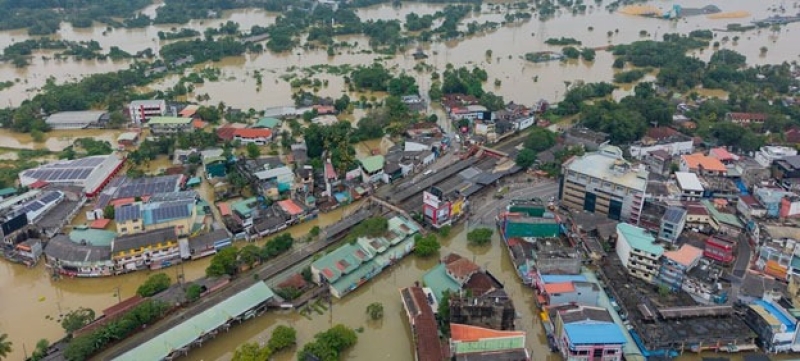
Tropical Cyclone Ditwah, which made landfall in Sri Lanka on 28 November 2025, is considered the country’s worst natural disaster since the deadly 2004 tsunami. It intensified the northeast monsoon, bringing torrential rainfall, massive flooding, and 215 severe landslides across seven districts.
The cyclone left a trail of destruction, killing nearly 500 people, displacing over a million, destroying homes, roads, and railway lines, and disabling critical infrastructure, including 4,000 transmission towers. Total economic losses are estimated at USD 6–7 billion—exceeding the country’s foreign reserves.
The Sri Lankan Armed Forces have led the relief efforts, aided by international partners including India and Pakistan. A Sri Lanka Air Force helicopter crashed in Wennappuwa, killing the pilot and injuring four others, while five Sri Lanka Navy personnel died in Chundikkulam in the north while widening waterways to mitigate flooding. The bravery and sacrifice of the Sri Lankan Armed Forces during this disaster—as in past disasters—continue to be held in high esteem by grateful Sri Lankans.
The government, however, is facing intense criticism for its handling of Cyclone Ditwah, including failure to heed early warnings available since November 12, a slow and poorly coordinated response, and inadequate communication with the public. Systemic issues—underinvestment in disaster management, failure to activate protocols, bureaucratic neglect, and a lack of coordination among state institutions—are also blamed for avoidable deaths and destruction.
The causes of climate disasters such as Cyclone Ditwah go far beyond disaster preparedness. Faulty policymaking, mismanagement, and decades of unregulated economic development have eroded the island’s natural defenses. As climate scientist Dr. Thasun Amarasinghe notes:
“Sri Lankan wetlands — the nation’s most effective natural flood-control mechanism — have been bulldozed, filled, encroached upon, and sold. Many of these developments were approved despite warnings from environmental scientists, hydrologists, and even state institutions.”
Sri Lanka’s current vulnerabilities also stem from historical deforestation and plantation agriculture associated with colonial-era export development. Forest cover declined from 82% in 1881 to 70% in 1900, and to 54–50% by 1948, when British rule ended. It fell further to 44% in 1954 and to 16.5% by 2019.
Deforestation contributes an estimated 10–12% of global greenhouse gas emissions. Beyond removing a vital carbon sink, it damages water resources, increases runoff and erosion, and heightens flood and landslide risk. Soil-depleting monocrop agriculture further undermines traditional multi-crop systems that regenerate soil fertility, organic matter, and biodiversity.
In Sri Lanka’s Central Highlands, which were battered by Cyclone Ditwah, deforestation and unregulated construction had destabilised mountain slopes. Although high-risk zones prone to floods and landslides had long been identified, residents were not relocated, and construction and urbanization continued unchecked.
Sri Lanka was the first country in Asia to adopt neoliberal economic policies. With the “Open Economy” reforms of 1977, a capitalist ideology equating human well-being with quantitative growth and material consumption became widespread. Development efforts were rushed, poorly supervised, and frequently approved without proper environmental assessment. Privatization and corporate deregulation weakened state oversight. The recent economic crisis and shrinking budgets further eroded environmental and social protections, including the maintenance of drainage networks, reservoirs, and early-warning systems. These forces have converged to make Sri Lanka a victim of a dual climate threat: gradual environmental collapse and sudden-onset disasters.
Sri Lanka: A Climate Victim
Sri Lanka’s carbon emissions remain relatively small but are rising. The impact of climate change on the island, however, is immense. Annual mean air temperature has increased significantly in recent decades (by 0.016 °C annually between 1961 and 1990). Sea-level rise has caused severe coastal erosion—0.30–0.35 metres per year—affecting nearly 55% of the shoreline. The 2004 tsunami demonstrated the extreme vulnerability of low-lying coastal plains to rising seas.
The Cyclone Ditwah catastrophe was neither wholly new nor surprising. In 2015, the Internal Displacement Monitoring Centre (IDMC) identified Sri Lanka as the South Asian country with the highest relative risk of disaster-related displacement: “For every million inhabitants, 15,000 are at risk of being displaced every year.”
IDMC also noted that in 2017 the country experienced seven disaster events—mainly floods and landslides—resulting in 135,000 new displacements, and that Sri Lanka “is also at risk for slow-onset impacts such as soil degradation, saltwater intrusion, water scarcity, and crop failure.” Sri Lanka ranked sixth among countries most affected by extreme weather events in 2018 (Germanwatch) and second in 2019 (Global Climate Risk Index).
Given these warnings, Cyclone Ditwah should not have been a surprise. Scientists have repeatedly warned that warmer oceans fuel stronger cyclones and warmer air holds more moisture, leading to extreme rainfall.
As one editorial observed: “…our monsoons are no longer predictable. Cyclones form faster, hit harder, and linger longer. Rainfall becomes erratic, intense, and destructive. This is not a coincidence; it is a pattern.”
Without urgent action, even more extreme weather events will threaten Sri Lanka’s habitability and physical survival.
A Global Crisis
Extreme weather events—droughts, wildfires, cyclones, and floods—are becoming the global norm. Up to 1.2 billion people could become “climate refugees” by 2050. Global warming is disrupting weather patterns, destabilizing ecosystems, and posing severe risks to life on Earth.
Indonesia and Thailand were struck by the rare and devastating Tropical Cyclone Senyar in late November 2025, occurring simultaneously with Cyclone Ditwah’s landfall in Sri Lanka.
More than 75% of global greenhouse gas emissions—and nearly 90% of carbon emissions—come from burning coal, oil, and gas, which supply about 80% of the world’s energy. Countries in the Global South, like Sri Lanka, contribute the least yet remain among the most vulnerable.
Yet wealthy nations and multilateral institutions, including the World Bank, continue to subsidize fossil fuel exploration and production. Global climate policymaking—including COP 30 in Belém, Brazil, in 2025—has been criticised as ineffectual and dominated by fossil fuel interests.
If the climate is not stabilised, long-term planetary forces beyond human control may be unleashed. Technology and markets are not inherently the problem; the issue lies in the intentions guiding them. The techno-market worldview, which promotes the belief that well-being increases through limitless growth and consumption, has contributed to deepening inequality and more frequent extreme weather events.
Ecological and Human Protection
Ecological consciousness requires recognising that humanity is part of the Earth, not separate from it. Policies to address climate change must be grounded in this understanding, rather than in worldviews that prize infinite growth and technological dominance.
Nature has primacy over human-created systems: the natural world does not depend on humanity, while humanity cannot survive without soil, water, air, sunlight, and essential life-support systems.
Although a climate victim today, Sri Lanka is also home to an ancient ecological civilisation. A historic teaching from Mahinda Thera to King Devanampiyatissa emphasised the duty to protect nature:
“The land belongs to the people and all living beings; thou art only its guardian.”
Sri Lanka’s ancient irrigation systems show centuries of sustainable development. Floods occurred, but never with the scale and frequency seen today. Ancient rulers and generations of farmers managed their environment with discipline and ecological wisdom.
During Cyclone Ditwah, widespread power outages and collapsed communication networks forced people to rely on one another. Spontaneous acts of solidarity emerged across all communities, demonstrating profound human compassion. Yet such solidarity alone is insufficient.
Sri Lanka urgently needs science-based environmental regulation, forest and wetland protection, proper maintenance of reservoirs, and climate-resilient infrastructure. Schools should teach environmental literacy that builds unity and responsibility.
If global institutions are genuinely concerned about Sri Lanka’s suffering, they could consider debt cancellation to support rebuilding efforts.
Addressing the climate emergency ultimately requires an evolution in human consciousness guided by morality, compassion, generosity, and wisdom.