

- Intimidation or bloodshed cannot halt Bangladesh’s march to democracy |
- Khaleda Zia integral to an important chapter in BD history: Yunus |
- Enthusiasm marks Victory Day celebrations across Bangladesh |
- Dhaka-Delhi ties deep; to be shaped by trust, dignity, mutual respect |
- EU deploys election observation mission to Bangladesh |
Asia-Pacific Braces for Rising Disaster Risks Ahead
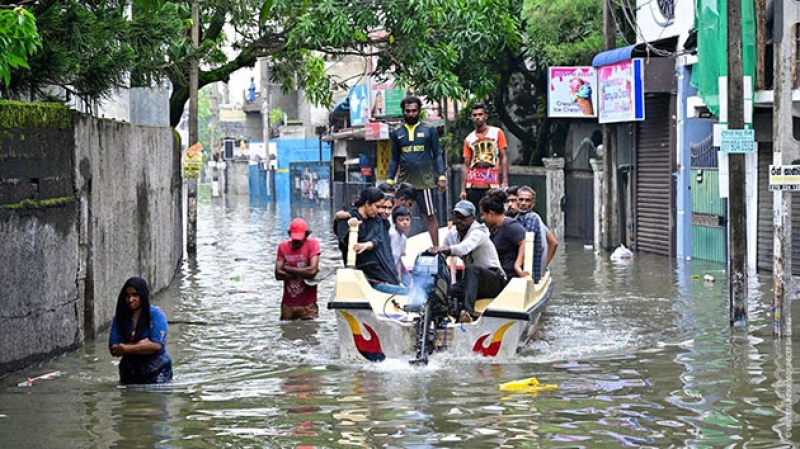
Residents travel by boat through flooded streets in Colombo after heavy rains from Cyclonic Storm Ditwah.
Cyclones Ditwah and Senyar are signs of a shifting disaster riskscape, not anomalies. Both storms broke historical patterns: Ditwah tracked unusually far south along Sri Lanka’s coast before looping into the Bay of Bengal, dumping more than 375 mm of rain in 24 hours and triggering landslides.
Senyar, only the second cyclone ever recorded in the Strait of Malacca, intensified near the equator and stalled over Sumatra, worsening floods in Aceh and North Sumatra.
The rising human and economic toll
According to the ESCAP Asia-Pacific Disaster Report 2025: Rising Heat, Rising Risk, the region is entering an era of cascading risks driven by intensifying heat and extreme weather, with marine heatwaves and warmer sea surface temperatures fuelling this new normal.
Historically low-risk areas, such as Sri Lanka’s central hills and Thailand’s southern strip, are now emerging as climate-risk hotspots.
The report projects that in South and South-West Asia alone, average annual flood losses could rise from a historical US$47 billion to US$57 billion.
Across Indonesia, Malaysia, the Philippines, Sri Lanka, Thailand and Viet Nam, storms in late November 2025 caused more than 1,600 fatalities, left hundreds unaccounted for and affected well over 10 million people.
Widespread flooding and landslides displaced 1.2 million people, disrupted essential services and isolated numerous communities, underscoring the scale of the response required and the substantial economic fallout expected.
The value of preparedness
While improved early warning systems have reduced loss of life compared with past decades, these storms show that disasters are becoming more destructive. Impact-based forecasts triggered mass evacuations, and community drills helped many families reach safety. Still, thousands were stranded.
Alerts were issued, yet on-the-ground implementation was often unclear, and some evacuation routes were already flooded. In many cases, social media became a lifeline when official systems fell short.
The trend is clear: technology alone cannot save lives without trust and rehearsed responses. Warnings work only when people know what to do and feel confident acting.
The ESCAP multi-donor Trust Fund for Tsunami, Disaster and Climate Preparedness shows that investing in preparedness yields high returns. Its 2025–26 call for proposals offers countries an opportunity to strengthen coastal resilience, integrate science and technology, and embed community-led action before the next storm season tests readiness.
The lessons we must learn
• Trusted local networks make early warnings effective
Early warnings have limits. In many areas, alerts were issued and hotlines opened, yet fast-rising floods left families stranded and dependent on rescue teams and volunteers. These events show that mobility constraints and uneven household preparedness can restrict action even when information is available.
Community-led initiatives, such as those developed after the 2004 Indian Ocean tsunami, demonstrate how local knowledge and regular drills improve decision-making. Two decades later, social cohesion has become a marker of resilience.
For example, Bangladesh’s Cyclone Preparedness Programme, with 76,000 volunteers, has sharply reduced cyclone-related deaths by delivering door-to-door warnings and guiding evacuations.
• Urban growth without risk-informed planning magnifies impacts
Ditwah and Senyar exposed how rapid urban growth without risk-informed planning worsens disaster impacts. Colombo’s wetlands have shrunk by 40 percent, while Hat Yai’s drainage systems were overwhelmed.
Many severely affected towns in Sumatra were located in known landslide-risk zones, leading to major disruptions to hospitals, transport networks and local businesses.
When natural buffers disappear, rainfall that once drained slowly can flood cities within hours. Urban resilience depends on integrating risk into development planning, preserving wetlands, enforcing zoning rules, and investing in drainage and flood defences.
Infrastructure alone is not enough; it must be designed for extremes. Cities that embed resilience into planning and protect natural systems are better positioned to withstand future storms and safeguard economic activity.
• Regional solidarity and shared solutions can save lives
The Asia-Pacific region faces converging risks, with storms amplifying monsoonal hazards, cascading into landslides and compounded by infrastructure weaknesses. Regional cooperation is no longer optional; it is the foundation of resilience in the world’s most disaster-impacted region.
In November 2025, eight countries—including Indonesia, Sri Lanka and Thailand—activated the International Charter on Space and Major Disasters, enabling rapid access to satellite imagery for emergency planning and demonstrating the value of shared systems.
As floodwaters surged across the region, participants at the ESCAP Committee on Disaster Risk Reduction reaffirmed their commitment to regional early warning systems and anticipatory action, recognising that hazards do not respect borders.
The Asia-Pacific region’s resilience depends on investing in people and preparedness cultures, strengthening regional solidarity, planning cities for extremes, protecting natural buffers, and ensuring last-mile guidance reaches every household.
Building societies equipped to manage rising risks is the smartest investment for a safer future.