

- First cruise ship crosses Strait of Hormuz since war began |
- MDBs stress co-op support global stability amid uncertainty |
- PM opens first Hajj flight, visits Ashkona camp |
- River ports asked to hoist cautionary signal No 1 |
- Oil prices drop 9% & Wall Street rallies to a record after Iran reopens Hormuz |
War on Iran Unlikely to Trigger Regime Change
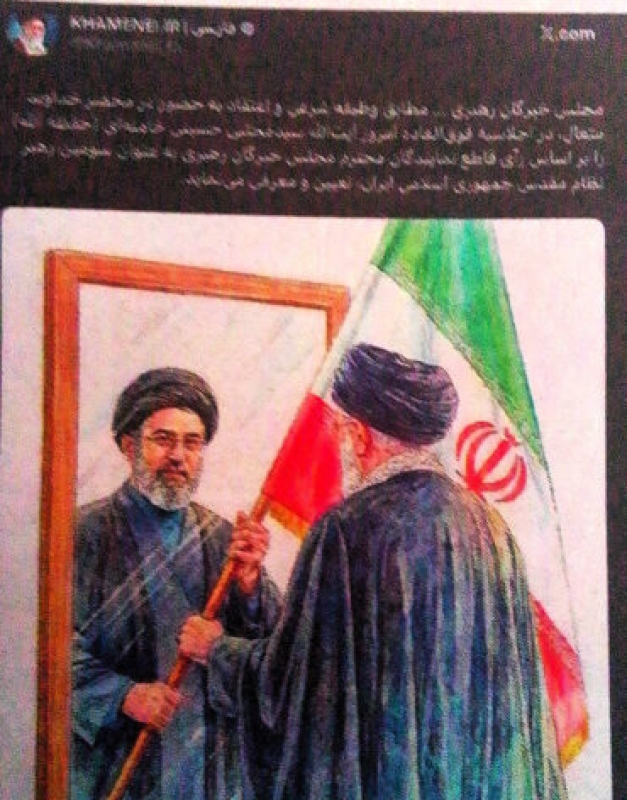
The dead Ali Khamenei hands over the Iranian flag to a mirror image of his son, Mojtaba Khamenei.
The war by the United States and Israel on Iran may be comparable to disturbing a hornets’ nest, spreading fear and instability across the region. The Israeli government has claimed the war was a “preventive” measure aimed at stopping Iran from developing a nuclear bomb. However, the conflict appears to have been carefully planned over a long period, with the current moment considered favourable to put the plan into action.
Iran’s air defences had already been weakened by earlier attacks, while recent Israeli strikes targeted the leadership of Hezbollah in Lebanon, one of Iran’s key allies. With Gaza Strip devastated and the fall of Bashar al‑Assad in Syria, Israeli Prime Minister Benjamin Netanyahu has consolidated support within his coalition government and continues to rely on backing from the United States under the administration of Donald Trump.
Washington has continued to support Israel through missile-defence systems, intelligence sharing and military coordination.
Current military operations appear aimed at striking a wide range of Iranian targets, from senior leadership to security infrastructure, in an attempt to weaken the country’s defensive capacity. The attackers have also suggested that the ultimate goal may be regime change in Iran.
However, even though Iran’s population of about 92 million people finds itself trapped between a destructive war and an authoritarian system, it is unlikely that a tolerant or democratic government would quickly emerge from the ruins of the current political structure. More likely, a weakened state could be controlled by leaders even more determined to retain power after surviving a severe crisis.
The situation is further complicated by the powerful role of the Islamic Revolutionary Guard Corps (IRGC). Although the Iranian army traditionally protects national sovereignty, the IRGC is responsible for safeguarding the Islamic Republic. With more than 125,000 members, the organisation plays a dominant role in Iranian politics, security and major sectors of the economy.
Its branches include the elite Quds Force, which specialises in unconventional warfare and intelligence operations. The IRGC also relies on a large volunteer militia network that strengthens its internal control.
The organisation’s influence and strict security presence have made it extremely difficult for opposition movements to organise. Unlike historical liberation movements such as the African National Congress led by Nelson Mandela, Iran lacks a widely recognised internal opposition leadership capable of replacing the current system.
Some analysts believe figures such as Ali Ardashir Larijani, a former IRGC commander and experienced political figure, could emerge as influential leaders in a future power structure. Larijani has held several senior positions, including secretary of the Supreme National Security Council and Iran’s chief nuclear negotiator.
Beyond political uncertainty, the conflict has also triggered major global economic concerns. Military operations have reportedly cost billions of dollars per day, while global financial markets have reacted with volatility.
The closure of the vital Strait of Hormuz, through which roughly one-fifth of the world’s oil supply normally passes, has pushed crude oil prices sharply upward and disrupted international energy markets.
Several Gulf states rely heavily on this shipping route for oil exports, including Saudi Arabia, Kuwait, Qatar and United Arab Emirates. Disruptions to this corridor have caused serious concern among energy-importing economies across Asia and Europe.
While major exporters such as Norway, Russia and Canada could benefit from higher prices, countries heavily dependent on imported energy may face severe economic pressure.
Developing nations could be hit particularly hard. Countries like Bangladesh depend heavily on Middle Eastern energy supplies and remittances from workers in Gulf states. Rising fuel prices and regional instability could therefore have far-reaching economic consequences.
Similarly, Pakistan faces risks due to its long border with Iran and the presence of millions of Pakistani workers in Gulf countries. Any further escalation or regional instability could significantly affect its economic and security environment.
Neighbouring states such as Turkey and Turkmenistan are also closely watching developments, fearing that a prolonged conflict could destabilise the entire region.
In the end, the war against Iran is unlikely to achieve a swift regime change. Instead, it risks triggering a prolonged conflict with serious political, economic and humanitarian consequences not only for Iran and its neighbours but also for the wider world.