

- BB earns Tk 25,977 crore net profit in FY26; approves six bonuses |
- Sagar-Runi murder: ICT finds link to cultural figure |
- Tk 3,000cr North Bengal agro-refinance fund interest cut rate to 7% |
- Khulna University team shines in worldwide research competition |
- No more “Aynaghar”, perpetrators to face justice: President Fakhrul |
Govt, Opposition lock horns over Parliamentary committee chairmanships
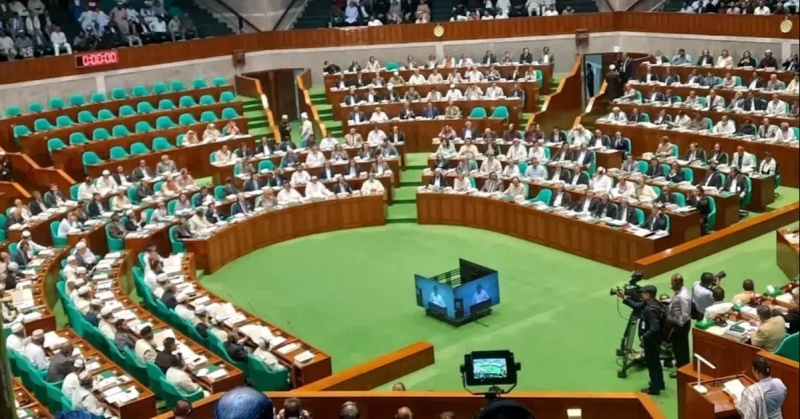
The government and the opposition on Sunday locked horns over the chairmanship of parliamentary standing committees, with the opposition refusing to nominate members to the special committee formed for constitutional amendments.
The opposition demanded that it be given chairmanships of 26 percent of parliamentary standing committees in proportion to its strength in Parliament, in line with the July National Charter.
The ruling party, however, said the opposition would not be given chairmanships of ministry-related parliamentary standing committees unless it first joins the special committee on constitutional amendments.
The positions emerged during an unscheduled discussion in Parliament after the Magrib recess, prompting Deputy Speaker Barrister Kayser Kamal to urge both sides to work together in the national interest.
Amid this standoff, the Deputy Speaker suggested that senior leaders of the ruling and opposition parties could hold “closed-door” discussions, if necessary, to resolve the differences.
Although the formation of parliamentary standing committees was scheduled for Sunday, no new committees were formed following the dispute. Several existing committees were reconstituted.
On July 13, Parliament formed a 12-member special committee, headed by Home Minister Salahuddin Ahmed, to work on constitutional amendments.
The opposition was requested to nominate five members to the committee, but it has not submitted any names.
The opposition has rejected the committee, saying it supports constitutional reform under the July National Charter and it has a fundamental difference of opinion over the formation of a committee specifically for constitutional amendments.
Taking floor in the House on an unscheduled discussion in Parliament, Chief Whip Nurul Islam Moni said he had earlier talks with the Deputy Opposition Leader over joining the parliamentary special committee and claimed that they had initially shown some flexibility.
He said the opposition had indicated that it would join the committee, prompting the ruling party to consider restructuring the constitutional amendment committee.
For the sake of restructuring the Constitutional amendment committee, the chief whip requested that the proposals for forming the committees not be placed before Parliament immediately.
He also requested the chair to give the floor to the opposition deputy leader before restructuring the constitutional amendment committee.
Then Opposition Deputy Leader Syed Abdullah Mohammad Taher said there had been an agreement that membership and other positions in parliamentary committees would be distributed according to the number of MPs held by each side.
“We have no problem getting 26 percent of the members. Twenty-six percent of the committee chairmanships should also go to the opposition,” he said.
Taher said that among the committees finalised so far, the opposition had received only one chairmanship and none of the ministry-related committees had been given to an opposition MP.
Referring to his conversation with the chief whip, Taher said the chief whip had not told him that joining the constitutional amendment committee was a condition for receiving committee chairmanships.
“These two issues cannot be related to each other,” he said.
“We came here after carrying out the anti-discrimination movement. So we do not want discrimination to be established by one side in this Parliament as well,” Taher said.
He said some MPs should not receive more rights while others were deprived of them, adding that Parliament should not be an example for discrimination.
Taher noted that the current session would continue until September 10 and said it would be better if an agreement could be reached before then.
“It would establish an example of an anti-discrimination Parliament,” he said.
In response, Chief Whip Nurul Islam said there was no precedent in the country over the past 54-55 years of giving the opposition chairmanship of parliamentary committees.
He said the government wanted to resolve all issues through consensus and had also wanted to amend the Constitution collectively.
He said Prime Minister Tarique Rahman had made it clear that the July National Charter would be implemented exactly as it was signed, “including every comma and full stop.”
The chief whip said that if the opposition participated in the constitutional amendment process, the government was willing to give it committee chairmanships according to the arrangement it had sought.
Later, Taher reiterated the opposition's position.
“Our principal decision is that we will not participate in the government's committee on constitutional amendments,” he said.
He also objected to what he described as an attempt to impose conditions on the opposition to make it join the committee.
“We do not think it is right to use conditions or pressure to force us to join a committee,” he said.
Taher maintained that the opposition was entitled to 26 percent of the chairmanships, including chairmanships of the relevant parliamentary committees.
Home Minister Salahuddin Ahmed, speaking in the discussion, said the government had earlier asked the opposition to nominate a person for the post of deputy speaker but had not waited for implementation of the July National Charter.
He said the opposition had declined to take the deputy speaker's post at that stage.
“Then we thought that once the July National Charter is fully implemented, meaning after the Constitution is amended, we would proceed accordingly,” the minister said.
Referring to the discussions of the Consensus Commission, the home minister said opposition MPs would receive chairmanships of other ministry-related parliamentary committees according to their proportion of seats in Parliament.
“But the July National Charter has to be implemented for that. The Constitution has to be amended first,” he said.
The minister said the government was nevertheless showing flexibility by inviting the opposition to join the special committee and begin the process of implementing the July National Charter simultaneously.
The minister said the opposition would be free to disagree, express dissent and also agree with some proposals.
“You will demand everything on the basis of the July National Charter, but you will not cooperate in implementing the Charter. That becomes contradictory,” he said. -UNB