

- PM Orders Proper Use of Public Money for National Interest |
- PM Seeks Marubeni Investment in AI Data Centre, KAFCO |
- Global trade reaches record $35 trillion despite conflicts |
- Attack on Riyadh airport kills 12, injures over 300: Saudi |
- Dhaka ranks 6th most polluted city |
Home Minister questions Jamaat's Islamist credentials in Parliament
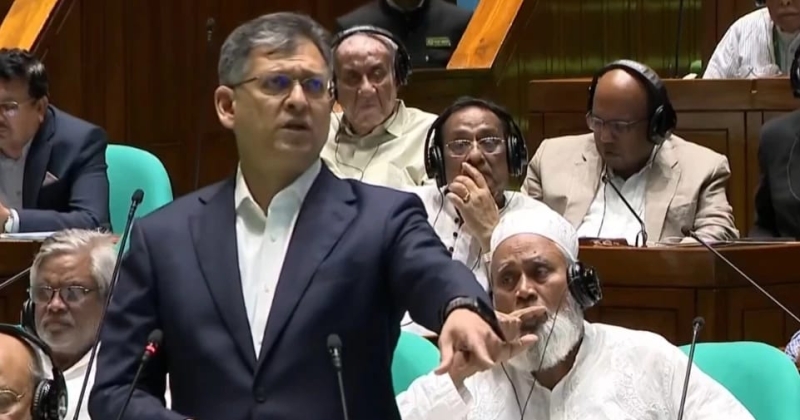
Home Minister Salahuddin Ahmed speaks during the general discussion on the proposed FY2026–27 national budget in Parliament on Sunday.
Home Minister Salahuddin Ahmed on Sunday questioned Jamaat-e-Islami's
claim of being an Islamic political party, saying its election manifesto
contains nothing about establishing Shariah rule.
“There is no
pledge in the party's election manife sto to establish Shariah rule ….
You have even removed 'Establishment of Islam' from your party's
monogram. How can you claim to be an Islamic party?” he said questioning
Jamaat's ideological position.
The Home Minister was
participating in the general discussion on the proposed national budget
for the 2026-2027 fiscal year in the House.
He also accused opposition Jamaat lawmakers of defending Islami Bank instead of addressing allegations over its operations.
"When
the issue of Islami Bank is raised, it appears to me that the bank's
board of directors is sitting on the opposition benches. They speak as
though they are defending the bank," Salahuddin said, pointing towards
Jamaat lawmakers.
He claimed that Tk 11,000 crore had been
disbursed under Islami Bank's Rural Development Scheme (RDS) on
political considerations between August 5, 2024 and the February-12
national election held in 2026.
Displaying documents in
Parliament, the minister said he had brought a breakdown of the
disbursed amount and challenged opposition lawmakers to refute his
claims.
"If any of you want to respond or challenge the authenticity of my claims, you can collect these documents from me," he said.
About
the proposed budget, the minister said the proposed national budget for
the 2026-27 fiscal year was formulated against the backdrop of an
economy devastated by massive capital flight and institutionalised
corruption, expressing hope that its economic and social benefits would
become visible within six months.
"The economic and social
impacts of this budget will not be seen right now. Inshallah, after six
months, the changes will become visible," he said.
The minister
said prices of some essential commodities have already declined to some
extent and asserted that the country's development journey would
continue uninterrupted.
"None will be able to resist our journey
(of progress)," he said, expressing optimism that their government would
be able to implement the budget successfully.
Salahuddin alleged
that around US$234 billion had already been siphoned out of the country
before the Awami League’s regime, forcing it to prepare the budget amid
a severely weakened economy.
"We are formulating this budget while standing on an economy that has virtually been turned into a bottomless basket," he said.
He
alleged that the previous fascist regime had institutionalised "the
economics of plundering", leaving behind a legacy of crony capitalism,
oligarchy and endless corruption.
He said the cumulative amount of laundered public money stood at around Tk 30 lakh crore.
Salahuddin
urged the Prime Minister to direct the Anti-Corruption Commission (ACC)
to investigate all allegations of corruption during the 18-month tenure
of the interim government.
"Those who are now demanding
accountability over corruption and foreign loans should welcome such an
investigation. Let the ACC find out where corruption occurred, how it
happened and who was responsible," he said.
Referring to a recent
report by Transparency International Bangladesh (TIB), he claimed that
allegations had been raised regarding corruption during the interim
government's tenure and said those claims should also be thoroughly
investigated.
Describing the proposed budget as a "Budget of a
New Economic Order for the Country", Salahuddin said its expanded social
safety net programmes would stimulate a revolving economy by enabling
beneficiaries to spend the financial assistance they receive, thereby
boosting economic activities.
Highlighting improvements in law
and order, the home minister said people can now file cases at police
stations without recommendations or influence from powerful persons.
"As
a result, the number of registered cases is now higher because, in the
past, many cases were deliberately not recorded to keep crime statistics
low," he said.
He said comparative data between 2025 and 2026
showed that several categories of crime had declined, although incidents
of rape had increased to some extent.
Regarding mob violence, Salahuddin said the number of incidents had fallen to 29 from 86 in 2025.
"But we want to bring the number of mob violence incidents down to zero," he said, reports UNB.