

- El Niño Could Threaten 347 Million Children Worldwide |
- PM Assures Support for Waste-to-Fuel Technology |
- CJP founder Abhijeet Dipke detained after flight lands in Delhi |
- India’s young return to streets as anger against EC and Modi grows |
- Dhaka’s air quality 4th worst in the world this morning |
Media freedom does not mean arbitrariness: Shibly
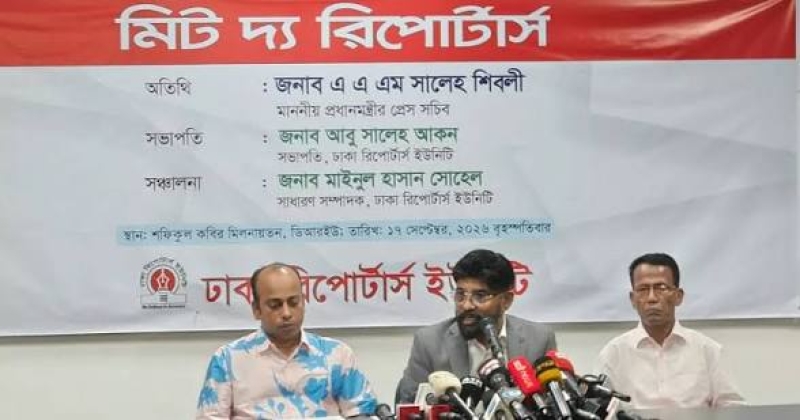
Prime Minister’s Press Secretary Saleh Shibly on Thursday said the government is committed to full media freedom, but such freedom does not mean “arbitrariness.”
He said the limits of media freedom should not be determined by the government or individuals, and that the courts have the authority to make the final decision.
The press secretary made the remarks while speaking at the “Meet the Reporters” programme organised by the Dhaka Reporters Unity.
He said those working in the media should understand that freedom does not mean being arbitrary or writing whatever one wants. “Those of us who are in this profession now believe that the Bangladesh government is in favour of freedom, freedom of the press and freedom of the media. When we talk about freedom, we should not become arbitrary. Freedom does not mean that you can write whatever you want,” he said.
Shibly said around 7 crore people use the internet in Bangladesh and anyone could write against another person simply because they want to.
“But when you start writing against someone, that person also has a statement, does he not? If not, and if I have unrestricted freedom, I can write whatever I want against whoever I want. How will we get out of this situation? There is no way to get out of it,” he said.
The press secretary said the practice of writing against someone simply because one dislikes the person is spreading “like an epidemic.”
He called upon people working in the media, including those involved in mobile journalism, citizen journalism, newspapers and television, to introduce regular fact-checking programmes or reports.
“If each of us hosts a programme, spanning 10-15 minutes, or if the print media publishes a report asking whether what we saw, heard and understood throughout the day after waking up was actually true, and if we conduct such a programme under any name such as fact-checking or verification of truth and falsehood, you will see that many people will benefit,” Shibly said.
He said people could argue and debate the limits of freedom, but they must understand that freedom also has boundaries. “However, neither you nor I, nor the government, will determine those boundaries. The courts will determine them,” he said.
The press secretary said the current government, led by Prime Minister Tarique Rahman, is also trying to ensure that all institutions, including the courts, operate independently and according to their statutory rules and laws.
He said it is also necessary to examine whether a newspaper or media owner has the capacity to run the organisation while paying salaries and allowances to its employees.
Shibly urged people to remain cautious about misinformation circulated by unregistered online portals.
He said the Prime Minister arrives at the office at 9:00am and a digital system is being followed to record when officials arrive and leave. “The system has been introduced not to merely monitor individuals, but also to understand how disciplined they have become and what they intend to do,” he said.
The press secretary said the Prime Minister digitally confirms his own presence and does the same when he leaves at night. “The reason is that the person who is leading us, whom we are following, whether he himself follows it is important,” he said.
He said people could see that the Prime Minister does first what he asks others to do.
Turning to the country’s economy, Shibly said Bangladesh began its journey from a fragile economic position but is gradually recovering as the country has entered a phase of reconstruction.
He said Bangladesh has now emerged as a highly safe and stable destination for foreign investment, overcoming various domestic and international risks.
The press secretary acknowledged that not everyone in Bangladesh has become a BNP supporter and that not everyone supports the government, adding that there is no need for everyone to support the government, reports UNB.
He said people do not, and should not, be expected to have identical opinions and perspectives. “But this country is ours. This state is ours. And the government is making every possible effort to become a government for everyone,” he said.
Shibly said the government’s first priority is to establish human dignity.
He said if someone commits an offence or crosses a legal limit, they should be tried under the law but should not face political persecution. “The government under Prime Minister Tarique Rahman wants to build such a Bangladesh,” he said.