

- PM Seeks Marubeni Investment in AI Data Centre, KAFCO |
- Global trade reaches record $35 trillion despite conflicts |
- Attack on Riyadh airport kills 12, injures over 300: Saudi |
- Dhaka ranks 6th most polluted city |
- El Niño Could Threaten 347 Million Children Worldwide |
New Disasters Hit Rohingya Refugees in Bangladesh
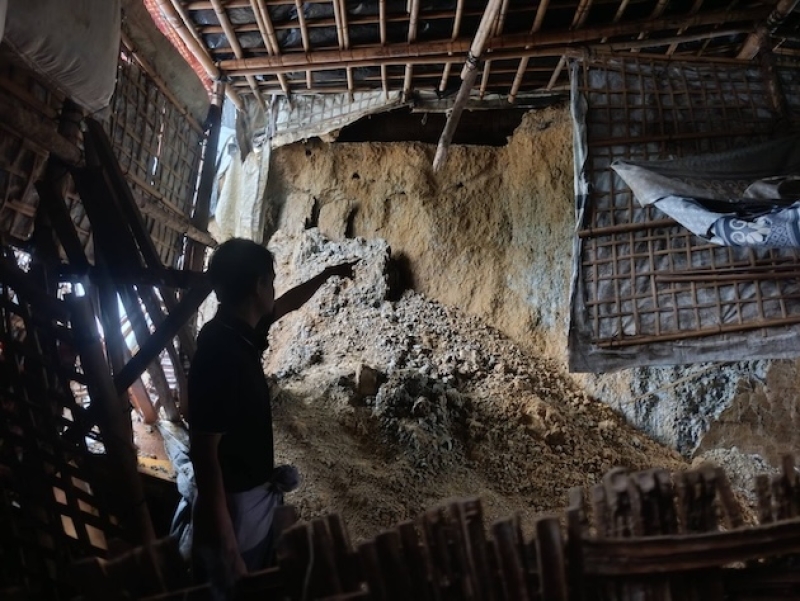
A Rohingya refugee points to the landslide that killed two of Abdu Rozork’s daughters and two of their children in their bamboo shelter in a refugee camp in Cox’s Bazar, Bangladesh, last month.
Rohingya refugees who fled conflict in Myanmar are facing fresh humanitarian challenges in Bangladesh as heavy monsoon rains, landslides and overcrowded camps claim lives and leave thousands displaced.
Abdu Rozork lost two daughters and two grandchildren when a landslide triggered by torrential rain buried part of his family's bamboo shelter in Cox's Bazar.
Having fled violence in Myanmar's Rakhine State in search of safety, Rozork said he never imagined his family would face another deadly disaster in Bangladesh.
The Rohingya camps in Cox's Bazar, already home to more than one million refugees, have received over 153,000 new arrivals since 2024 as conflict intensified in Myanmar, according to UNHCR.
With no additional land allocated for new shelters, many recently arrived families are living in overcrowded conditions or building makeshift homes on unstable hillsides vulnerable to landslides and flooding.
Days of heavy rainfall since early July triggered floods and landslides that killed at least 17 people and displaced more than 3,000 others in the camps, according to Human Rights Watch.
Rozork said his requests for safer shelter materials and a retaining wall were denied because his family had only recently entered Bangladesh.
Many new arrivals have endured repeated tragedies.
Thirteen-year-old Mohammed Kayes fled fighting in northern Rakhine after schools closed and food shortages worsened. During the journey, his father disappeared after being taken away by members of the Arakan Army, while his mother later died in Bangladesh following a prolonged illness.
Now living with his grandmother and caring for younger siblings, Kayes said he hopes to continue his education and become a teacher.
Another refugee, 17-year-old Sawfowan, said his family fled after conflict engulfed their village and medical treatment became unavailable for his diabetic mother. After reportedly being pushed back twice at the Bangladesh border, they eventually entered the country and reunited with relatives in the camps.
Community leaders say many newly arrived refugees report forced displacement, disappearances, movement restrictions and food shortages in Myanmar before facing overcrowding, funding cuts and inadequate shelter in Bangladesh.
UNHCR said new arrivals are receiving food, cooking gas and other relief assistance under existing government approvals. However, the agency acknowledged that limited land availability and funding shortages have restricted efforts to relocate vulnerable families to safer locations.
UNHCR also described the recent deaths caused by monsoon rains as a reminder of the continued vulnerability of the refugee camps.
Bangladeshi authorities say Rohingya continue to cross the border every week as violence persists in Myanmar's Rakhine State.
Rights groups have documented allegations of forced recruitment, killings, drone attacks, village burnings and arbitrary arrests involving the conflict in Rakhine, while the Arakan Army has denied responsibility for some of the reported abuses.
Despite tighter border controls, dangerous camp conditions and growing humanitarian challenges, Rohingya families continue to flee Myanmar in search of safety.