

- PM Pushes Plans for Second Padma, Jamuna Bridges, Barrage |
- Tap grants, local finance; shun loans for energy sovereignty |
- Govt eyes 3,000-4,000MW solar power addition to grid before next summer: PM |
- Dhaka Ranks Fifth Among World’s Most Polluted Cities on Tuesday |
- Protests Disrupt Production at 681 Factories Across Bangladesh |
Tap grants, local finance; shun loans for energy sovereignty
Shama Obaed urges unified activism at COP31 Antalya
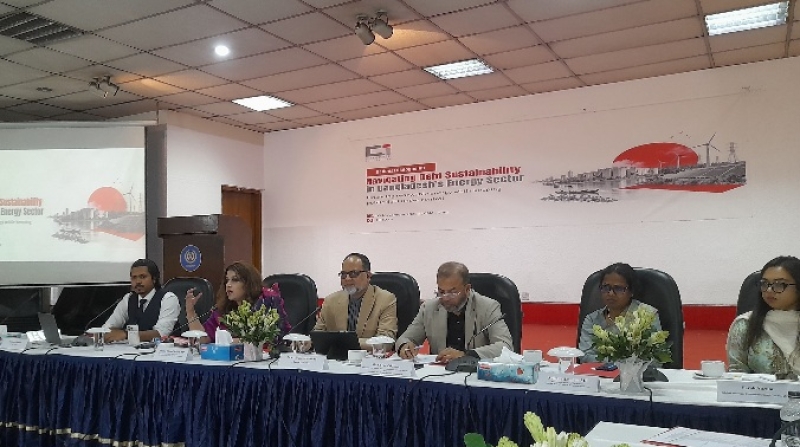
Shama Obaed Islam, second from left, addressing a national dialogue on Navigating Debt Sustainability in Bangladeshs Energy Sector at CIRDAP auditorium on Tuesday 3 Nov 2026.
Bangladesh’s path toward clean energy sovereignty is being severely undermined by a crushing debt bias, institutional failures, and inflated project costs, top energy experts, policymakers, and financial analysts warned at a national dialogue on Tuesday.
Organised by the think-tank Change Initiative at the CIRDAP auditorium in Dhaka, the dialogue, titled "Navigating Debt Sustainability in Bangladesh’s Energy Sector," brought together key government officials, environmentalists, and financial leaders to map out a strategic exit from import-dependent, fossil-fuel-driven debt structures. Speakers highlighted that while Bangladesh’s per capita national debt stands at $80, the energy sector alone accounts for $9 of that burden. Despite contributing minimally to global greenhouse emissions, the country is being forced to rely overwhelmingly on loans rather than grants for its green transition, with 92 percent of climate finance structured as debt.
M Zakir Hossain Khan, Chief Executive of Change Initiative, made a sharp critique of the legacy infrastructure left by the previous administration. "We need energy sovereignty to steer clear of import-dependent energy," Khan asserted. "If the debt burden increases, attaining that sovereignty will become impossible. The energy crisis is deepening, industries are suffering, and the economy will be crippled if current trends continue."
Khan questioned why the current administration has not completely abandoned the highly contentious energy initiatives of the past regime. "We take Multilateral Development Bank (MDB) loans, but we must stop pursuing 'mega projects for mega disasters.' Our current limitation is that we lack the institutional capacity to prepare rigorous project proposals required to secure internationally available grants."
Presenting the study's findings, Mofazzal Hossain of Change Initiative revealed that out of $6 billion in finance received from MDBs, a meagre 4 percent goes to climate finance—and even that small portion is routinely misallocated back into the fossil fuel sector. Md. Mahbul Hasan, Director of Project Development, noted that project implementation costs in Bangladesh are now three times higher than in the Philippines, Thailand, and Vietnam, suppressing equity returns and discouraging foreign direct investment.
To break the cycle of debt, Change Initiative proposed the immediate creation of a decentralized Renewable Energy Fund. To prevent monopoly and systemic mismanagement, the think-tank recommended an institutional ceiling ensuring no single entity can secure more than 15 percent of the fund’s total allocation.
The dialogue also spotlighted massive untapped domestic financing mechanisms. Omar Faruque suggested leveraging an un-structured source of Islamic finance: Zakat. "Good governance could help unlock up to Taka 2 lakh crore from a structured Zakat system—an amount equal to our current budget financing gap," Faruque stated.
Zakir Hossain Khan said that the Zakat Board should be modernized using blockchain technology and decentralized. Experts also strongly cautioned against using traditional Sukuk bonds for coal projects, demanding strict enforcement of "Green Sukuk" frameworks.
The banking sector's role was also heavily scrutinized. Khondkar Morshed Millat, former Director of the Sustainable Finance Department of Bangladesh Bank, pointed out critical policy conflicts. "Bangladesh Bank asks commercial banks to ensure 5 percent green financing, but it does not specify the exact share that must go to renewable energy," Millat said. He urged the central bank to introduce credit guarantees to fast-track renewable financing for non-defaulting borrowers.
GreenWatch Dhaka editor Mostafa Kamal Majumder noted the government’s setting the target of generating 10,000 megawatts of solar power by 2030, withdrawal of taxes and vat on solar energy equipment and underlined the need for good governance to achieve it.
Panellists said turning Bangladesh's 1.3 million diesel irrigation pumps over to solar power could immediately generate 1,300 MW of clean energy. Currently, solar irrigation accounts for only 5 percent of the sector. However, past execution has left a trail of bad investments.
Nasiruddin, an Executive Engineer at DESCO, revealed that mandatory rooftop solar installations on buildings in Dhaka City are largely non-functional today. "Because quality was not maintained and workmanship was poor, it proved to be a wrong investment. When we try to ask owners to reactivate them, they show the least interest," he said, emphasising that strict quality control is non-negotiable for future integration.
Speaking as the Chief Guest, Shama Obaed Islam, State Minister for Foreign Affairs, stated that the government has been working aggressively over the last six months to overhaul and transition the energy sector. She revealed that the Foreign Ministry has newly established a dedicated "Climate Wing" to streamline international climate diplomacy. "We need a unified approach to extract the maximum benefit from COP31, despite all the international negativity," the State Minister said, referencing the upcoming climate summit.
She said that the government is leaning toward innovative, crowd-sourced people's participation to generate electricity, invoking BNP’s historical political strategies of rural electrification to boost field production. She also noted that Bangladesh has taken a separate pavilion at the upcoming summit to actively market biodegradable jute fibre.
Presiding over the dialogue, Shaikh Faridul Islam, State Minister for Environment, Forests, and Climate Change, assured participants that the government is taking sweeping administrative steps to fully leverage the scopes available at the Antalya COP31 summit.
"We are entirely committed to making this country livable for present and future generations," Minister Faridul Islam concluded. "To do that, we are adopting agile programmes that actually work on the ground, rather than remaining confined to rigid, pre-set bureaucratic frameworks." – GreenWatch Desk