

- Five-Day Holiday Rush: Crowds Swamp Dhaka Bus Terminals |
- Dhaka Ranks Seventh Among 126 Cities on Tuesday |
- BD Consulate in Toronto tops global ranking for Diplomatic Service |
- Execution of 2 Bangladeshis in KSA “very disappointing”: State Minister Kobir |
- PM Urges Dhaka Officials to Keep City Clean for Children |
Japan Launches Mission to Collect Samples From Mars’ Moons
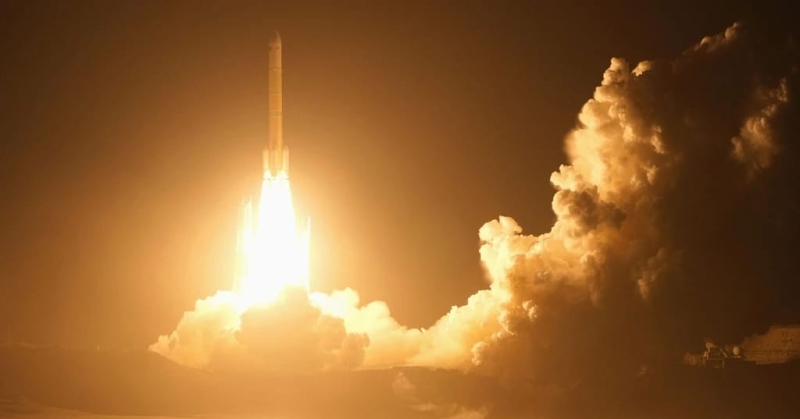
Japan launched a spacecraft toward Mars on Tuesday on a landmark mission to explore the planet’s two small moons and bring samples back to Earth.
The five-year mission, led by the Japan Aerospace Exploration Agency (JAXA), involves five space agencies and aims to deploy a robotic lander and rover on Phobos, the larger and closer of Mars’ two moons.
The spacecraft lifted off before dawn from Tanegashima Island, Japan’s main spaceport. Officials confirmed the launch was successful about an hour later, after the spacecraft separated from the rocket’s upper stage as planned.
Flight controllers applauded and exchanged handshakes and embraces following the confirmation.
Although NASA has successfully landed nine spacecraft on Mars over the past five decades and China achieved a landing in 2021, no spacecraft has ever landed on Phobos or its companion moon, Deimos. Samples have yet to be returned from Mars or either of its moons.
If successful, the mission will bring dust, soil and rock samples from Phobos back to Earth in 2031.
“There's a lot of adrenaline and a lot of excitement and a lot of wow,” said NASA astrophysicist Tom Statler, who is involved in the project.
Japan brings experience from two successful asteroid sample-return missions, which could prove valuable in carrying out the complex operation.
Exploring Phobos
Phobos is an irregular, potato-shaped rocky body measuring about 14 miles (22 kilometres) across. Scientists hope that studying its samples will help explain how Mars’ moons formed and provide clues about the formation of other moons in the solar system.
Known as Martian Moons Exploration (MMX), the $578 million mission involves a spacecraft weighing about five tonnes that is expected to reach Mars by late next summer.
The spacecraft will manoeuvre into position near Phobos before deploying a French-German rover named Idefix, after the white terrier in the Asterix comic series.
About the size of a microwave oven, Idefix will land independently on Phobos, bouncing for several minutes before coming to rest in the moon’s extremely weak gravity.
The four-wheeled rover is designed to right itself if it lands upside down. However, it could become stuck if it sinks into soft soil or gets trapped between rocks, said Julien Baroukh of the French Space Agency.
Once its solar panels are deployed, the rover will no longer be able to right itself, he said. It will therefore move at an extremely slow speed of one millimetre per second.
Idefix will act as a “scout for safety” as it explores Phobos for about 100 days, Baroukh said. Its findings will help Japanese flight controllers identify areas without deep powdery soil or difficult terrain before the main spacecraft’s stationary lander descends to collect samples.
The lander is scheduled to touch down in late 2028 or 2029 and remain on Phobos for about two hours. It will drill into the surface and collect at least 10 grammes of material before launching back into space.
The spacecraft will also study Deimos through a series of flybys before departing the Martian region in 2030 and returning to Earth with the samples in 2031. The sample capsule is expected to land in the Australian desert.
Mission Faces Significant Risks
The mission faces considerable technical challenges, with previous spacecraft failures highlighting the difficulties of exploring Mars’ moons.
Russia has failed in all three of its attempts to explore Phobos, as well as in several other Mars missions. Japan also previously failed to place a spacecraft into orbit around Mars during its only other mission to the planet.
Even NASA has encountered setbacks in efforts to answer a fundamental question: whether life ever existed on Mars.
Scientists hope the mission will help determine whether Phobos and Deimos formed after an ancient collision between Mars and a large space rock or are asteroids captured by the planet’s gravity.
Regardless of their origin, Phobos is expected to contain traces of material from Mars itself. The samples could therefore provide valuable insights into the formation of planets and moons and potentially the origins of life.
The findings are also expected to help shape future Mars exploration, including missions involving astronauts, said Lindsay Hays, NASA’s acting planetary science director.
“It is a once-in-a-lifetime chance. We are part of the first sample return mission from the Martian system,” said Markus Grebenstein, the rover chief at the German Space Agency.
Japan is not alone in pursuing sample-return missions from the Martian system. China plans to launch its own Mars sample-return mission in 2028, while NASA is still debating how to retrieve more than 30 sample tubes collected by its Perseverance rover.
Japan and China are both targeting 2031 for the return of samples from the Martian system.
Japan is contributing $350 million to the MMX mission. NASA is providing $87 million, while the French Space Agency is contributing about $68 million, the German Space Agency around $56 million and the European Space Agency approximately $17 million.