

- PM Tarique Rahman Pledges Inclusive Dev in Dialogue with Persons with Disabilities |
- PM Inspects 13 Dhaka Sites, Sets Deadlines for Cleanliness |
- Efforts to build a clean Bangladesh must start now, PM tells students |
- Five killed as fire breaks out in Cox’s Bazar resort |
- PM visits hospitals and edu institutions to assess dengue situation |
PM Tarique Rahman Pledges Inclusive Dev in Dialogue with Persons with Disabilities
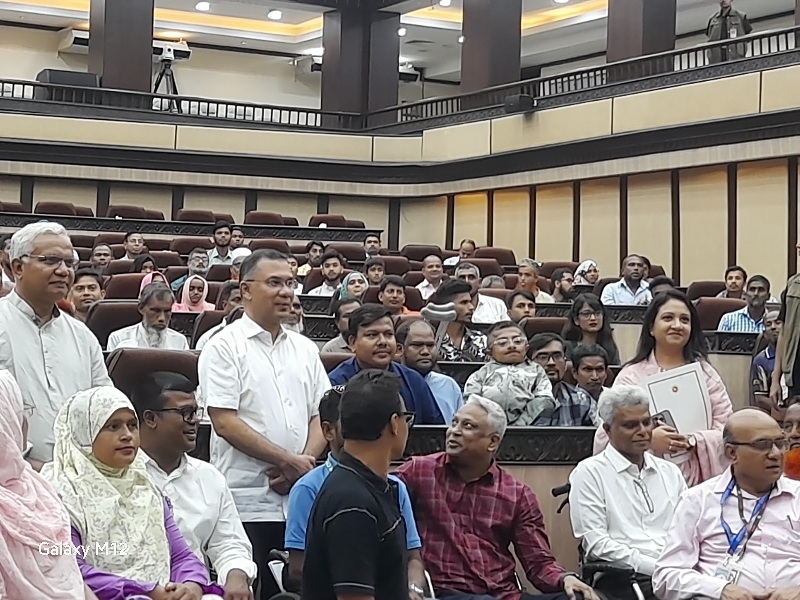
Prime Minister Tarique Rahman in a group photo with persons with disabilities on Saturday 17 October 2026.
GreenWatch Desk
Prime Minister Tarique Rahman on Saturday held an unprecedented dialogue with more than 200 persons with disabilities from across Bangladesh at the Shapla Hall of the Prime Minister's Secretariat, where participants directly voiced their concerns, aspirations and recommendations for building a more inclusive society.
The hour-long interaction, described by disability rights advocates as a historic first, allowed representatives of persons with disabilities from different districts and backgrounds to speak directly to the head of government about barriers they continue to face in education, employment, healthcare, transportation, justice and political participation.
The programme was organised by the Bangladesh Pratibandhi Kalyan Somity (BPKS) and moderated by its Executive Director Abdus Sattar Dulal, who is also President of Disabled People's International and a United Nations disability rights champion.
Addressing the gathering, Dulal said the meeting had set an example for the world.
"This is a unique initiative. The Prime Minister of Bangladesh has shown how persons with disabilities can be heard directly at the highest level of government. I am confident that other heads of state and government around the world will follow this example," he said.
Representatives from different regions highlighted a wide range of concerns.
Several speakers called for the effective implementation of existing disability policies and laws. Azhar Hossain of Chandpur noted that former Prime Minister Begum Khaleda Zia had initiated disability-related policies and urged the government to ensure their full implementation.
Chameli Akter stressed accountability among institutions responsible for enforcing disability rights, while Shahidul Islam of Tangail called for increased allocations in the national budget.
Political participation emerged as a recurring theme. ABM Sohel of Barisal, a local Juba Dal leader, expressed his ambition to serve in Parliament and local government bodies. Asad from Kurigram and Md Anwar Hossain Hazari highlighted the absence of meaningful representation of persons with disabilities in Parliament and local government institutions.
Issues affecting women with disabilities were also raised. Kaberi Sultana of Manikganj called for greater educational and employment opportunities for disabled women, while Mamata from Patnitala in Naogaon described difficulties faced by survivors of violence in obtaining justice, particularly when judicial officials are unable to communicate with persons with hearing or speech impairments.
Healthcare accessibility featured prominently in the discussion. Mamunur Rashid Ifty, whose parents are hearing impaired, explained the communication challenges faced in hospitals where doctors and nurses are unable to use sign language. Pradip Kumar Saha emphasised healthcare as a fundamental necessity, while participants urged the government to make health services more accessible.
A number of speakers focused on employment and economic empowerment. Ali Hossain, a visually impaired participant, spoke of the challenges faced by educated but unemployed persons with disabilities. Haider from Moulvibazar proposed special employment opportunities and raising the age limit for government jobs to 37 years.
Innovation and entrepreneurship were also highlighted. Wakeful Islam Rifat, described as an innovator, said persons with disabilities could contribute significantly to the economy if provided with adequate support and encouragement. Jannatul Ferdous Payel argued that disability should not be viewed as a limitation and that proper training could transform persons with disabilities into valuable national resources.
Participants repeatedly called for improvements in physical accessibility. Mamunur Rashid from Naogaon, Sharmin Patanjali, and others demanded disability-friendly infrastructure and public services. Shahidul Islam Sazzad urged adoption of universal accessibility standards in design and construction.
Transport accessibility also emerged as a major concern. Md Hafiz of Bogura noted that public transport remains largely inaccessible to persons with disabilities, while other speakers called for reserved seating and better travel facilities.
Several participants highlighted social inclusion and dignity. Saiful Rahman of Manikganj called for an exploitation-free Bangladesh where no citizen experiences deprivation, while Chander Kona said persons with disabilities often face exclusion and lack of affection even within their families.
The role of media was also discussed. Amir Akash from Lakshmipur said news about disability issues seldom receives adequate coverage in mainstream media and called for greater visibility of disability-related stories.
Sports and recreation featured among the demands. Md Mohsin, a wheelchair cricket player, sought representation in district and upazila sports committees.
Responding to the speakers, Prime Minister Tarique Rahman announced a series of commitments aimed at improving the quality of life of persons with disabilities.
He said all new schools, colleges and government offices would be required to incorporate accessibility features and disclosed that he had already instructed authorities not to approve building plans lacking provisions for persons with disabilities.
The Prime Minister pledged to raise the age limit for government employment, expand training and employment opportunities, introduce special buses in major cities and work towards improving accessibility in hospitals, courts and public institutions through wider use of sign language.
He also announced plans to direct the Bangladesh Bureau of Statistics to undertake a more accurate assessment of the number of persons with disabilities in the country and said the government would explore creating parliamentary representation for persons with disabilities, similar to the reserved seats available for women.
The Prime Minister further pledged that allowances for persons with disabilities would be increased in line with the government's financial capacity.
Speaking at the event, the Principal Secretary assured participants that all recommendations had been documented and would be reviewed for implementation.
State Minister for Social Welfare said policy amendments were underway and that eight ministries were being brought together to improve services for persons with disabilities.
Social Welfare Minister Dr. Zahidul Islam said the government hoped to finalise employment regulations within the year, establish sports complexes in Dhaka and Bogura, create model schools in every upazila and improve transport infrastructure by making train and bus platforms more accessible.
A particularly emotional moment came when wheelchair cricket player Md Mohsin presented a cap to the Prime Minister. Moved by the gesture, Tarique Rahman stepped down from the stage to personally receive the gift.
The programme concluded with a group photograph featuring the Prime Minister and more than 200 persons with disabilities who attended the event.
Participants and organisers described the meeting as a milestone in disability inclusion in Bangladesh, expressing hope that the commitments made during the dialogue would translate into concrete actions across the country.