

- Kuakata's 'Mini Switzerland', 'Lal Kakrar Char' captivating tourists |
- Democratization of economy Govt’s core objective: Amir Khasru |
- OIC Condemns Terrorist Attack in Bannu District of Pakistan |
- Pakistan, India, both celebrate victory a year after war |
- Iran sends response to US peace proposal via Pakistan |
Renewable energy to make SMEs sustainable employment hubs
Energy price would remain high in 2026 despite Iran assurance
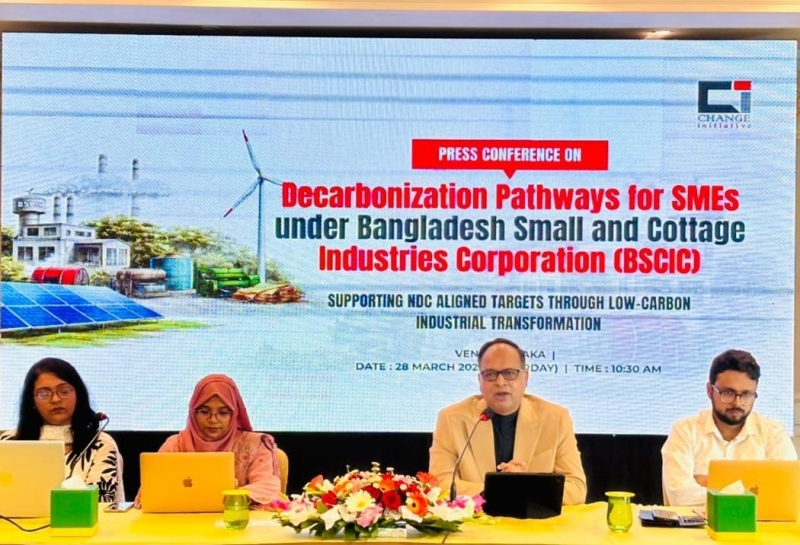
Zakir Hossain Khan, CEO, Change Initiative, presenting the study findings at a news conference on Saturday 28 March 2026.
SMEs in BSCIC industrial estates can unlock over 14.09 million tons of carbon dioxide emission reductions and generate upto 0.40 million dollars revenue through carbon credit annually and achieve a 30%–50% reduction in operational costs through decentralised rooftop solar energy.
A study conducted by Change Initiative has also revealed that this will secure long-term export competitiveness by meeting environmental and natural standards.
Releasing the findings of the study at a news conference at a local hotel, M. Zakir Hossain Khan, CEO of the organisation said, SMEs account for more than 90% of industrial units, employ around 85% of the industrial workforce, and generate 25%-30% of GDP, yet operate within an energy system where approximately 95% of electricity is fossil-fuel based, which is highly exposed to global volatility.
Khan said that the present government can raise the share of renewable energy to 20 percent, its electoral commitment up to the year 2030, in just a year if it is taken under a crash programme.
Funding will not be a problem if money is utilized in the appropriate sector with efficiency and guarding against corruption, he said.
Replying to a question he said the harnessing of a $5 billion renewable energy fund from donors is possible while another $5 billion can be raised over carbon tax and pollution tax from Bangladesh’s export destinations as well as at home.
He underlined the urgent need for energy transition moving towards energy security and sovereignty by moving away from dependence on imports.
The research focuses on four high-impact sectors within BSCIC industrial estates, tannery, plastic manufacturing, plastic packaging, and light engineering, which together are estimated to emit 46.99 metric tonnes of carbon dioxide annually, with a technically feasible reduction potential of 14.097 metric tonnes of carbon dioxide per year.
The keynote presentation was made by Co-Researchers Sabrin Sultana and Najifa Alam Torsa, who dwelt on the the key findings of the research.
Zakir Hossain Khan said, “While global conflicts threaten to turn out our lights and air pollution steals years from our lives, our factory rooftops sit idle. BNP’s renewable energy vision must move beyond targets to ensure energy sovereignty, by reducing import dependence and delivering reliable, affordable power to SMEs, which drive Bangladesh’s economy and employment. We don't just want to "survive" the 2026 energy crisis; we want to lead the region. Renewable energy transitions in China, India and Vietnam shows we can turn to a Nature-Smart, Sovereign Bangladesh by securing energy independence or sovereignty, insulating CMSMEs from grid instability and the price volatility of imported fossil fuels without losing competitiveness or employments.”
The study combines machine-level energy assessments, production mapping, and verified electricity data to build a robust emissions baseline.
Beyond technical solutions, the study identifies structural barriers limiting adoption, including limited access to concessional finance, high initial investment, lack of technical expertise of relevant stakeholders, and absence of standardized energy auditing systems.
To address these constraints, the study proposes a cluster-based decarbonization pathway built on three pillars: 1) Shared renewable energy systems at estate level,
2) Innovative financing models, including OPEX and concessional renewable energy finance, and 3) Strengthened institutional coordination through BSCIC and related agencies.