

- Early winter cucumber brings hope of bumper harvest in Sirajganj |
- Saudi coalition intercepts Houthi missile after blasts in Riyadh |
- COP31 to Focus on Implementing Climate Policies |
- 16 Killed, 46 Injured as 7.0-Magnitude Quake Hits China's Xizang |
- Dhaka Ranks 12th Among World's Most Polluted Cities on Friday |
Venus May Have Swallowed Its Own Moon, Study Suggests
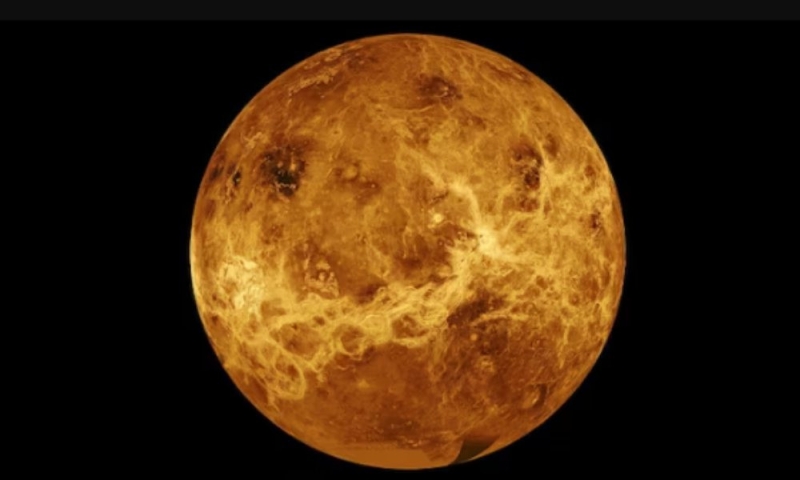
Venus may once have had a natural satellite, but the planet’s extremely slow rotation could have caused the moon to spiral inward and eventually collide with and become absorbed by the planet, according to a new study by scientists at the University of California, Riverside.
The research, published in The Astrophysical Journal, offers a new explanation for why Venus has no moon today. Scientists have long debated whether Venus never formed a natural satellite or whether a moon that once orbited the planet was destroyed by a later collision.
The new theory focuses on Venus’s slow rotation. The planet takes about 243 Earth days to complete one rotation on its axis—longer than the 225 days it takes to orbit the Sun.
Stephen Kane, an astrophysicist and the study’s lead author, said that if Venus had once possessed a moon, it would not have been able to retain it for a long period.
According to the theory, tidal interactions between Venus and its hypothetical moon would gradually have altered the moon’s orbit. Instead of moving away from the planet, as Earth’s moon is doing, the satellite would eventually have spiralled inward. It could then have been torn apart by Venus’s gravity before its remains fell onto the planet.
Researchers developed computer models based on planetary physics to examine how hypothetical moons of different sizes might have evolved around Venus. The simulations showed that, under many plausible conditions, the moons would ultimately move toward the planet and meet the same fate, although the timing would vary.
The scientists believe the event may have occurred during the first billion years of Venus’s history. The solar system formed around 4.5 billion years ago, meaning that any possible moon could have disappeared relatively early in the planet’s development.
However, the study does not provide direct evidence that Venus ever had a moon. Instead, it presents a possible explanation based on the planet’s rotation, mass, orbital dynamics and tidal forces.
Earth and Venus are similar in size, mass and composition, and Venus is often described as Earth’s twin. But the two planets have evolved very differently. Earth has a large natural satellite, while Venus has none.
The researchers also compared the Venusian system with the Earth-moon relationship. Earth rotates much faster, and tidal energy is gradually transferred from Earth’s rotation to the Moon’s orbit. As a result, the Moon is moving away from Earth by about 3.8 centimetres each year.
Scientists have measured this movement using laser beams reflected from special mirrors placed on the lunar surface by Apollo 11 astronauts in 1969.
The situation on Venus may have been the opposite. Because the planet rotates so slowly, tidal forces could have caused a hypothetical moon to lose orbital energy and move closer to Venus over time.
Venus is a rocky planet slightly smaller than Earth, but its surface is covered by a dense, toxic atmosphere. Its powerful greenhouse effect makes it the hottest planet in the solar system, with surface temperatures reaching about 471 degrees Celsius—hot enough to melt lead.
The study may also help scientists understand how planets and their moons evolve after major collisions. One widely accepted theory suggests that Earth’s Moon formed from debris ejected after a massive impact involving the early Earth and another planetary body.
The researchers believe similar large collisions may have occurred during the early history of Venus, when the young solar system was filled with rapidly moving rocky objects. But unlike Earth, Venus may not have been able to preserve a moon created through such an event.
Further information about Venus may come from NASA’s planned DAVINCI and VERITAS missions. The missions are expected to study the planet’s atmosphere, surface and geological history, helping scientists better understand how Venus developed into its current extreme state.