

- Covered van hits Gazipur police patrol team, killing SI, BNP leader |
- Korean City scrambles to rescue dusky shark after it returns to canal |
- PM inspects Mongla Port, Sundarbans, proposed economic zone |
- Early winter cucumber brings hope of bumper harvest in Sirajganj |
- Saudi coalition intercepts Houthi missile after blasts in Riyadh |
China plans new-generation geologic map of Mars by 2028
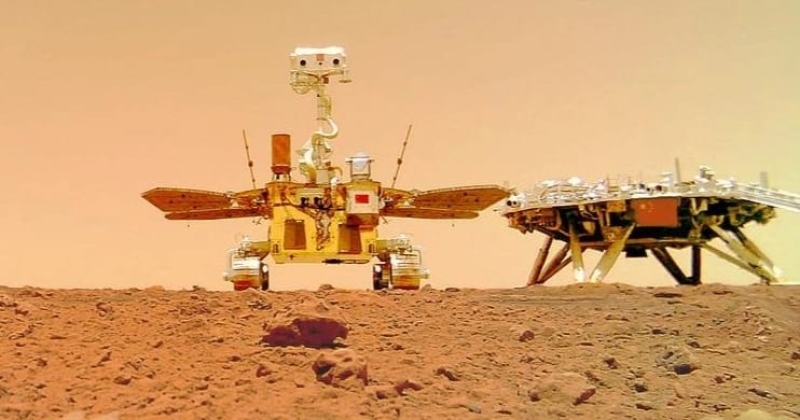
China plans to complete a new-generation geologic map of Mars by the end of 2028, with the goal of reconstructing the planet’s watery past and developing a Chinese system for dividing Martian geologic time.
Hou Zengqian, an academician of the Chinese Academy of Sciences and chief scientist of China’s Tianwen-3 Mars sample-return mission, announced the plan Monday at a symposium held at the Institute of Geology under the Chinese Academy of Geological Sciences.
China’s Zhurong rover, which landed on Mars in 2021 as part of the Tianwen-1 mission, has provided new evidence about the planet’s history of water. The findings suggest that a vast ancient ocean still existed about 3.5 billion years ago, while short-lived floods may have occurred around 1.6 billion years ago.
These findings, which help fill gaps in understanding how Mars’ ancient climate changed, will be included in the new geologic map.
The map will also introduce a Chinese system for dividing Martian geologic time. Mars is currently divided into the Noachian, Hesperian and Amazonian periods, based mainly on the density of visible impact craters rather than specific dates. China hopes its proposed system will eventually gain international acceptance, Hou said.
The project will mainly use data from Tianwen-1, along with information from Mars probes operated by the United States and the European Space Agency. Researchers will combine orbital and surface data, including images, spectral readings, radar, gravity and magnetic measurements, to create a global database covering multiple physical features of Mars.
Artificial intelligence will play a central role in analyzing the data. Geological expertise will be incorporated into large AI models through rule-based systems to make their results easier to explain. Multi-scale analysis will also help researchers identify features ranging from individual minerals to large tectonic units.
The project is expected to produce a 1:5 million-scale global geologic map of Mars, a 1:50,000-scale map of the rover landing area and several thematic atlases by the end of 2028.
It will also produce what researchers describe as the world’s first intelligent geologic map of Mars and serve as a model for future geological mapping of the moon, Venus and asteroids.
Yang Zhiming, director of the Institute of Geology, said geological mapping has been a major focus of the institute for 70 years. Its work has expanded from regional and national maps to the moon and now Mars.
Such mapping, Yang said, provides scientific support for China’s planetary exploration program in deciding where to go, what to study and why. -UNB