

- Govt Committed to Making Bangladesh a Dignified Nation: PM |
- Rights Groups Urge Sanctions on Myanmar After ICJ Ruling |
- PM Pays Tribute at Shikha Anirban on Armed Forces Day |
- COP31 Nations Push for Fossil Fuel Action, More Finance |
- WFP Seeks $12.1bn to Feed 91 Million People in 2027 |
Triple-Star System Near Earth Challenges Stellar Theories
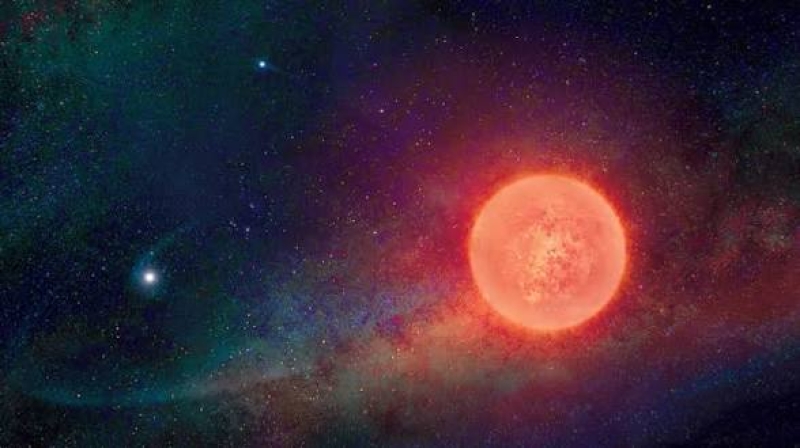
Artistic illustration of the Welopōʻai triple-star system, located just 28 light-years from Earth. The system consists of a red dwarf star (right) and a closely orbiting white dwarf (left), with a second white dwarf (upper) orbiting the pair at a much greater distance. Welopōʻai is the closest known triple-star system containing two white dwarfs. Note: This illustration is not to scale.
Astronomers have discovered an unusual triple-star system just 28 light-years from Earth, challenging existing theories about how stars evolve, interact and die.
Named Welopōʻai, the system contains two white dwarfs — extremely dense remnants of dead Sun-like stars — and a red dwarf, a star considerably smaller and dimmer than the Sun.
The discovery was made by an international team led by the Trottier Institute for Research on Exoplanets (IREx) at the Université de Montréal. Their findings were published on November 19, 2026, in the journal Astronomy & Astrophysics.
The researchers initially discovered the system while searching for planets orbiting the red dwarf.
“We were actually looking for planets. Instead, we found something much more surprising,” said Étienne Artigau, the study's lead author and an IREx researcher.
The investigation began with observations from the SPIRou instrument at the Canada-France-Hawaii Telescope on Maunakea, Hawaii. Designed to detect exoplanets, the instrument measures small changes in a star's velocity caused by the gravitational influence of orbiting objects.
However, the researchers detected unusually large velocity variations in the red dwarf, reaching nearly 16 kilometres per second — more than 1,000 times greater than expected.
Several years of follow-up observations indicated that an unseen companion had a mass exceeding half that of the Sun.
Its combination of relatively high mass and extremely low brightness suggested that it was most likely a stellar remnant, possibly a white dwarf.
“The unusual combination of high mass and very low brightness left only one plausible explanation: it was the remnant of a dead star,” said Charles-Antoine Parent, a co-author of the study and an undergraduate student at Université Laval.
The team subsequently used the Gemini North telescope and its 'Alopeke instrument to capture high-resolution images, directly identifying the faint companion as a white dwarf.
Another, more distant white dwarf was already known to be part of the system. The observations revealed that the red dwarf and one white dwarf orbit closely around each other, while the second white dwarf revolves around the pair.
The researchers said no comparable system is known within 100 light-years of Earth.
The discovery is particularly puzzling because the system's evolutionary history appears difficult to explain using existing models.
Before becoming a white dwarf, the newly identified stellar remnant was approximately 40% more massive than the Sun. As it aged, it expanded into a giant star hundreds of times larger than its original size.
During this phase, its close interaction with the red dwarf should potentially have resulted in the smaller star being engulfed or the two stars merging.
Instead, the red dwarf survived and remains in a surprisingly wide and stable orbit.
“This system should not exist,” said Patrick Dufour, a professor at Université de Montréal who specialises in white dwarfs and co-authored the study.
“We have no clean explanation for how it got here. That is the question driving our next observations.”
The team also measured the mass of the newly identified white dwarf with an uncertainty of less than 1%. Such precise measurements are rare and could help scientists test theories of stellar evolution and understand how matter behaves under extreme densities.
Researchers now plan to investigate the gravitational interactions among the three stars to determine whether they can explain the system's unusual evolutionary history.
The name Welopōʻai was selected through A Hua He Inoa, a naming programme of the 'Imiloa Astronomy Center of Hawaii. It combines the Hawaiian words welo, meaning an inherited or family trait, and pō'ai, referring to an orbit or circular path, symbolising a “path of family traits”.
The study brings together researchers from 10 countries, including Canada, Spain, Burkina Faso, France, Switzerland, the United Kingdom, the United States, Chile, China and Portugal.