

- Dhaka's air 5th worst in the world this morning |
- Around 7,500 Bangladeshis imprisoned in Saudi Arabia: Shama Obaed |
- Bangladesh Outperforms India in Global Hunger Index 2026 |
- Covered van hits Gazipur police patrol team, killing SI, BNP leader |
- Korean City scrambles to rescue dusky shark after it returns to canal |
Yunus Urges Early EU FTA Talks to Protect Duty-Free Access
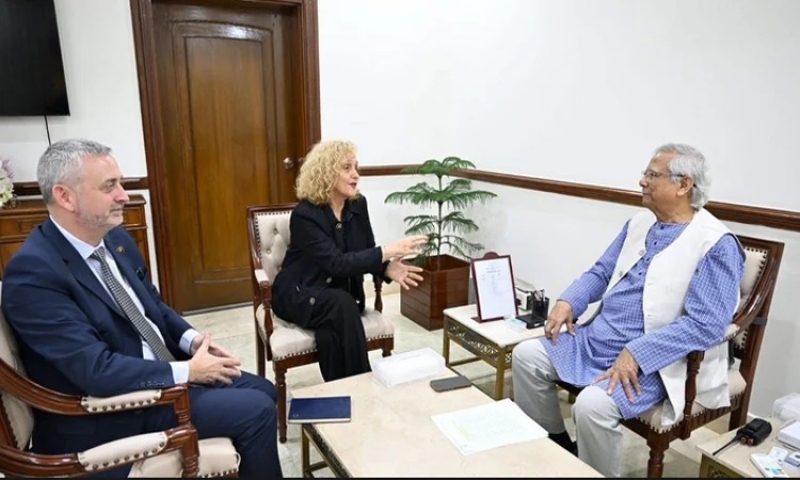
Chief Adviser Professor Muhammad Yunus today called for an early start to Free Trade Agreement (FTA) negotiations with the European Union (EU).
Chief Adviser Professor Muhammad Yunus on Sunday called for the early launch of Free Trade Agreement (FTA) negotiations with the European Union (EU) to safeguard Bangladesh’s trade preferences in its largest export market as existing duty-free access is set to expire in the coming years.
The call came during a meeting with Nuria Lopez, chairperson of the European Chamber of Commerce in Bangladesh (EuroCham), at the State Guest House Jamuna. EU Ambassador to Bangladesh Michael Miller also attended the meeting.
Discussions focused on accelerating European investment in Bangladesh, ensuring smooth trade relations with the EU, and advancing reforms to further improve the country’s business climate. The participants also exchanged views on the upcoming elections and the deployment of international observers.
Professor Yunus said the interim government has recently concluded an Economic Partnership Agreement (EPA) with Japan, securing duty-free access for more than 7,300 Bangladeshi products to the world’s fourth-largest economy.
He said Bangladesh is preparing to pursue similar arrangements with other partners, including the EU, to ensure continued duty-free access—particularly for ready-made garments—in the European market over the long term.
“The EPA with Japan has opened new doors for us and given renewed hope to our export sector. We are keen to move forward with an FTA with the EU to expand our market access,” the Chief Adviser said.
EuroCham chairperson Nuria Lopez stressed the urgency of initiating FTA talks, noting that Bangladesh may lose its existing trade preferences in the EU after graduating from Least Developed Country (LDC) status.
She said an FTA would help attract more European investment, create jobs, and boost Bangladeshi exports to advanced Western markets. Lopez also pointed out that India is negotiating an FTA with the EU, while Vietnam already enjoys preferential access through an existing agreement.
“We are advocating for an FTA. I will go to Europe to encourage private companies to invest in Bangladesh,” she said.
EU Ambassador Michael Miller said the commercial relationship between the EU and Bangladesh would evolve after LDC graduation, but not before 2029.
He highlighted the EU’s strong interest in bringing European investment and technology to Bangladesh, describing the country as a key market with a population of nearly 200 million. He also said the EU is ready to organise an EU–Bangladesh Business Forum in 2026.
“We are looking for early political signals that EU companies will be encouraged to invest and will enjoy a level playing field,” he said.
Professor Yunus also emphasised the potential relocation of factories to Bangladesh, noting that European firms could benefit from the country’s large pool of skilled labour at competitive costs.
“We are building a free trade zone. Our goal is to turn Bangladesh into a manufacturing hub for global businesses. We want more European investment,” he said.
The Chief Adviser welcomed the EU’s decision to deploy a large contingent of election observers for the upcoming general elections and referendum, calling it a strong vote of confidence in Bangladesh’s democratic process.
“It is important that EU election observers are here. It reflects confidence in revitalising our democracy,” he said, adding that the overall election campaign environment was “very positive.”
Lamiya Morshed, SDG Coordinator and Senior Secretary of the government, was also present at the meeting.