

- Bangladesh to Introduce New Law to Curb Extortion, IGP Says |
- UN Marks 81 Years of Global Cooperation and Peace |
- Dhaka's air 5th worst in the world this morning |
- Around 7,500 Bangladeshis imprisoned in Saudi Arabia: Shama Obaed |
- Bangladesh Outperforms India in Global Hunger Index 2026 |
Bangladesh to get carbon credits for electricity generation from waste
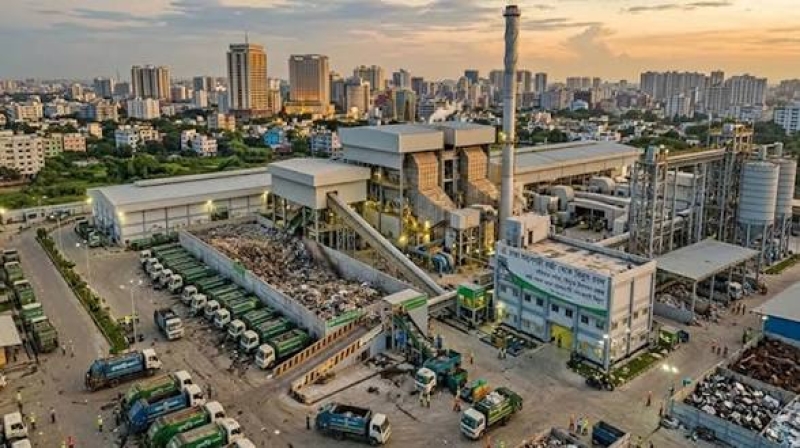
Bangladesh is set to gain carbon credit in the international market through electricity generation from waste, with the country’s first large-scale waste-to-energy project at Aminbazar landfill in Dhaka creating the opportunity.
The project, being implemented at the Dhaka North City Corporation’s Aminbazar landfill, is expected to provide a sustainable solution to the capital’s growing waste-management problem while contributing to greenhouse gas emissions reduction.
A financing agreement has already been signed with China for its implementation following consultations and agreement among the Ministry of Local Government, the Power Division, the Environment Division, the city corporation and other stakeholders.
Electricity generated by the project is expected to be connected to the national grid in 2028. The project will generate 42.5 megawatts of electricity from landfill waste.
Project officials told BSS that the initiative should not be viewed solely as a decision to purchase electricity at Taka 25 per unit. Its broader economic significance lies in addressing Dhaka’s waste crisis, improving landfill management, protecting the environment, generating energy and creating opportunities for Bangladesh’s future carbon economy, they said.
The city corporation currently spends around Taka 520 crore annually on managing the Aminbazar landfill. Project-related officials said the city corporation would not have to bear this cost once the Chinese company operates the power plant.
They also said Bangladesh could receive carbon credit worth approximately Taka 90 crore annually as the plant reduces carbon emissions.
State Minister for Local Government, Rural Development and Cooperatives Mir Shahe Alam told BSS that China is making a direct investment of Taka 6,000 crore in the project.
The project is being implemented through an initiative of China’s CMEC Group, with financing involved various international financial institutions, including the Asian Infrastructure Investment Bank, DBS, NDB and Bank of China.
“Everyone is talking about the price, but ultimately the price will be below Taka 10. Most importantly, Bangladesh will receive carbon credits,” he said.
A carbon credit is an international environmental and financial mechanism and certificate representing the reduction or removal of one metric tonne of carbon dioxide or an equivalent amount of greenhouse gas emissions.
Internationally, one carbon credit represents one tonne of carbon dioxide or an equivalent greenhouse gas prevented from entering the atmosphere.
At a recent meeting on climate change, Prime Minister Tarique Rahman instructed the relevant authorities to assess the potential for increasing Bangladesh’s carbon credit by reducing carbon emissions and to formulate an action plan in this regard.
The Prime Minister emphasized increasing the use of renewable energy, introducing environment friendly technologies in the industrial sector, improving energy efficiency, conserving forests and increasing carbon absorption through extensive tree plantation.
He also instructed the authorities to adopt realistic plans to utilize Bangladesh’s potential in the international carbon market.
The state minister further stressed the need to ensure transparency in carbon-credit management, develop a reliable database and strengthen coordination with international organizations.
Environmentalists said the project offers another economic benefit. Organic waste produces methane when it decomposes in landfills. If such organic waste is diverted from landfills and taken to controlled digesters, the methane can be captured directly and used as fuel.
This could simultaneously provide an alternative to fossil fuels and reduce uncontrolled methane emissions from landfills.
For this reason, the relationship between biogas projects and the carbon economy is considered important.
The project’s carbon-credit potential will depend on measuring, reporting and independently verifying how many tonnes of carbon-equivalent emissions it reduces compared with conventional landfill management. Carbon credits may be generated for each tonne of verified emissions reduction.
However, the amount of money that could be earned cannot be determined in advance, as the value will depend on the quality of the credits, market conditions, the project methodology and international rules.
Climate change expert, environmentalist and BRAC University Emeritus Professor Dr Ainun Nishat welcomed the government’s move toward carbon trading.
“First of all, I would like to thank and congratulate the Prime Minister and the government for thinking positively about carbon trading,” he told BSS.
He said the Aminbazar project would not only generate electricity from waste but could also establish a more organized waste-management system in the country. It could help free the city from the odors and pollution associated with untreated waste, he observed.
He also said that capturing and using methane would reduce environmental pollution and could contribute to developing a model for a modern city.
“China will generate electricity through this project and also initiate carbon-credit trading. This is very encouraging,” Dr Nishat said.
He added that the Environment Ministry was developing new plans concerning carbon trading and said the government’s approach appeared to be long-term, with the Prime Minister overseeing the process, reports BSS.
“Now it is important to implement these initiatives,” he said.