

- Who gets to shape AI? UN debate centres on power, trust and inclusion |
- PM Tarique Rahman likely to visit Japan later this month |
- PM Tarique Heads to Feni for Daylong Programmes |
- Long-term support for Manta gypsy fishing community urged |
- Customs blocks import of nearly 2000 drones by Chawk Bazar trader |
Ensure fairness, understanding, and equitable water-sharing rights in South Asia
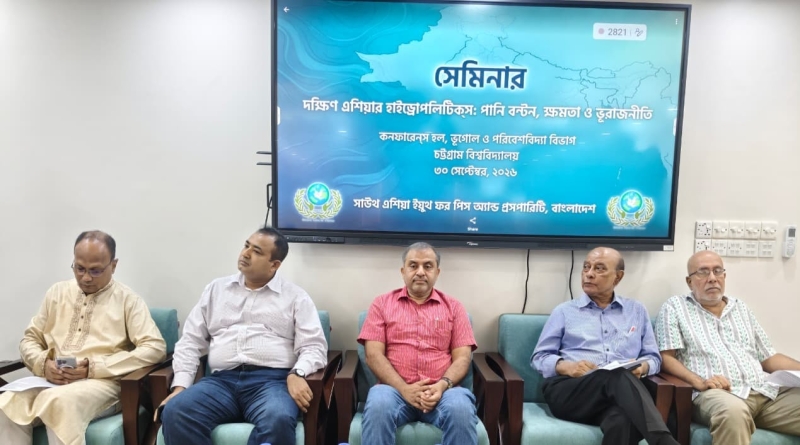
Participants in the seminar held on Chittagong University campus on 30 September Wednesday.
The South Asia Youth Peace and Sustainability Initiative organized a seminar titled "Water Politics in South Asia: Water Sharing, Power, and Politics" on Wednesday, September 30. The event was held at the conference room of the Department of Zoology and Environmental Sciences at the University of Chittagong.
Professor Dr. Md. Iqbal Sarwar of the Department of Zoology and Environmental Sciences, University of Chittagong, presided over the seminar. In his keynote presentation, Mr. Muhammad Tanvirul Islam from the Department of Geography and Environmental Studies at the University of Chittagong stated that understanding South Asia's water politics—or hydro politics—requires looking beyond the simple question of which country receives or controls the water.
Instead, deeper, multifaceted issues are involved. Factors such as a country's location along the river (upstream or downstream), the capacity to control water flow, technological capabilities, data availability, and political and economic equations collectively determine a nation's bargaining power. The issue of South Asia's rivers is not merely about water allocation; it is a matter of cooperation, equity, and shared responsibility. While these rivers foster connections among nations, unequal management and political mistrust can also become sources of conflict.
The future of the Teesta River depends on mutual trust and cooperative management, moving beyond the hegemonic politics India has exercised over the river—a shift necessary to ensure the rights of other riparian neighbours and establish a peaceful South Asia.
Dr. A.S.M. Mahfuzul Haque (Mahfuz Parvez), Professor and Chairman of the Department of Political Science at the University of Chittagong, observes that attempts to weaponize the Teesta River in South Asia pose a threat to the region's peace and stability; India is effectively turning the Teesta into a tool against Bangladesh.
He emphasized the need to adopt a multidisciplinary approach to identify the problems and potentials of the country's rivers, and called for increased expert consultation to formulate government policies. Mr. Shamsuddin Elias, Chattogram Bureau Chief of *The Business Standard*, stated that a comprehensive assessment of Bangladesh's rivers is essential; specifically, the percentage contribution of these rivers to the GDP must be quantified and made public.
We should not limit ourselves to the timeframe of the existing treaty; instead, amidst climate change, we must participate in discussions to establish new, equitable water-sharing arrangements.
Dr. Gazi Md. Barjat Ali, a professor in the Department of Geography and Environmental Studies at the University of Chittagong, stated that to ensure equitable water distribution in South Asia, riparian nations must collaborate on water rights and management through water-friendly agreements.
Saleh Zaman, General Secretary of the Chattogram Metropolitan Journalists Union, remarked that the youth need to be informed about the ethical guidelines regarding water usage. He called for a concerted effort to secure a fair share of water resources.
Jahidul Karim, Joint Secretary of the Chattogram Water and Sewerage Authority (CWASA), stated that water has become a key element of politics in South Asia. He emphasized the need to move away from hegemonic mindsets and instead adopt a pragmatic approach based on equity and fairness regarding water usage in the region. He also underscored the importance of the youth playing an active role in safeguarding Bangladesh's rightful share of water. - Press Release