

- Extreme heat linked to over 5,500 excess preterm births in BD |
- Talks on Ganges to be based on BD’s legitimate demands: Shama |
- Safe food drive: Tk 35.5 lakh fined, 28 cases filed in October |
- PM Orders Comprehensive Earthquake Preparedness Measures |
- Cyclone Murasu to cross Andhra Pradesh coast tonight |
Talks on Ganges to be based on BD’s legitimate demands: Shama
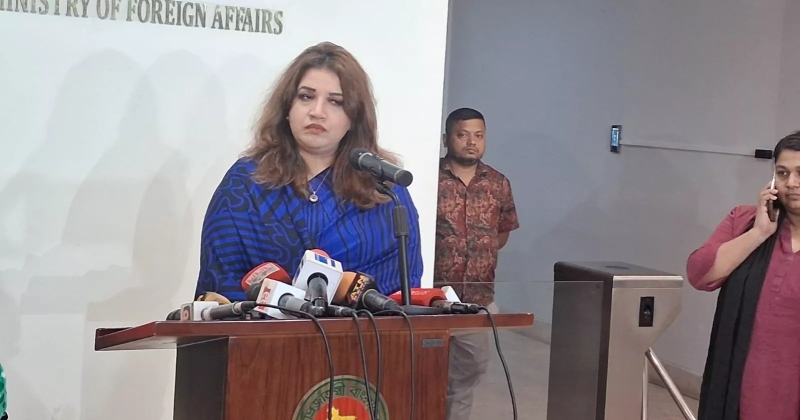
State Minister for Foreign Affairs Shama Obaed Islam talking to reporters at the ministry on Monday 2 November 2026.
Highlighting the importance of sustained engagement with its neighbour, State Minister for Foreign Affairs Shama Obaed Islam on Monday said the government has formed a high-level committee to negotiate a renewed Ganges Water Sharing Treaty with India to safeguard Bangladesh’s legitimate rights.
Talking to reporters at the Ministry of Foreign Affairs, she said Bangladesh would have to continue discussions with India to pursue its legitimate demands and rights, noting that securing what the country reasonably deserves requires sustained engagement.
“If I want to secure what I am legitimately entitled to, I have to fight for it. And if I have to fight for it, I have to talk to them. It’s as simple as that… We hope India will take the right decision,” Shama said in response to a question.
The State Minister said the negotiations would be based on Bangladesh’s legitimate demands, which are essential for the country and its people.
“We will pursue the best possible outcome for the future, and our decisions regarding the resolution of our water-related issues will be guided by this approach,” she said.
Shama said Bangladesh has many issues with India that need to be resolved through dialogue and discussions.
Indian Ministry of External Affairs spokesperson Randhir Jaiswal recently said issues concerning the Ganges treaty and other shared rivers would be discussed through the Joint Rivers Commission (JRC).
“On the Ganga Water Treaty, as also other rivers that we share between Bangladesh and India, we have a Joint Rivers Commission. All matters relating to rivers, river-related matters, will be discussed as part of this Joint Rivers Commission,” he said, adding that technical-level meetings on the Ganges treaty had continued.
Securing its fair share of water from transboundary rivers is likely to emerge as a major issue for Bangladesh in the coming days, making effective water diplomacy, international cooperation and constructive engagement with India increasingly important, officials and experts have said.
The urgency is underscored by the Ganges Water Sharing Treaty, signed on December 12, 1996, which is set to expire on December 12 this year.
The government has become increasingly vocal in recent weeks, signalling that Bangladesh will seek a new or revised agreement that safeguards its interests, particularly its share of dry-season flows, with the inclusion of a guarantee clause.
Bangladesh and India share 54 transboundary rivers, but the Ganges remains the only one covered by a bilateral water-sharing agreement between the two countries.
Water Resources Minister Shahiduddin Chowdhury Anee recently said Bangladesh wants a new or revised Ganges agreement rather than simply renewing the existing treaty, with provisions guaranteeing its required share of water during the dry season.
“Our main priority will be to bring back the guarantee clause that was included in the 1977 agreement,” he said on Thursday.
The 1977 agreement, negotiated during the tenure of BNP founder Ziaur Rahman, included a safeguard stipulating that if the Ganges flow at Farakka fell below the level projected in the agreement for Bangladesh's scheduled share during any 10-day period, the release to Bangladesh would not fall below 80 percent of that share.
“We are hopeful that the treaty will be renewed or concluded in a way that safeguards the legitimate rights of our country and its people,” Shama said.
On the significant trade deficit Bangladesh faces with India, she said reducing the gap remains a government priority, while stressing that dialogue is essential to resolving bilateral issues.
“We have a huge trade deficit with India, and reducing it is one of our goals. But to resolve any problem, we have to sit at the negotiating table,” Shama said.
“Even if you have a dispute with a neighbour, you need to maintain at least a minimum level of relations to communicate,” she added. - UNB