

- Around 7,500 Bangladeshis imprisoned in Saudi Arabia: Shama Obaed |
- Bangladesh Outperforms India in Global Hunger Index 2026 |
- Covered van hits Gazipur police patrol team, killing SI, BNP leader |
- Korean City scrambles to rescue dusky shark after it returns to canal |
- PM inspects Mongla Port, Sundarbans, proposed economic zone |
80pc tube wells in Chhatak run dry; water crisis acute
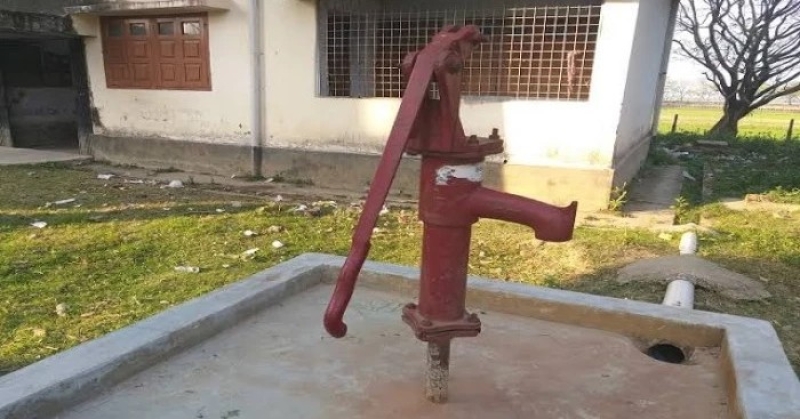
Eighty percent tubewells in Chatak under Sunamganj have gone dry creating an acute scarcity of safe drinking water. UNB
Sunamganj, Mar 3 – A severe water crisis has gripped vast areas of Chhatak upazila in Sunamganj where nearly 80 percent of tube wells have run dry amid prolonged drought and a sharp decline in groundwater levels.
With more than 12,000 of the upazila’s approximately 18,000 tube wells no longer yielding water, over 100,000 residents in more than 300 villages are facing acute hardship in accessing safe drinking water, according to local sources and official data.
The crisis spans in 13 unions including Bhatgaon, Kalaruka, Chharmahalla, Singchapair, Dolarbazar, Chaila-Afzalabad, Gobindaganj-Saidergaon, Uttar and Dakshin Khurma, Noarai, Islampur, Chhatak Sadar and Jaubazar.
Officials say groundwater levels have fallen abnormally to depths between 200 and 300 feet, rendering most shallow and even some deep tube wells ineffective.
Long Walks for Water
With tube wells failing to produce water despite repeated pumping, women, children and elderly residents are being forced to walk several kilometres daily to collect water from distant sources.
Many households have resorted to boiling pond water for drinking and cooking.
Health workers said reliance on untreated surface water has led to a rise in diarrhoea, fever and skin diseases in the affected communities.
Junaed Ahmed of Multanpur village in Jaubazar union said that 15 years ago water could be found at a depth of 500 feet but now even drilling to 700 feet does not guarantee supply.
“Even after pumping several times a day, no water comes out,” he said.
In Gilachhara village of Uttar Khurma union, Arjad Ali described the situation as desperate. “We are surviving by boiling pond water. There is no other option,” he said.
Schools Also Affected
The crisis has also disrupted educational institutions.
A head teacher of a local school said that for nearly a month none of the school’s tube wells has been functional.
“We are compelled to boil pond water for limited use,” he said.
Environmental Degradation Blamed
Residents alleged that years of canal encroachment, filling up of ponds, destruction of natural water bodies in haor and beel areas, and reduced river flow have contributed to the rapid depletion of groundwater.
They also raised concerns over alleged irregularities in the allocation of government deep tube wells.
In some cases, tube wells meant for public use were allegedly installed on privately owned land, limiting access for the wider community.
Md Ishaq Ali, sub-assistant engineer of the Department of Public Health Engineering, said groundwater levels have dropped far below normal.
“Earlier, water was available at 400 feet. Now even at 700 feet it is uncertain. Installation of new deep tube wells is underway under government initiatives,” he said.
Chhatak Upazila Nirbahi Officer Diplomacy Chakma said the administration is reviewing the situation and will take necessary measures to address the crisis.
Locals said the situation may worsen unless urgent steps are taken to restore water sources and ensure sustainable groundwater management in the haor belt. - UNB