

- Dhaka ranks world’s second most polluted city this morning |
- Dhaka ranks world’s second most polluted city on Monday |
- February polls bring new stability of policy in BD: Japan Envoy |
Insects may be guiding seasonal bird migration in eastern Himalayas
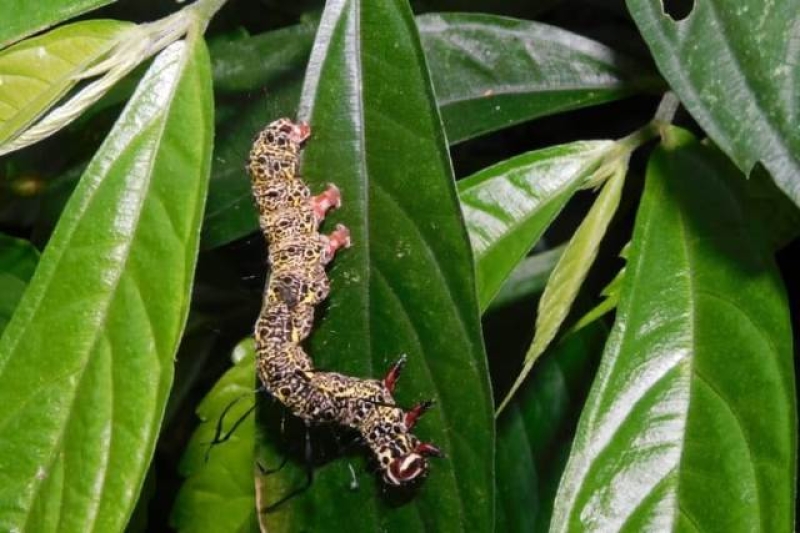
A looper caterpillar belonging to the Noctuidae moth family. These foliage-bound caterpillars serve as a vital food source and are frequently preyed upon by leaf-gleaning birds. Image by Tarun Menon. - Mongabay India
Manjeera Gowravaram
• A study from Arunachal Pradesh found that flying and ground-dwelling insects shift to lower elevations in winter and insect-eating birds closely mirror these seasonal changes.
• Leaf-dwelling insects showed no such seasonal change, and the birds that depend on them remained largely resident, suggesting bird migration across elevations is linked to food availability.
• The findings suggest that climate change could disrupt the timing between insect availability and bird movements, potentially affecting breeding success in Himalayan mountain ecosystems.
Every winter, in the Himalayas of Arunachal Pradesh, certain birds like babblers, laughing thrushes, yuhinas and other small mountain birds, that spent the warm months at the top of the mountains, begin making their way down. Many of them don’t really fly at all, they just hop, branch by branch, tree by tree, descending hundreds of metres over days and weeks. And come summer, they go back up again.
These seasonal journeys are common in the Himalayas, where roughly 65% of high-elevation birds make some form of elevational movement. Yet, the reasons behind these shifts have remained only partially understood.
“The theory behind why birds migrate has two major explanations, both connected to temperature,” said Tarun Menon, a Ph.D. researcher at the Indian Institute of Science and the study’s lead author. “One is that cold directly affects the bird and it moves to stay warm. The other is that the cold affects the food, and the bird is following the food.”
What Menon had noticed during his earlier work in the Himalayas was that the birds that were most likely to migrate down the mountain in winter were almost always insectivores. That observation eventually grew into a larger question: were the birds following the insects rather than escaping the cold?
The study, published in Biology Letters, offers evidence from the eastern Himalayas that insect availability, more than temperature alone, may be guiding these seasonal movements. The researchers sampled arthropods and birds in summer (April–June) and winter (November–January) across seven sites along a 2,300-metre forested elevation gradient in Eaglenest Wildlife Sanctuary and the adjoining Singchung Bugun Village Community Reserve, ranging from 800 to 3,100 metres above sea level.
While insects have been studied across mountain elevations before, this study looks at it from the perspective of migration, looking at how insects are changing with season and elevation, and what that means for birds, says Menon.
Different insects respond differently to winter
To understand how food availability changes through the year, the team sampled arthropods using sticky traps for flying insects, pitfall traps for ground-dwelling insects, and branch beating for leaf-dwelling insects. Over the study period, they collected 12,744 arthropods in summer and 4,079 in winter across 23 orders. Flies (Diptera), true bugs (Hemiptera), ants and wasps (Hymenoptera), and spiders (Araneae) were among the most abundant.
The team found that the abundance of flying and ground insects rose with elevation in summer; however, in winter, this pattern reversed, with their numbers concentrating at lower elevations. However, leaf insects behaved differently. Their abundance declined with elevation across both seasons, with a modest peak around 1,600 metres, and showed little seasonal change. The study attributes this stability to the buffering effect of vegetation: leaves create a sheltered microclimate that insulates the insects living on them from temperature extremes.
One finding stood out as especially unexpected. Spiders were more abundant in winter than in summer, particularly at lower elevations — the reverse of nearly every other group. Menon suspects it comes down to their physiology and behaviour. “Spiders are known for cold-adaptive traits and their ability to exploit microhabitats, which may allow them to persist when other arthropods go dormant.” Their significance as a winter food source for birds is the subject of a follow-up study currently in preparation.
The birds moved with their prey
The insect abundance matters because different birds hunt differently. Salliers catch insects in mid-air. Terrestrial-gleaners work the forest floor. Leaf-gleaners pick insects off leaves. Between November 2022 and January 2024, the study used mist-nets to sample birds throughout two summers and two winters, collecting 1,971 distinct individuals from 160 species in the summer and 1,721 individuals from 133 species in the winter.
The results closely mirrored the arthropod patterns. Salliers and terrestrial-gleaners became more common at higher elevations in summer and decreased in winter, tracking their prey’s seasonal shifts. Leaf-gleaners, meanwhile, showed no meaningful change across elevations or seasons, consistent with feeding on insects that are themselves seasonally stable. This close match between prey abundance and bird distribution points to that “birds are very likely tracking food rather than just going to a place where they have favourable temperatures,” Menon said. “They’re mostly looking for where they can find the best amount of food.” Although, the researchers caution that temperature, weather and other environmental factors likely play a role too.
The study adds to a growing body of evidence that Himalayan birds move between elevations primarily to follow seasonal pulses of insect abundance. Temperature still matters, either because it affects the birds directly or because it shapes insect populations, but it may not be the cue the birds are responding to most closely. According to a global analysis from earlier this year, spanning 34 mountain ranges, elevational migrants do not consistently track temperature as they move through the year.
The findings have implications for conservation too. Mountain ecosystems are expected to experience substantial shifts in temperature and rainfall as the climate changes. If those changes shift the timing of insect emergence earlier in the year, birds that rely on fixed seasonal cues to time their migration could struggle to keep up. “The birds are relying on, say, the day and night cycle to time their migration,” Menon explained. “If spring arrives early but the birds aren’t able to time their migration accurately, they come after that food peak and then there’s not enough food to raise their young.”
For a region that supports some of the world’s richest mountain biodiversity, understanding these ecological connections is important. For now, the forests of Eaglenest still keep their seasonal rhythm. The babblers hop downhill in November. In April, they go back up. And now, there’s data to explain why. Mongabay India - https://india.mongabay.com/2026/07/insects-may-be-guiding-seasonal-bird-movements-in-the-eastern-himalayas-study-finds/?mc_cid=3482de8b3f&mc_eid=fcb2d76ab3