

- Around 7,500 Bangladeshis imprisoned in Saudi Arabia: Shama Obaed |
- Bangladesh Outperforms India in Global Hunger Index 2026 |
- Covered van hits Gazipur police patrol team, killing SI, BNP leader |
- Korean City scrambles to rescue dusky shark after it returns to canal |
- PM inspects Mongla Port, Sundarbans, proposed economic zone |
Beanibazar green cover shrinks, migratory birds disappear
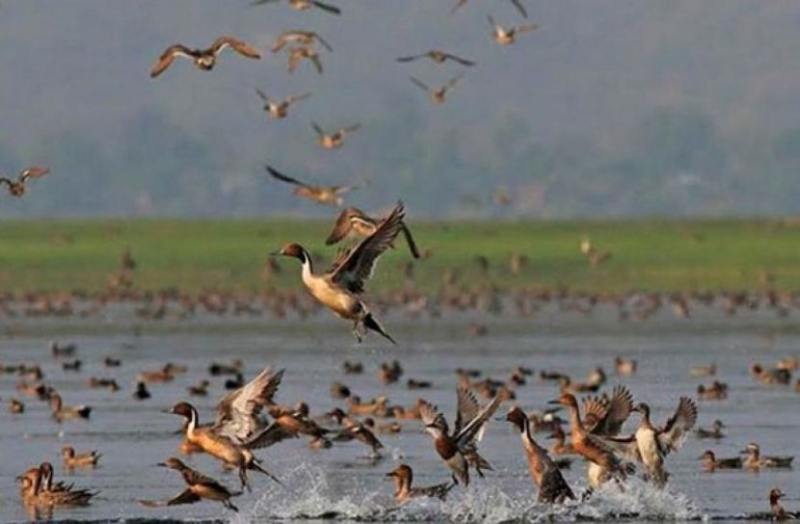
Migratory birds that once used to flock to Beanibazar in Sylhet are rarely seen in the area now. UNB
By-Milad Md Jaynul Islam. Sylhet, Dec 8 - With winter already underway, Beanibazar in Sylhet is witnessing an alarming disappearance of migratory birds.
Once a vibrant winter habitat, the region’s wetlands, including the Muria Haor and several small and large beels, are now largely devoid of the seasonal visitors.
Local residents said that despite the seasonal chill, migratory birds have almost vanished this year.
Waterbodies, reservoirs, canals and rivers in the upazila no longer echo with their familiar calls.
Even a decade ago, various wetlands, rivers, creeks and canals across Beanibazar teemed with numerous species of migratory birds as soon as winter approached.
But with forest areas shrinking and natural habitats deteriorating, the birds appear to have changed their routes.
In recent years, the upazila has seen widespread deforestation.
Concrete expansion has replaced greenery, while the use of pesticides and grass-killing chemicals in farmlands has made natural grasslands scarce.
As a result, experts said, ecological diversity is declining and bird populations are steadily reducing.
Locals say that bird calls no longer wake up villagers as they once did.
They said chirping in homestead yards, the fluttering on tree branches, and the lively movement of native species such as doyel, parrots, doves, crows and cuckoos have largely faded.
Previously, they said, migratory birds would arrive in Muria Haor and other wetlands with the onset of winter.
As water receded towards the end of Ashwin, large flocks—along with native egrets—descended to feed on small fish like puti. The birds stayed through January and February before returning to their native habitats in spring.
This year, however, even familiar sanctuaries show no sign of their presence, with the arrival rate dropping sharply.
Local observers said that extensive damage to natural environments—often in the name of modernisation—has severely affected biodiversity in the area.
Members of the local civil society also point to bird hunting as a major factor.
Despite legal restrictions, they said, indiscriminate hunting continues in several parts of the upazila.
Witnesses said hunters often apply toxic chemicals in paddy fields to incapacitate birds, alongside setting traps and nets that easily capture them.
Beanibazar Upazila Livestock Officer Dr Md Mobin Hai said rapid urbanisation, deforestation, climate change, environmental pollution, unrestricted tree-felling and excessive pesticide use are among the main reasons behind the declining bird population.
He said the destruction of habitats and food sources, unregulated hunting, lack of enforcement and poor conservation efforts have compounded the problem.
Upazila Livestock Extension Officer Dr Shamim Hossain said indiscriminate clearing of forests and bushes is reducing the birds’ natural habitats, resulting in a decline in their movement and diversity.
“We have conducted several drives to stop bird hunting. But hunters usually get advance warning, making it very difficult to catch them," he said.
Beanibazar Upazila Nirbahi Officer Golam Mustafa Munna said migratory birds no longer find sufficient food in the region.
He added that climate change is also a significant factor in the declining number of birds arriving in the area.
As winter deepens, residents fear Bianibazar’s once vibrant wetlands may continue to fall silent unless stronger conservation measures are taken. - UNB