

- Cold wave disrupts life, livelihoods across northern Bangladesh |
- US to Exit 66 UN and Global Bodies Under New Policy Shift |
- LPG Supply Restored Nationwide After Traders End Strike |
- Stocks advance at both bourses; turnover improves |
- LCs surge for stable dollar, but settlement still sluggish |
Rescued Sundarbans tigress still in trauma, physically frail
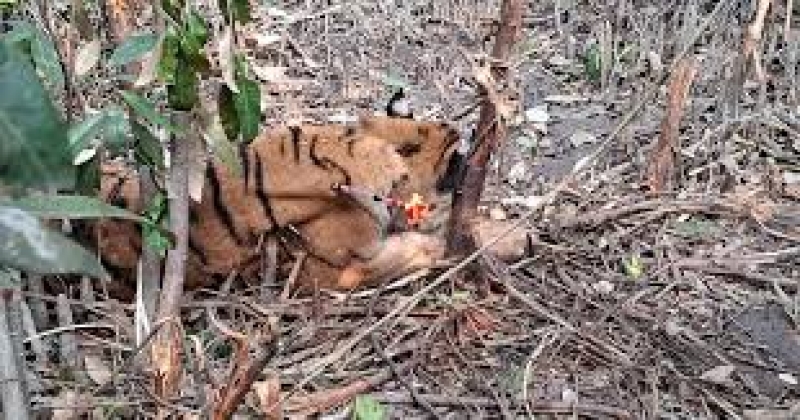
A critically injured tigress rescued from a poacher’s trap in the Sundarbans remains traumatised and physically very weak, veterinarians said on Tuesday.
Professor Dr Mohammad Abu Hadi Noor Ali Khan of Mymensingh Agricultural University, who heads a four-member expert medical board at Gazipur Safari Park, said the tigress is still in a fragile condition, although her health has shown slight improvement compared to the initial stage.
“She is extremely weak and remains under trauma. Small pieces of meat are being given, and she shows aggression when people come close,” he said.
The tigress is being treated with vitamin C, painkillers, analgesics, saline, electrolytes and antibiotics, according to the medical board.
Dr Khan said the board is hopeful about her recovery but could not specify how long it would take before she can be rehabilitated and returned to the Sundarbans.
He also urged collective efforts to protect wildlife in the Sundarbans, including tigers and deer, stressing the need to deter poachers. He recommended appointing at least two veterinary surgeons in each range of the Sundarbans and developing a modern wildlife medical treatment system in the forest.
Gazipur Safari Park Veterinary Officer Dr Julkar Nain, who has been treating the tigress since her rescue, said the animal is still in trauma and remains at high risk.
“There is concern about wound decomposition on her leg, death of some cells and the separation of skin around the wound,” he said, adding that the wound is being dressed regularly.
He said the tigress is also suffering from electrolyte imbalance involving sodium, potassium, calcium, magnesium and phosphate. Due to extreme weakness, she is unable to walk, although her overall physical condition has improved slightly.
Khulna Wildlife and Nature Conservation Department DFO Nirmal Kumar Pal said the tigress is under constant observation and her condition has shown some improvement.
He added that the four-member expert medical board formed by the Ministry has examined the animal and prescribed necessary medication.
The tigress was first spotted by a fisherman on Saturday afternoon about half a kilometre inside the forest. Forest officials later surrounded the area, tranquilised the animal on Sunday afternoon and transported it to the Khulna Wildlife Rescue and Rehabilitation Centre.
Meanwhile, a Chital deer trapped in a poacher’s snare was rescued from the Ghagramari area of the Sundarbans’ East Division on Wednesday afternoon. Forest department officials conducted combing operations in the forest on Tuesday and Wednesday and recovered 19 abandoned traps, though no poachers were arrested.
According to Forest Department data, the number of tigers in the Bangladesh part of the Sundarbans stood at 125 as of October 2024, up from 114 in 2018 and 106 in 2015, reports UNB.
Despite the population increase, tigers in the region continue to face threats from poaching, climate change and rising salinity.