

- November 7 Declared a Public Holiday Every Year |
- LPG Shortage, Overcharging Hit Consumers Across Dhaka |
- Energy, investment, Rohingya issue to top Bangladesh-Indonesia talks |
- Japan Remains Bangladesh’s Trusted Development Partner: Envoy |
- Dhaka ranks world’s second most polluted city this morning |
AI Fuels Rising Abuse of Women Journalists Globally
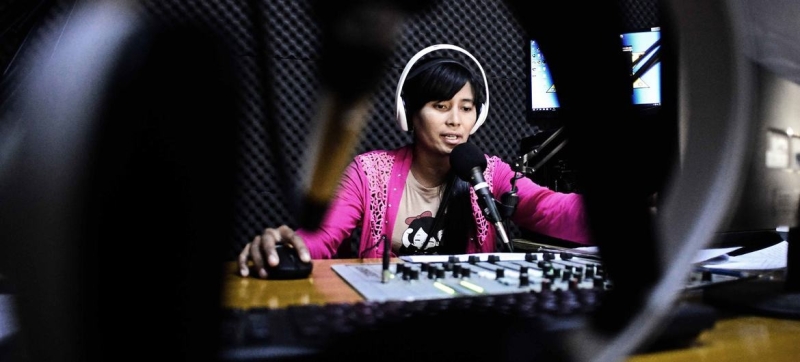
A radio presenter broadcasts in Myanmar. (file)
Reports of online violence against women journalists have doubled since 2020, with serious impacts on their health and well-being, according to a study published ahead of World Press Freedom Day, observed annually on 3 May.
The report by UN Women and its partners highlights how online abuse targeting women in public life is becoming increasingly sophisticated, invasive and harmful in the era of artificial intelligence (AI).
“AI is making abuse easier and more damaging, fueling the erosion of hard-won rights in a context marked by democratic backsliding and networked misogyny,” said Kalliopi Mingerou, who leads efforts to end violence against women at the agency.
Intimate photos leaked
The report, Tipping Point: Online Violence—Impacts, Manifestations and Redress in the AI Age, is based on a 2025 survey of 641 participants from 119 countries.
The findings show that 12 percent of women human rights defenders, activists, journalists and other media workers have experienced non-consensual sharing of personal images, including intimate or sexual content.
Six percent reported being victims of “deepfakes”—AI-generated images that appear real—while one in three said they had received unsolicited sexual advances online.
About 41 percent of respondents said they self-censor on social media to avoid abuse, while 19 percent limit their professional work for the same reason.
‘Forced into silence’
The situation is even more alarming for women journalists and media workers. Around 45 percent said harassment has forced them to self-censor on social media—a 50 percent increase since 2020. Nearly 22 percent said they also self-censor in their professional work.
“When right-wing groups online brand me a ‘traitor,’ and thousands of messages spread these false allegations, simply living in my own country becomes terrifying,” said one environmental journalist from India.
“We have begun to self-censor, withdrawing from investigative reporting. Local operatives, fueled by these posts, have confronted my relatives. It is not easy to live freely; we are forced into silence.”
Women journalists are now twice as likely to report incidents of online abuse to the police compared with 2020—22 percent versus 11 percent. Legal action has also increased, rising from 8 percent in 2020 to 14 percent in 2025.
Mental health impacts
The report highlights the severe mental health toll of online violence. Nearly 24.7 percent of women journalists and media workers have been diagnosed with or treated for anxiety or depression, while almost 13 percent have been diagnosed with post-traumatic stress disorder (PTSD).
One respondent described how the pressure forced her to leave her job. “Unable to cope, I resigned in December 2023 and am now focusing on recovering my mental health,” she said, adding that the situation has also caused severe financial hardship.
Lack of legal protection
Despite the growing crisis, significant gaps remain in legal protections. According to World Bank data, fewer than 40 percent of countries have laws protecting women from cyber harassment or stalking.
Mingerou stressed the need for urgent action. “Our responsibility is to ensure that systems, laws and platforms respond with the urgency this crisis demands,” she said.
The report is the second in a series based on the global survey. The next edition will examine perpetrators’ behaviour, patterns of abuse, and the role of major technology companies.