

- First cruise ship crosses Strait of Hormuz since war began |
- MDBs stress co-op support global stability amid uncertainty |
- PM opens first Hajj flight, visits Ashkona camp |
- River ports asked to hoist cautionary signal No 1 |
- Oil prices drop 9% & Wall Street rallies to a record after Iran reopens Hormuz |
Orban Ousted After 16 Years in Hungary Election
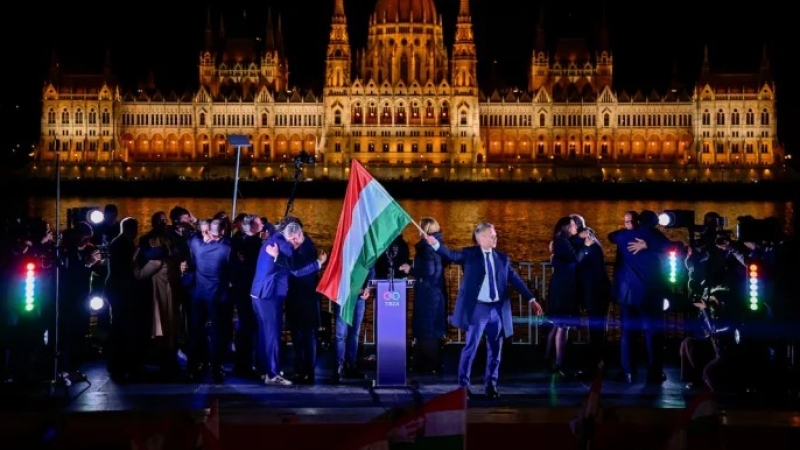
Peter Magyar, leader of the opposition Tisza party, holds a national flag following the partial results of the parliamentary election, in Budapest, Hungary, April 12, 2026.
Hungary’s long-serving prime minister Viktor Orban has been voted out of power after 16 years, in a landmark election that signals a sharp political shift both at home and across Europe.
The nationalist leader conceded defeat following a decisive win for centre-right challenger Peter Magyar, whose Tisza party campaigned on anti-corruption reforms and closer ties with European institutions.
Magyar’s victory marks a clear rejection of Orban’s increasingly centralised style of governance and his confrontational stance towards Western allies. He has pledged to rebuild relations with the European Union and NATO, both of which were strained during Orban’s tenure.
With more than 90% of votes counted, Tisza secured a strong lead in both national support and constituency wins, putting it on course to form the next government. However, it remains uncertain whether the party will secure the two-thirds parliamentary majority needed for sweeping constitutional reforms.
Addressing supporters in Budapest, Magyar described the result as a turning point, saying voters had chosen change after years of political division. Celebrations erupted across the capital, with thousands gathering along the Danube to mark the outcome.
Voter turnout approached 80%, one of the highest in Hungary’s post-communist history, underscoring the significance of the election.
Orban, widely seen as a leading figure among nationalist movements, maintained close ties with Donald Trump and Vladimir Putin. His departure is expected to reshape Hungary’s position within Europe and reduce tensions within the EU, where Budapest had frequently blocked key decisions, including financial support for Ukraine.
European leaders welcomed the result, expressing hope for renewed cooperation. The political transition could also pave the way for the release of EU funds previously withheld over rule-of-law concerns.
Magyar, a former ally of Orban who broke ranks to form Tisza, framed the election as a choice between East and West. He is now expected to steer Hungary back towards the European mainstream while pursuing domestic reforms aimed at strengthening democratic institutions.
The outcome not only ends Orban’s long dominance but also sends a strong signal across Europe, where his brand of nationalist politics had gained influence in recent years.