

- Israel’s Ethnic Cleansing of West Bank Bedouin & Herding Communities |
- BB appoints observer to Islami Bank to restore discipline |
- 24 injured as Uttara University bus overturns in Gazipur |
- Tk 9.38 lakh crore national budget to be unveiled Thursday |
- Bangladesh Economy Tops $500bn for First Time |
Thailand and Cambodia agree to ceasefire
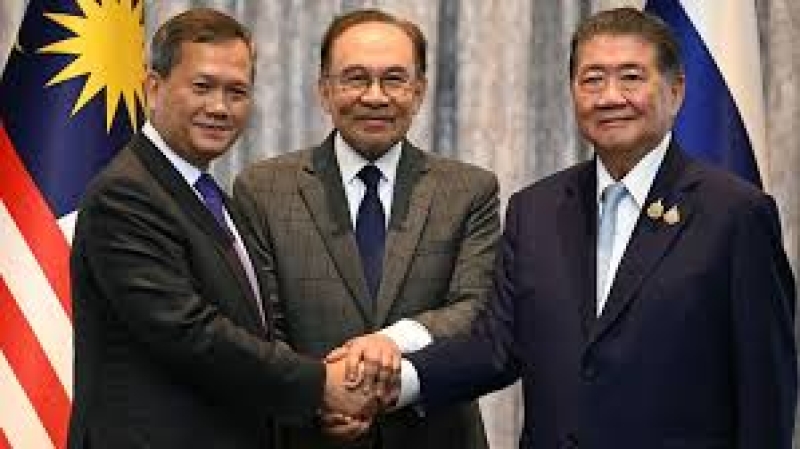
Thailand and Cambodia on Saturday signed a new ceasefire deal aimed at ending weeks of armed confrontations along their disputed border.
The ceasefire came into force at noon and requires both sides to stop troop movements and prevent the use of airspace for military operations. Cambodian officials said Thailand was the only country to have launched air attacks, including strikes carried out earlier on Saturday.
Under the agreement, Thailand will return 18 Cambodian soldiers it captured during fighting in July once the ceasefire has remained intact for 72 hours. Their release has been a key demand from Cambodia.
Soon after the agreement was signed, Thailand’s Foreign Ministry lodged a protest, claiming a Thai soldier suffered permanent injuries after stepping on an anti-personnel land mine allegedly planted by Cambodian forces.
The ceasefire was formally signed at a border checkpoint by Cambodia’s Defense Minister Tea Seiha and Thailand’s Defense Minister Nattaphon Narkphanit, following three days of discussions among military officials.
The deal reaffirms earlier ceasefire arrangements reached in July after five days of clashes, as well as subsequent agreements. The July truce was mediated by Malaysia and supported by pressure from U.S. President Donald Trump, who threatened to suspend trade benefits unless both sides agreed. A more detailed agreement was finalized in October at a regional meeting in Malaysia attended by Trump.
Despite those earlier efforts, tensions continued through hostile rhetoric and sporadic border violence, which escalated into intense fighting in early December.
U.S. Secretary of State Marco Rubio welcomed the new ceasefire and called on both countries to fully comply with it and previous peace commitments. U.N. Secretary-General Antonio Guterres described the ceasefire as an important move toward reducing civilian suffering, stopping hostilities, and creating conditions for long-term peace. He also praised Malaysia, China, and the United States for their mediation efforts, adding that the United Nations is ready to support peace and stability in the region.
China’s Foreign Ministry also praised the agreement and announced it would host trilateral talks with Thai and Cambodian foreign ministers in Yunnan province on Sunday and Monday. Beijing said it would play a constructive role in strengthening the ceasefire, rebuilding trust, improving relations, and maintaining regional peace.
Civilians have suffered heavily during the conflict. Thai officials reported that since Dec. 7, 26 soldiers and one civilian were killed directly in combat, while total civilian deaths reached 44. Cambodia has not released official military casualty figures but reported 30 civilian deaths and 90 injuries. Hundreds of thousands of residents on both sides of the border have been displaced.
Cambodia’s defense minister said the ceasefire would allow displaced residents to return home, resume farming, and enable children to go back to school.
Both countries accused each other of starting the violence and insisted their actions were defensive.
The agreement also commits both sides to respecting international bans on land mines, a major concern for Thailand. Thai officials say soldiers have been injured in at least 10 incidents this year by newly laid mines, while Cambodia claims the explosives are remnants from its civil war that ended in the late 1990s.
Following Saturday’s injury, Thailand noted that the agreement includes provisions for joint humanitarian demining operations to protect both soldiers and civilians. Another clause requires both sides to avoid spreading misinformation.
The deal also calls for renewed efforts to demarcate the border and for cooperation against transnational crimes, particularly online scam networks that have caused massive financial losses worldwide and are often linked to Cambodia.
Malaysia’s Prime Minister Anwar Ibrahim praised the agreement, saying it shows a shared understanding that restraint is essential, especially to protect civilians.
However, concerns remain over the durability of the ceasefire. Thailand’s Defense Ministry spokesperson said the return of displaced civilians would signal enough stability to proceed with releasing the Cambodian prisoners. He stressed that the 72-hour ceasefire period is meant to test Cambodia’s commitment to halting violence, warning that failure to do so would raise doubts about its sincerity in pursuing lasting peace, reports UNB.