

- US Supreme Court Voids Donald Trump Global Tariffs |
- India looks forward to engaging with new govt in Bangladesh |
- No more running after doctors, services to reach doorsteps |
- ‘Revolutionary’ shift in economy, stock market soon: Amir Khashru |
- Stocks end week sharply lower as DSE, CSE indices tumble |
US Supreme Court Voids Donald Trump Global Tariffs
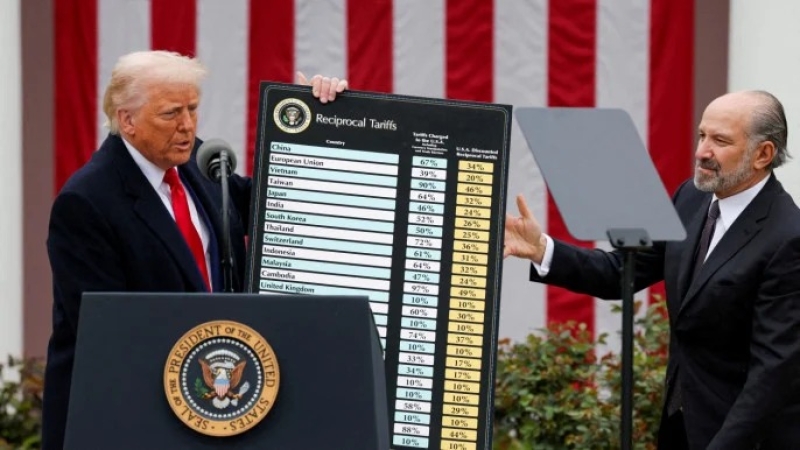
US President Donald Trump holds a chart next to US Secretary of Commerce Howard Lutnick as Trump delivers remarks on tariffs in the Rose Garden at the White House in Washington, DC, on 2 April 2025.
The US Supreme Court on Friday struck down sweeping global tariffs imposed by President Donald Trump under emergency powers, delivering a major legal setback with far-reaching implications for international trade.
In a 6–3 ruling authored by Chief Justice John Roberts, the court upheld a lower court decision that Trump exceeded his authority by using the International Emergency Economic Powers Act (IEEPA) to impose import taxes.
Roberts wrote that the law allows the president to regulate imports during a national emergency but does not authorise the imposition of tariffs. He said any such extraordinary power must be clearly granted by Congress, which the statute did not do.
The majority also held that interpreting the law to permit tariffs would intrude on Congress’s constitutional authority over taxation and trade. The ruling invoked the “major questions” doctrine, which requires explicit congressional approval for executive actions of vast economic and political significance.
Tariffs had been a cornerstone of Trump’s economic and foreign policy, fuelling a broad trade confrontation that unsettled markets and strained relations with major trading partners. Economists had projected that the duties could generate trillions of dollars in revenue over the coming decade.
The case was brought by businesses affected by the tariffs along with 12 US states, most led by Democratic administrations, challenging what they described as an unprecedented use of emergency powers to levy import taxes without congressional approval.
Three conservative justices—Clarence Thomas, Samuel Alito and Brett Kavanaugh—dissented. Kavanaugh argued that tariffs are a traditional tool for regulating imports and that the law’s text and historical practice supported the administration’s position.
He warned that the decision could create uncertainty for trade agreements negotiated under the tariff regime, noting that the duties had been used to secure deals worth trillions of dollars with countries including China, United Kingdom and Japan.
Under the US Constitution, authority to impose taxes and tariffs rests with Congress. Trump instead relied on IEEPA, a 1977 law intended primarily for sanctions and asset freezes during national emergencies, becoming the first president to use it to levy tariffs on such a scale.
Administration officials had argued that regulating imports under emergency powers included the authority to impose tariffs. Critics said the move bypassed Congress and expanded presidential power beyond legal limits.
Economic data indicated the tariffs had already generated more than $175 billion in revenue, raising questions about whether importers could seek refunds following the ruling.
Trump had defended the measures as essential to national security and economic strength, claiming they prevented other countries from exploiting the United States. He also signalled he would pursue alternative legal avenues if the court ruled against him.
Officials said the administration could attempt to preserve parts of the tariff regime using other statutes, including provisions allowing duties on imports deemed to threaten national security or in response to unfair trade practices.
The decision was welcomed by many lawmakers and business groups, who argued that the tariffs had raised consumer prices and disrupted supply chains. Others warned that removing them abruptly could alter the balance of ongoing trade negotiations.
Legal analysts said the ruling reinforces limits on executive authority and reasserts Congress’s central role in trade policy, while leaving open the possibility of new tariffs enacted through legislation or narrower statutory powers.