

- Speaker sees no possibility of Hasina's return even in 10-yrs |
- Bangladesh Ambassador to Japan returns home ahead of PM’s visit |
- Sajek Road Blockade: 2,933 Tourists Evacuated Amid Gunfire |
- Climate Crisis May Displace 7.5% of Bangladeshis by 2050 |
- NEIR Rollout Targets Tk 2,000cr Revenue Loss From Illegal Phones |
Agro-Ecological Farming Taking Roots In Bangladesh
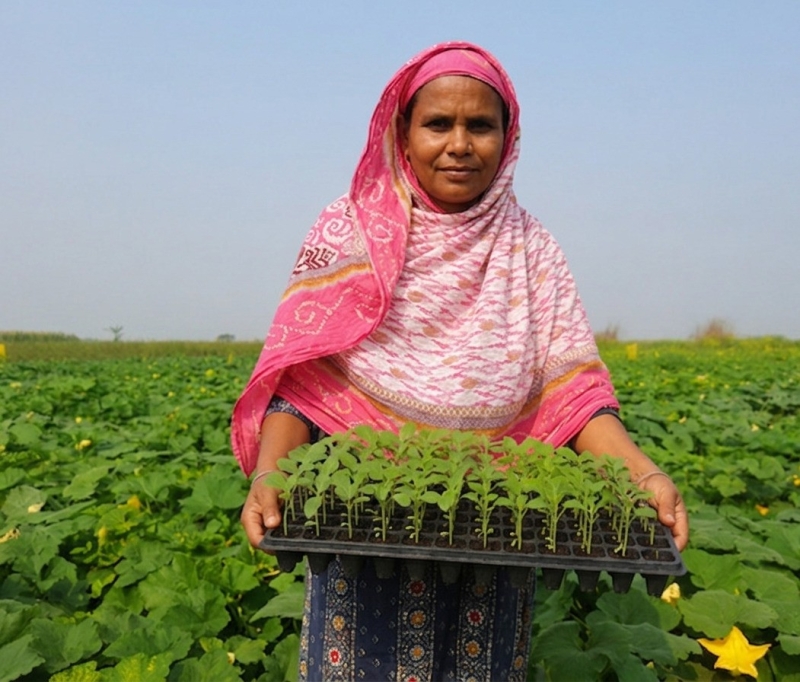
A woman farmer carrying seedlings for transplantation for vegetable cultivation under agro-ecological methods in Faridpur.
Ziaur Rahman
Nature-based agricultural practices are transforming the lives of farming families across the char islands of Faridpur. Thanks to scientific farming and renewable energy the once-barren sandy land is being turned into productive fields, while the fragile ecosystem is gradually being restored.
On the windswept char lands of Faridpur, where shifting sands and poor soil once offered little hope, a quiet agricultural revolution is taking roots. What was once considered barren land is now producing vegetables almost throughout the year, transforming the lives of hundreds of farming families.
While visiting North Channel and neighbouring char islands in Faridpur, this correspondent found a quiet but remarkable change unfolding across the landscape. Vegetable fields now stretch across land once regarded as too sandy for profitable farming. Solar-powered irrigation pumps, compost pits, vermicompost units and net-house nurseries have become visible symbols of a new farming system that is improving farm incomes while restoring the health of the land.
Among the beneficiaries of this transformation is 55-year-old farmer Mojibor Molla, whose journey demonstrates how scientific farming, institutional support and determination can turn hardship into prosperity.
Only three years ago, Mojibor cultivated a few bighas of sandy land that yielded little return. Like many farmers living on the char, he struggled to support his family. Today, his thriving agro-ecological farm stands as a model of sustainable agriculture and rural entrepreneurship. Land that was once considered unsuitable for cultivation now produces vegetables.
By adopting agro-ecological farming practices, Mojibor has increased his annual income to nearly Tk 12 lakh, compared to Tk 4-5 lakh he earned from the same land under conventional farming. The improvement has been equally impressive at the field level. Land that once generated only Tk 40,000 to Tk 50,000 a year now earns him Tk 1 lakh to Tk 1.5 lakh per bigha through diversified vegetable cultivation.
The productivity of his land has also improved significantly. Instead of harvesting only two crops a year, Mojibor now grows four to five crops annually. The change has strengthened his family's financial security while gradually restoring the fertility of degraded land through environmentally sustainable farming practices.
The transformation did not happen overnight. It began with a willingness to adopt farming methods that work with nature rather than against it.
Instead of depending on a single crop, Mojibor practises mixed vegetable farming, cultivating a variety of seasonal vegetables. His fields now produce different crops side by side, ensuring better use of land and reducing the risk of crop failure.
He also follows companion planting, where different crops are grown together so they naturally repel harmful insects, improve soil health and make better use of sunlight, nutrients and space. Crop rotation and mulching further help conserve soil moisture, suppress weeds and restore soil fertility, reducing dependence on chemical inputs.
The benefits of these practices are easy to see. Rows of brinjal, chilli, gourds and leafy vegetables have replaced the monocrop fields that once dominated the landscape. Farmers say the diversified cropping system has not only increased production but also reduced pest attacks and improved the quality of their produce.
Mojibor's success has encouraged many neighbouring farmers to rethink the way they cultivate their land. Across North Channel Char, traditional monocropping is gradually giving way to diversified vegetable farming. The shift is improving household incomes while making agriculture more resilient to climate change and environmental stress.
Behind many of these changes is the support of the Palli Karma-Sahayak Foundation (PKSF) through its local partner, Amra Kaj Kory (AKK), under the Rural Microenterprise Transformation Project (RMTP). The initiative is helping marginal farmers in the char areas of Faridpur Sadar adopt high-value agriculture, safe vegetable production, improved market linkages and environmentally sustainable farming practices.
One of the project's most visible innovations is the introduction of solar-powered irrigation. Across the char, the familiar sound of diesel-operated pumps is gradually being replaced by clean solar energy. The change has reduced irrigation costs, lowered carbon emissions and made farming both more economical and environmentally sustainable.
The transformation extends beyond irrigation. Farmers are also moving away from chemical fertilizers in favour of organic alternatives. Vermicompost, produced from locally available organic waste using earthworms, has become an important source of plant nutrients. Farmyard manure and beneficial bio-fertilizers are also widely used to improve soil health naturally. Crop rotation, physical barriers and plant-based bio-pesticides help keep pests under control without harming the surrounding environment.
Most of these bio-fertilizers and bio-pesticides are produced within the community. Young entrepreneurs collect wheat straw, maize stalks, cow dung and other agricultural residues to produce vermicompost. What was once discarded as farm waste is now being converted into valuable organic fertilizer, creating employment while providing farmers with an affordable and environmentally friendly alternative to chemical fertilizers.
Farmers Turn Waste into Wealth
Among those helping drive this transition is Anowar Hossain, a young farmer from North Channel who has turned organic fertilizer production into a successful rural enterprise. Concerned by the declining fertility of local soils after years of excessive use of chemical fertilizers, he received professional training in vermicompost production. Today, using cow dung, banana plants and other biodegradable materials, he produces several tonnes of organic fertilizer every month.
Anowar, a vermicompost producer, showed how agricultural waste, once considered of little value, is being transformed into a resource that benefits both farmers and the environment. The composting sheds, neatly arranged under shade, were filled with earthworms quietly converting cow dung, wheat straw, maize stalks and other organic residues into nutrient-rich fertilizer.
"My journey began on a small scale," Anowar recalled. "I collected cow dung and farm waste such as wheat straw and maize stalks from nearby households. After composting the materials, I added earthworms and kept everything moist and under shade until the waste gradually turned into vermicompost. It was hard work in the beginning, and my wife stood beside me every step of the way. Today, we have a small team producing vermicompost commercially. The income supports my family, and I hope to expand the business further in the coming years."
His enterprise now supplies local farmers with an affordable alternative to chemical fertilizers while creating employment opportunities for several rural families. More importantly, it demonstrates how agro-ecological farming is creating new businesses alongside higher crop production.
The benefits of the new farming system are visible across the char lands. Vegetable cultivation is steadily replacing traditional rice farming as growers shift to crops that offer higher returns, require less water, mature more quickly and can be harvested several times a year.
Farmers prepare their own organic fertilizers and plant-based bio-pesticides before carrying freshly harvested vegetables directly to local markets. Many said they no longer rely solely on middlemen to sell their produce to get better prices.
One farmer, who previously cultivated only rice and lentils, said the difference had been dramatic.
"Earlier I harvested only two crops a year. Now I grow four to five crops annually and earn three to four times more through agro-ecological farming," he said with quiet satisfaction.
Another encouraging development is the growing production of environmentally friendly vegetable seeds. Farmers are no longer dependent entirely on outside suppliers. Instead, many of them are producing quality seeds locally using sustainable methods that relying on vermicompost, cow dung, crop rotation and natural bio-pesticides prepared from neem, tamarind, garlic, chilli and other plant extracts.
Some farmers have also established net-house nurseries where vegetable seeds are produced under controlled conditions. These simple structures protect young plants from insects and adverse weather while maintaining suitable temperature and humidity, helping produce high-quality seed and healthy seedlings.
-- From the August print edition