

- The Green Heart of Agricultural Learning: Give SAU Its Field Back |
- India's record 720-9 has New Zealand on the ropes in 1st test |
- 95 platoons of BGB deployed in seven districts, including Gopalganj |
- Turkey's final draft at UN COP31 doesn't mention fossil fuels |
- Dhaka Ranks 14th Among World's Most Polluted Cities on Sunday |
Bangladesh's Onion Output Exceeds 5 Million Tonnes
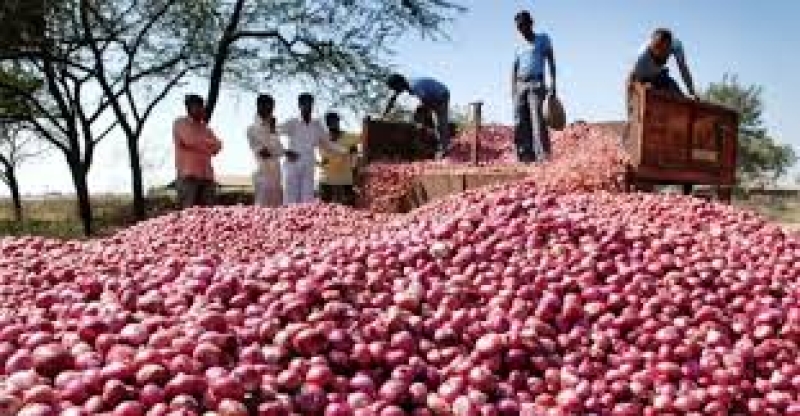
Bangladesh has moved towards self-sufficiency in onion production, with output exceeding 5.09 million tonnes amid higher yields and improved storage facilities, reducing the country's dependence on imports.
According to the Department of Agricultural Extension (DAE), annual onion production has reached more than 5.09 million tonnes against domestic demand of around 3.6 million tonnes, representing a surplus of 41.39%.
Government initiatives to establish modern storage facilities have also helped maintain supplies in local markets, particularly during the off-season from September to December. Improved post-harvest management has reportedly reduced losses by around 10%, helping address seasonal shortages.
Post-harvest losses of onions in Bangladesh generally range from 20% to 30%. The rate can rise to 50% or more during periods of severe spoilage or adverse weather conditions. However, modern storage systems have helped maintain a more stable supply throughout the year.
Traditionally, shortages between September and December have pushed up prices and increased reliance on imported onions as domestic stocks run low. The distribution of air-flow machines among farmers, alongside higher production, has helped reduce the need for imports, according to the DAE.
The report estimates that reduced imports have saved around $382 million, equivalent to more than Tk4,764 crore.
DAE data show that Bangladesh produced 4.448 million tonnes of onions in fiscal year 2024-25 and imported another 473,000 tonnes. In the previous fiscal year, production stood at around 3.9 million tonnes, while imports reached nearly 600,000 tonnes.
DAE Director General M Abdur Rahim said the country no longer needed to depend on onion imports, citing the development of modern storage facilities with a combined capacity of around 400,000 to 500,000 tonnes.
He said the storage capacity was sufficient to address the annual supply shortage during the off-season and help maintain supplies throughout the year.
According to Rahim, 26,700 air-flow machines have so far been distributed among farmers, while the government plans to provide another 4,000 under its agricultural incentive programme in the current fiscal year.
He described onion cultivation as profitable, saying farmers were spending around Tk50,000 per bigha to produce 100 maunds of onions, which could be sold for around Tk100,000.
A farmer in Madhukhali upazila of Faridpur said he had stored 145 maunds of onions over the past six months using an air-flow machine. He said conventional storage methods caused a weight loss of around 10kg per maund, while the new technology had reduced the loss to between 2kg and 2.5kg.
Another farmer in Godagari upazila of Rajshahi said modern storage facilities had improved farmers' earnings. He said onions sold for Tk800 to Tk1,000 per maund immediately after harvesting in April, while prices generally rose to Tk1,600-Tk1,700 per maund between September and December.
A farmer in Bhanga upazila of Faridpur said the government should now focus on onion exports to ensure better returns for farmers. He said production costs currently stood at around Tk40 per kilogramme.
The DAE reportedly stopped issuing import permits for onions in December 2025. However, the supplied figures also mention imports of 86,368 tonnes during August-December of fiscal year 2025-26.
Meanwhile, onion production this year reportedly reached 5.09 million tonnes from more than 300,000 hectares of land, an increase of 700,000 to 1 million tonnes compared with the previous year.
Favourable rainfall in late March, around two weeks before harvesting, helped raise yields to as much as 100 maunds per bigha from the usual 70 maunds, according to the report.
To improve storage capacity, the government has distributed 26,700 air-flow machines among farmers. The technology helps preserve onions over extended periods by maintaining controlled temperature, humidity and air circulation, supporting a steady supply to markets throughout the year.
A project has also been undertaken to help onion farmers adapt to the adverse effects of climate change in major production areas through improved storage facilities.
Project Director Dr Mahfuzur Rahman said higher production and the expansion of storage technology among farmers had helped reduce the country's dependence on imported onions.
Under the initiative, each participating farmer received Tk27,000 in financial assistance through a bank account. Of the amount, Tk19,000 was allocated for purchasing an air-flow machine, Tk7,000 for constructing a platform and Tk1,000 for installing a signboard at the farmer's home.
The technology has enabled farmers to store up to 300,000 tonnes of onions, as each machine has a storage capacity of around 10 tonnes.
The project has been implemented in 107 upazilas across 16 districts, including Pabna, Faridpur, Rajbari, Rajshahi, Kushtia, Magura, Jhenaidah, Manikganj, Natore, Naogaon, Meherpur, Chapainawabganj, Madaripur, Shariatpur, Rangpur and Bogura.
Around 3,900 farmers are also receiving technical training under the project.
Rahman said Bangladesh has around 200,000 onion growers across 17 major onion-producing districts. The technology has been distributed to 50,000 farmers through government and private initiatives.
To increase production of summer and small-bulb onion varieties, the government has extended the second phase of the Expansion of Improved Varieties and Technologies of Spices Project (EIVTSP) until 2031. The project covers 110 upazilas in 40 districts and 25 horticulture centres.
An earlier five-year project, with an allocation of Tk137.42 crore, is scheduled to continue until June 2027.
Project Director Masudur Rahman said the initiative would support the production of quality summer onion seedlings through demonstration plots and 25 horticulture centres across the country.
He said short-duration summer onion varieties suitable for cultivation during the Kharif season, including BARI Onion-5, would be promoted among farmers.