

- Bangladesh election nomination paper filing time expires Monday |
- Cold, foggy condition to persist affecting transport, navigation |
- Bangladesh’s Finance Sector Stabilises, Challenges Remain |
- Govt Proposes Up to Tk1cr for Milestone Crash Victims |
- Hadi Killing: Inqilab Mancha Sets 24-Day Justice Ultimatum |
Haor farmers reap early gains as mustard cultivation thrives
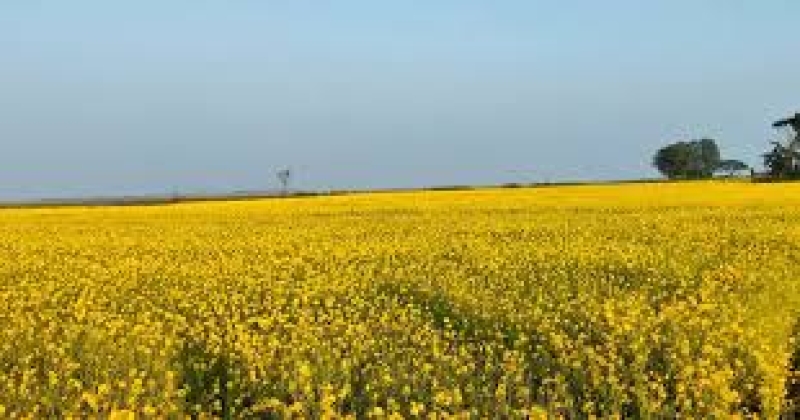
A vast golden carpet has spread across the haor wetlands of Madhyanagar upazila in Sunamganj, as a bumper mustard harvest this season brings renewed hope and financial relief to local farmers.
The low-lying fields, riverbanks and wetlands of Banshikunda Uttar and Dakshin, Chamardani and Madhyanagar Sadar unions are now awash with bright yellow mustard flowers, transforming the landscape into a striking spectacle that is also drawing curious visitors.
Mustard, widely known as a low-cost and high-profit oilseed crop with a short growing cycle, has gained growing popularity among farmers in the haor region.
According to the Madhyanagar upazila agriculture office, mustard was cultivated on around 550 hectares of land this season, with officials optimistic about meeting, and possibly exceeding production targets.
For many farmers, the shift towards mustard has been driven by rising production costs and price uncertainty surrounding paddy and other staple crops. “We often suffer losses from rice cultivation due to high input costs and unstable market prices,” said one farmer. “Mustard needs less investment, grows quickly and sells well. It is safer for us.”
As a result, mustard cultivation has expanded significantly in fallow lands and haor-adjacent areas this year, making productive use of land that often remains uncultivated after the monsoon.
The agriculture office said sowing typically begins at the end of Kartik, with harvesting completed by mid-Poush, allowing farmers to earn returns early in the season.
Even before harvesting the seeds, farmers generate additional income by selling mustard flowers and leaves, which are used locally to prepare dishes such as bora (fritters) and leafy vegetables.
After harvesting, the dried stalks are sold as fuel, further adding to household earnings.
Upazila Deputy Assistant Agriculture Officer Akmal Hossain said the outlook remains positive. “Like previous years, the mustard production target has been achieved. If there is no major pest or disease outbreak, farmers can expect a bumper harvest,” he said.
He said timely distribution of fertilisers and seeds under government incentive programmes ensured smooth cultivation this season.
Across Bangladesh, mustard cultivation has emerged as a profitable rabi-season crop, particularly in districts such as Magura and Narail.
With the Bangladesh Agricultural Research Institute (BARI) keeps on developing high-yielding mustard varieties to support the farmers and keep up the encouraging growth trend, farmers have responded equally with the adoption of improved seeds and modern techniques, reports UNB.
Mustard farming is playing an increasingly vital role in Bangladesh’s agricultural economy with the country striving to reduce its dependence on imported edible oil, officials said.