

- Dhaka's air 5th worst in the world this morning |
- Around 7,500 Bangladeshis imprisoned in Saudi Arabia: Shama Obaed |
- Bangladesh Outperforms India in Global Hunger Index 2026 |
- Covered van hits Gazipur police patrol team, killing SI, BNP leader |
- Korean City scrambles to rescue dusky shark after it returns to canal |
Why Nature Matters to Business and the Global Economy
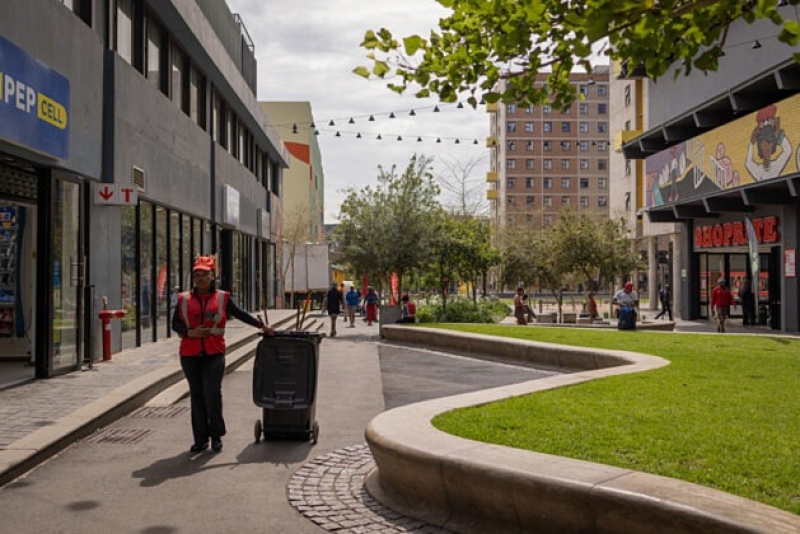
Jewel City, a newly developed mixed-use precinct situated in the heart of the Johannesburg CBD is meant to create a safe, green and energetic place for people in the city.
Our food, fuel and fortunes come from nature, but as these resources are converted into profits, the balance between exploitation and replenishment of the planet is becoming increasingly precarious.
Global businesses impact nature through mining, manufacturing, processing and retail operations. At the same time, nature affects business operations, as biodiversity loss and extreme weather events—such as droughts, floods and rising temperatures—disrupt supply chains and productivity.
How global business affects nature, and vice versa, is the focus of a new assessment by the Intergovernmental Platform on Biodiversity and Ecosystem Services (IPBES), set to be launched next week during the 12th session of the IPBES Plenary.
IPBES is the global science-policy body tasked with providing the best available evidence to decision-makers for people and nature. Its assessment reports respond directly to requests from governments and policymakers, making them immediately relevant worldwide.
The plenary session got underway earlier today (February 3, 2026) with a keynote address by Emma Reynolds MP, the UK Secretary of State for Environment, Food and Rural Affairs. Remarks were also delivered by Astrid Schomaker, executive secretary of the Convention on Biological Diversity; Kaveh Zahedi, director of the FAO Office of Climate Change, Biodiversity and Environment; IPBES chair Dr David Obura; and IPBES executive secretary Dr Luthando Dziba.
“This week you will work to agree on the business and biodiversity assessment. I pray with all my heart that it will help shape concrete action for years to come, including leveraging public and private sector finance,” King Charles said.
Reynolds struck an optimistic note.
“Around the world, momentum is building. Countries are restoring wetlands and forests. Communities are reviving degraded landscapes. Businesses are discovering that investing in nature delivers real returns. The tide for nature is beginning to turn. But we cannot afford to slow down,” she said. “The window to halt biodiversity loss by 2030 is narrowing. We must build on this momentum—now more than ever.”
Obura said the Manchester plenary was symbolic, noting the city’s historic role in industrial and business transformation.
“This is especially important just days after the World Economic Forum’s 2026 Global Risks Report again highlighted biodiversity loss as the second most urgent long-term risk to business worldwide,” he said.
Dziba said IPBES remained on course.
“IPBES is therefore on track to deliver—over the coming years—crucial knowledge and inspiration to support the implementation of current goals and targets, and to provide the scientific foundation needed for the global agenda beyond 2030,” he said.
The Business and Biodiversity Assessment, the first of its kind, presents scientific evidence on how global business depends on and affects nature. Aimed at governments, businesses, financial institutions, civil society, Indigenous Peoples and local communities, the assessment offers insights and options to improve outcomes for biodiversity and nature’s contributions to people.
After three years of work by 80 leading experts from science, the private sector, Indigenous Peoples and local communities across 35 countries, the assessment promotes business accountability and transparency while improving awareness of impacts and dependencies on nature. It was completed in two years—shorter than the usual four-year IPBES assessments—at a cost exceeding USD 1.5 million.
The assessment comes at a time when scientists warn that the world is off track in reducing carbon emissions, with slow progress in phasing out fossil fuels. While nature provides the resources that drive industry, it also increasingly affects business operations.
Speaking to IPBES’s Nature Insight: Speed Dating with the Future podcast, Professor Ximena Rueda Fajardo, co-chair of the assessment, said engaging with nature is no longer optional for business.
“Businesses are both beneficiaries of nature and major contributors to its decline, so they have a critical role in ensuring the wise stewardship of our environment,” she said, adding that this is vital for long-term prosperity and sustainable futures.
IPBES notes that more than half of global GDP—around USD 117 trillion in 2025—is generated in sectors that are moderately to highly dependent on nature.
According to the World Economic Forum, biodiversity is shrinking faster than at any point in human history. If left unchecked, up to 50 percent of all species could be lost by mid-century. Over the past 50 years, land- and sea-use change, climate change, resource exploitation, pollution and invasive species have driven more than 90 percent of biodiversity loss.
Ecosystem services such as food, medicine, clean air, disease control and climate regulation are difficult to quantify but are estimated to be worth more than USD 150 trillion annually. Conservative estimates suggest that nature loss could cost the global economy at least USD 479 billion per year by 2050.
Business activities—from pollution and waste to fossil fuel use—have had a profound impact on nature, IPBES found. At the same time, the degradation of nature poses growing risks to economic stability.
The IPBES assessment, expected to be approved during the plenary, maps how businesses and financial institutions depend on and impact biodiversity. It also highlights the need for collaboration among governments, consumers, Indigenous Peoples, local communities and civil society to achieve global biodiversity goals by 2030 and the vision of living in harmony with nature by 2050.
Matt Jones, chief impact officer at the UN Environment Programme’s World Conservation Monitoring Centre and co-chair of the report, said no business is independent of biodiversity.
“Even a hairdresser depends on nature,” he said, noting that many personal care products are derived from natural ingredients. “Once businesses understand the risks from nature loss, the conversation fundamentally changes.”
Conservative estimates suggest that the collapse of essential ecosystem services—such as pollination, marine fisheries and timber provision—could lead to annual global GDP losses of USD 2.7 trillion by 2030. Biodiversity loss is already estimated to be costing the global economy around 10 percent of its output each year.