

- Stocks surge at DSE, CSE for second straight day |
- REHAB seeks Tk 3000 crore special fund support housing sector |
- Trump, Putin discuss Iran conflict, Ukraine settlement in phone call |
- US Launches ‘Most Intense’ Strikes as Iran Vows Response |
- Family Card Scheme to Cover 4 Crore Families in 5 Years |
Democratic Renewal Makes Ekushey More Meaningful
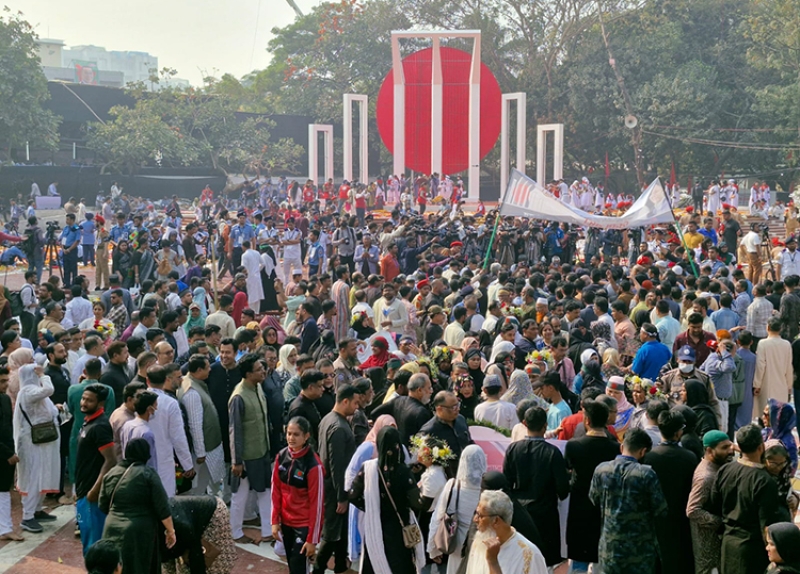
Amar Ekushey, the historic day marking the sacrifices of the language movement, and International Mother Language Day was observed across Bangladesh with solemnity and reflection, as citizens paid homage to the martyrs whose courage laid the foundation for the nation’s cultural and political identity. Through quiet processions, floral tributes, and commemorative ceremonies, the country remembered those whose struggle for the recognition of Bangla evolved into a broader movement for democracy and independence.
Ekushey has come following the democratic renewal in Bangladesh after long 17 years. And this makes the occasion more meaningful and enjoyable to people who fought autocracy with the spirit of safeguarding democratic rights.
This year, the Ekushey book fair, traditionally held at the Bangla Academy, has been scheduled for 15 days beginning February 25. In view of the general elections held on February 12, the fair was deferred and shortened, illustrating the delicate balance between observing democratic processes and honouring cultural heritage. Despite these adjustments, publishers, writers, and readers alike described the event as a living testament to the language movement's enduring legacy.
The observance of Amar Ekushey (21st) is inseparably linked to the movement to Make Bangla a state language as the central government sought to impose Urdu as the sole state language. This move was met with widespread resistance in East Pakistan, where Bangla was spoken by the majority. On February 21, 1952, students and activists in Dhaka defied Section 144, which prohibited public gatherings, to demand recognition of Bangla as a state language. Police opened fire on demonstrators, killing at least four students: Abul Barkat, Rafiq Uddin Ahmed, Salam, and Abdul Jabbar.
The bravery displayed by these students forced the government to recognise Bangla as a state language in 1956. Beyond this immediate victory, the movement inspired subsequent campaigns for democracy and provincial autonomy, over time culminating in Bangladesh’s independence in 1971.
Scholars and historians argue that the language movement shaped the nation’s political culture, fostering civic activism and a collective identity that continues to influence Bangladesh today.
The observances began just after midnight at the Central Shaheed Minar in Dhaka. President Mohammed Shahabuddin placed the first wreath, followed by Prime Minister Tarique Rahman. The PM stood in silence alongside cabinet members and leaders of the Bangladesh Nationalist Party and offered munajat for not only the martyrs of 1952 but also those who fell in the 1971 Liberation War and subsequent democratic movements including the July 2024 mass upsurge.
Members of the diplomatic corps and representatives of international organisations based in Dhaka laid floral wreaths and paid tributes to language martyrs and in observance of the International Mother Language Day. The Chief of the Army Staff, The Chief of the Naval Staff and the Chief of the Air Staff then laid wreaths. The ceremony resounded with the song “Amar Bhaiyer Rokte Rangano Ekushey February, Ami Ki Bhulite Pari”, a poignant reminder of the bloodshed that shaped the nation.
Leaders of Bangladesh Jamaat-e-Islami and the National Citizen Party for the first time, and members of the 11-party alliance, formally paid their respects to martyrs at the Shaheed Minar. Their participation reflected a rare cross-party engagement in the commemoration of a shared national heritage. However, leaders and activists of the Jatiya Party reportedly faced obstruction when attempting to offer tributes around 2:00am, and they were compelled to leave without completing their formal homage.
Students of the Faculty of Fine Arts at the University of Dhaka decorated roads leading to the Shaheed Minar with intricate alpana designs and murals, blending motifs from the 1952 movement with contemporary references, including the 2024 mass uprising. The displays reinforced the visual and emotional connection between historical sacrifices and ongoing civic engagement.
The United Nations Educational, Scientific and Cultural Organization (UNESCO) has officially recognized February 21 as International Mother Language Day. This designation underscores the global importance of linguistic diversity, cultural preservation, and the universal right to maintain one’s mother tongue.
Despite the day’s significance, educational experts and cultural commentators have expressed concern over the declining quality of education in Bangladesh over the past 15 years. They argue that institutional negligence, coupled with government pressure to prevent student failures, has inflated academic results.
Furthermore, distortions in history textbooks—often presenting Muslims as outsiders or marginalizing their contributions—have skewed perceptions of the nation’s past. Educators stress the urgent need for critical, unbiased historical teaching to ensure that future generations understand and value the principles of the language movement.
The cultural impact of the language movement is significant. One of its most enduring contributions is the Ekushey Book Fair, organised for more than five decades. The fair helped establish Dhaka as a hub for Bangla literature. Over the years, it has become a focal point for writers, poets, and readers, nurturing an appreciation for Bangla poetry, prose, and academic works. The fair has promoted authors, encouraged publishing innovation, and fostered a vibrant literary community that continues to grow.
Amar Ekushey also reflects the broader trajectory of Bangladesh’s political evolution. The courage of students and ordinary citizens in 1952 demonstrated that collective action could challenge injustice and shape national policy.
Observances this year highlighted both pride and concern. Citizens reflected on the nation’s achievements and resilience, yet also acknowledged the erosion of educational standards and historical awareness. The barefoot processions, humble floral tributes, and literary celebrations collectively reaffirmed Bangladeshis’ commitment to uphold the ideals of the language martyrs.
UNESCO’s recognition of February 21 as International Mother Language Day has amplified Ekushey February’s significance globally. It emphasizes the universal value of preserving mother tongues, promoting linguistic diversity, and protecting cultural heritage. For Bangladesh, it is both an honour and a responsibility: to champion literacy, education, and respect for linguistic rights worldwide.
Cultural revitalization is equally important. Literature, poetry, and the arts remain key instruments for preserving the memory of the language movement and fostering public engagement. Even in its deferred and abbreviated form this year, the symbolic book fair represents the continuation of this legacy, emphasizing the enduring link between language, identity, and cultural vitality.
The legacy of the language martyrs continues to inspire Bangladeshis to safeguard their language, culture, and democratic values. Their sacrifices serve as a guiding light, reminding citizens that the nation’s achievements are rooted in courage, unity, and a relentless pursuit of justice. As the country commemorates Amar Ekushey, it not only remembers the past but also reaffirms its commitment to preserving the principles that define Bangladesh’s identity: linguistic pride, cultural resilience, and democratic participation. (This story has been published in the February print edition of the GreenWatch)