

- Greenhouse Gas Levels Reach Record High in 2025: WMO |
- Dengue deaths hit 400 as 11 more die in 24 hours |
- Bangladesh’s Dengue Death Toll Hits 400 After 11 More Deaths |
- Support to coastal security, early completion of MRT lines, Airport Terminal III, business promotion assured |
- Tarique Seeks Japanese Support for Energy, Tech and Infrastructure |
JBCCI Seeks Tax Cuts, Business-Friendly Budget
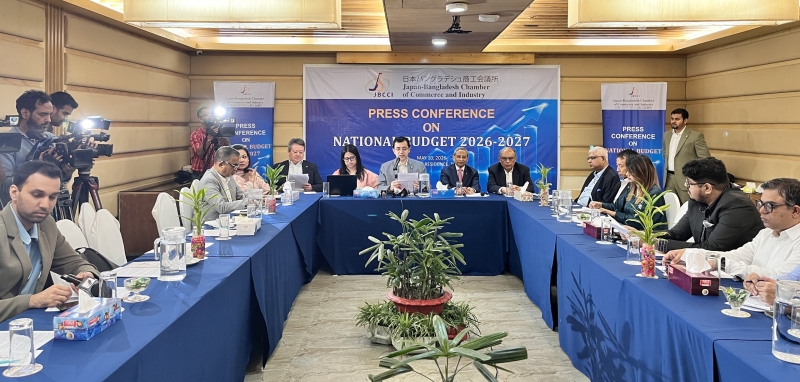
The Japan-Bangladesh Chamber of Commerce and Industry has placed a wide-ranging set of proposals for the national budget for FY 2026–27, urging the government to prioritize investment, industrial competitiveness, fiscal modernization, and sustainable economic growth.
At a pre-budget press conference, the chamber said Bangladesh is currently passing through a crucial economic transition amid global uncertainty, inflationary pressure, higher financing costs, and preparations for post-LDC graduation.
JBCCI leaders stressed that the upcoming budget should focus more on investment-led growth and economic expansion instead of placing excessive emphasis on revenue collection.
One of the key proposals includes reducing the corporate tax rate for the private sector from the existing 25 percent to 20 percent to attract both local and foreign investment.
According to the chamber, many competing economies are offering lower corporate tax rates to encourage Foreign Direct Investment (FDI), while Bangladesh’s comparatively higher tax burden is discouraging industrial expansion and new capital inflows.
The organization also recommended major reforms in the Tax Deducted at Source (TDS) and withholding tax structure. It proposed lowering taxes imposed on suppliers, subcontractors, service providers, rental payments, and foreign service providers.
JBCCI said excessive withholding taxes are creating pressure on business cash flow, increasing working capital shortages, and raising the cost of doing business. It suggested that taxation should mainly be based on net profits rather than advance or minimum tax systems.
The chamber further proposed withdrawing minimum tax obligations for businesses suffering losses, arguing that the current system imposes financial burdens even on struggling companies and weakens business sustainability.
To improve investor confidence, JBCCI emphasized the need for a faster, automated, and time-bound VAT and income tax refund system. Delays in refunds, it said, often block working capital and create liquidity crises for businesses.
In another major proposal, the chamber recommended reducing the standard VAT rate from 15 percent to 7.5 percent and introducing a simplified unified VAT structure to reduce compliance complexity and disputes.
The business body also called for reducing customs duties, regulatory duties, VAT, advance tax, and advance income tax on industrial raw materials, renewable energy equipment, healthcare products, automobiles, steel, cement, and manufacturing inputs.
It said high import duties are raising production costs and hurting export competitiveness, while lower duties would help industrial growth and encourage green and energy-efficient technologies.
JBCCI also sought targeted fiscal support for several major sectors, including ready-made garments, textiles, information technology, pharmaceuticals, construction, agriculture, agro-processing, and healthcare.
The recommendations include lower export source tax, reduced corporate tax rates, VAT exemptions on raw materials and machinery, tax holidays for strategic industries, incentives for sustainable investments, and support for technology adoption and export diversification.
Speaking at the event, Manabu Sugawara highlighted the importance of improving port facilities, simplifying customs procedures at airports and seaports, strengthening road connectivity, and ensuring a stable power supply to attract more foreign investment and support long-term economic growth.