

- Why President Shahabuddin resigned from office |
- President Mohammed Shahabuddin Resigns |
- Experts Call for Better Flood Forecasting, Urban Planning |
- Fakhrul Urges Public to Ignore Resignation Rumours |
- President Shahabuddin Set to Resign Today: Agency |
Citizen Leaders Urge Dedicated Budget for Coastal Protection
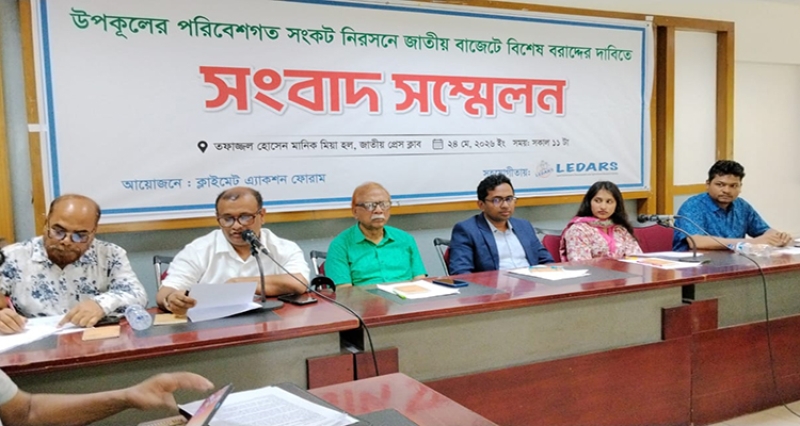
Citizen leaders have called for a dedicated allocation in the national budget to address the mounting challenges facing Bangladesh’s coastal regions, warning that climate change and recurring natural disasters are intensifying risks for millions of people living along the coast.
They said the lives, livelihoods, natural resources, and ecosystems of people across the country’s 19 coastal districts are under increasing pressure due to rising climate threats. Frequent cyclones, tidal surges, river erosion, salinity intrusion, and changing weather patterns have compounded existing vulnerabilities, making long-term and integrated policy interventions essential.
The demands were made at a press conference organised by the Climate Action Forum (CAF) and Leaders at the National Press Club on Sunday. The event was chaired by CAF Convener Aminur Rasul Babul, while the keynote paper was presented by Nikhil Chandra Bhadra, Coordinator of the Sundarbans and Coastal Protection Movement.
The press conference brought together academics, environmental activists, development practitioners, journalists, and representatives of civil society organisations who voiced concerns over the future of Bangladesh’s coastal communities.
Among those who spoke at the event were Sher-e-Bangla Agricultural University teacher Mir Mohammad Ali, former President of Dhaka Reporters Unity Rafiqul Islam Azad, SERAC Bangladesh Executive Director SM Soikat, Bangladesh Poribesh Andolon (BAPA) Joint Secretary Humayun Kabir Suman, Sachetan General Secretary Sakila Parveen, Leaders National Advocacy Coordinator Shakil Ahmed, and Youth Climate Action Forum Convener Sadia Sultan Shapla, among others.
Speakers at the event said Bangladesh is among the countries most vulnerable to the impacts of climate change despite contributing only a very small share to global greenhouse gas emissions. They argued that coastal communities are paying a disproportionate price for a crisis they did little to create.
They noted that climate-induced challenges such as sea-level rise, increasing salinity in agricultural land and freshwater sources, riverbank erosion, and repeated natural disasters are affecting millions of people living in coastal areas. These challenges are not only damaging infrastructure and disrupting livelihoods but are also contributing to poverty, food insecurity, displacement, and health-related problems.
Speaking at the press conference, Assistant Professor Mir Mohammad Ali said Bangladesh’s coastal region is of strategic importance to the country’s economy, food security, fisheries, and biodiversity.
He said the Sundarbans serves as a natural shield for the country against cyclones and storm surges and also plays a critical role in mitigating climate change by absorbing carbon emissions. He further noted that the coastal economy significantly contributes to national development through fisheries and aquaculture industries.
“Shrimp, crab, and marine fish exports contribute substantially to the country’s foreign exchange earnings. Therefore, protecting coastal regions is not merely an environmental issue but also an economic necessity,” he said.
However, he observed that allocations for climate-related programmes in the national budget remain inadequate compared to the scale of the challenges.
He also pointed out that despite repeated discussions about climate adaptation, there remains a lack of separate and targeted planning specifically for coastal regions.
According to the speakers, existing climate-related projects are often fragmented and implemented by different agencies without adequate coordination, reducing their overall effectiveness.
In his presidential remarks, Aminur Rasul said ensuring a special budget allocation for coastal environmental protection and climate adaptation has become increasingly urgent.
He stressed the need for sustainable embankment construction and maintenance, safe drinking water facilities, climate-resilient agricultural practices, improved infrastructure, and expanded social protection programmes for vulnerable communities.
He also highlighted the importance of protecting the Sundarbans and implementing comprehensive disaster-risk reduction strategies.
“Integrated long-term planning is necessary to reduce vulnerability and ensure the safety of coastal communities,” he said.
He called for coordinated efforts involving government agencies, local administrations, civil society organisations, development partners, and local communities to safeguard both people and ecosystems in coastal regions.
At the press conference, organisers presented a 21-point demand charter outlining several policy recommendations and development priorities.
Among the key demands was the establishment of a Coastal Development Board to ensure balanced and coordinated development across the country's 19 coastal districts through stronger inter-ministerial coordination.
The speakers also called for the creation of separate administrative offices for the southwest, central, and southeast coastal regions to ensure more effective implementation of region-specific policies and programmes.
Other demands included declaring highly vulnerable districts such as Satkhira, Khulna, Bagerhat, Barguna, and Patuakhali as climate- and disaster-risk zones.
The proposed measures also included establishing environmentally sustainable economic zones, constructing and repairing durable embankments, ensuring safe drinking water in remote coastal communities, and modernising cyclone shelters to make them more accessible and inclusive for women, children, elderly people, and persons with disabilities.
The speakers further stressed the need for improving healthcare and education facilities in remote coastal areas, promoting alternative livelihood opportunities for climate-affected populations, and increasing investment in research and innovation for climate adaptation.
They argued that stronger community participation should also be incorporated into climate-related planning and implementation processes to ensure sustainable and effective solutions.
The speakers said that while infrastructure development remains important, ensuring long-term resilience requires a broader approach that includes environmental conservation, social protection, and sustainable economic planning.
They warned that without immediate and coordinated action, climate risks in coastal regions could intensify further in the coming years, placing additional pressure on communities and development efforts across the country.
Concluding the event, participants reiterated that protecting coastal regions should be treated as a national priority and reflected more prominently in future budget planning and development strategies.