

- Gridlocks in Bonn sets stage for Antalya showdown |
- Army to be deployed in 6 districts ahead of AL’s founding anniversary |
- UK Prime Minister Keir Starmer quits |
- PM Urges Malaysia to Recruit More Bangladeshi Workers |
Gridlocks in Bonn sets stage for Antalya showdown
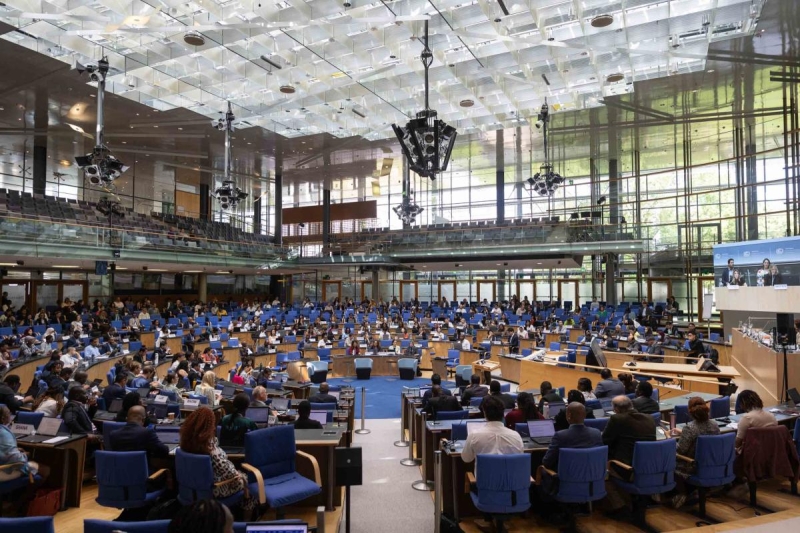
Bonn Climate Talks 2026.
Kuala Lumpur, 22 June (Jinghann Hong) – The conclusion of the Bonn climate talks on June 18, at the 64th session of the UNFCCC’s Subsidiary Bodies (SB64), revealed critical faultlines along among Parties, paving the way for the big showdown in Antalya, Turkiye, at COP 31 to be held in November this year.
Ending just slightly before midnight when the World Conference Centre premises were about to be shutdown, Julia Gardiner (Australia), the Chair of the Subsidiary Body for Implementation (SBI) and Carol Franco (Dominican Republic), the Vice-Chair of the Subsidiary Body for Scientific and Technological Advice (SBSTA), presided over the closing plenary that was held in two parts, with closing statements from Parties delivered first [see highlights below], prior to the gavelling of the conclusions, to allow for more time to unlock the gridlock over three agenda items at the level of heads of delegations [HODs].
The most fractious items were: the Global Goal on Adaptation (GGA), the Sharm el-Sheikh Mitigation Ambition and Implementation Work Programme (MWP) and the Forum on the Impact of the implementation of Response Measures (RM).
According to sources, at the HODs meeting, SBI Chair Gardiner emphasised on the strict time limits and sequenced the consideration of the three disputed agenda items as follows: first, starting with the MWP and consideration of the draft conclusions; the RM draft conclusions as is; and thereafter, consideration of the GGA. However, the Arab Group proposed to address the GGA matter first as a priority giving the rationale that Parties have already engaged on the substance of the draft text and that it is important to continue that and hence, bring it up front for consideration. The European Union [EU] wanted to move on with the MWP and RM items, but the United Kingdom [UK] was in agreement to start with the GGA.
SBSTA Vice-Chair Franco then asked if Parties could accept the GGA draft text as is since there was no further time available to discuss and open it. However, the African Group [AG] underlined that some elements it had been raising were missing in the text and proposed wordings to be added [as regards the work of the technical task force on the Belem Adaptation Indicators]. The SBI Chair Gardiner made clear that there was no time to open the text to which the AG responded that it could not take the draft text as is. The AG’s stance was supported by the Arab Group, South Africa, the Like-Minded Developing Countries [LDMC] and Egypt, while the EU, Canada, Norway, the UK, and the Environmental Integrity Group [EIG] were opposed to the changes proposed. The SBSTA Vice-Chair Franco then announced that because there were objections, there is “no way forward” on the GGA text, thus, inviting the application of Rule 16 of the UNFCCC’s Rules of Procedure.
[Rule 16 provides that “Any item of the agenda of an ordinary session, consideration of which has not been completed at the session, shall be included automatically in the agenda of the next ordinary session.”]
Sources also said that on the MWP and the RM, following intense exchanges, Parties agreed to only procedural conclusions of continuing consideration of these matters at SB 65, with the big fights on substance to continue in Antalya. [More details on these matters will follow in forthcoming articles].
On the whole, among the key flashpoints at the Bonn talks, as evidenced by the statements delivered during the plenary, were over what is the “best available science”; the meanings of the decisions adopted in Belem last year especially in relation to the MWP and its mandate, as well as strong opposition from developed countries in acknowledging their commitments in relation to the provision of finance in the various draft texts proposed over many issues across the board.
Highlights of statements from the closing plenary
Uruguay for the G77 and China, expressed its deep concern with the progress made on the GGA. Emphasising that the GGA is a key priority for developing countries, it highlighted the need for progress particularly on adaptation finance, stressing that the principles of equity and common-but differentiated responsibilities and respective capabilities [CBDR-RC], in light of different national circumstances, are central and should be upheld as the basis for the work.
On finance, it stressed the need to reflect the agenda item on Article 9.1 of the Paris Agreement [PA] viz. the ‘Climate Finance Work Programme’ [CFWP] on the provisional agenda item of CMA 8 [8th session of the Conference of Parties to the PA] and thanked the Brazilian COP 30 Presidency for requesting [the secretariat] for its inclusion in the provisional agenda for CMA 8.
On the ‘Sharm el-Sheikh Joint Work on Implementation of Climate Action on Agriculture and Food Security’ (SJWA), the Group regretted that Parties could not make further advancements, saying that this should move beyond dialogues and reports and translate into effective implementation of climate action. It added that this agenda item must remain focused on agriculture and food security as agreed at COP27, and not on a transformative agriculture approach which was not appropriate for this work.
The G77/China welcomed the selection of the United Nations Environment Programme (UNEP) as the host of the Climate Technology Centre and Network (CTCN) and looked forward to the Financial Mechanism strengthening its linkages with the Technology Mechanism to support the implementation of the Belém Technology Implementation Programme.
On Research and Systematic Observation [RSO], the Group emphasised the importance of science in the deliberations. While it commended the scientific community’s efforts in advancing research and addressing knowledge needs and gaps, it noted that structural research and systematic observation gaps persist in developing countries and urged for the provision of the means of implementation (MOI) to developing countries to urgently address these deficits. It also underlined the importance of the integrity of information on climate change.
On trade and climate, it emphasised that the dialogue should not be a talk-shop, and that it looked forward to a concrete process that builds from one dialogue to the next.
On mitigation, it also reaffirmed its continued commitment to contribute to the ultimate objective of the Convention and the goals of the PA including the temperature goal It also welcomed the progress made during this session under the Just Transition Work Program (JTWP), as well as the successful conclusion of the negotiations of the 5th comprehensive review of the implementation of the framework for capacity-building.
It expressed disappointment and concerns regarding the outcomes of the ‘transparency’ agenda [where developed countries were opposed to acknowledging the lack of funds to support developing countries in this regard.]
China, for the Like-Minded Developing Countries (LMDC) said that that the Party-driven, inclusive, transparent and consensus-building process under the Convention is of great value to progress, and that applies to the design of events, workshops, dialogues as well. It called to stick to mandates as Parties move from negotiations to implementation, the latter of which include mitigation, adaptation, and MOI and international enablers for cooperation, in particular a supportive and open international economic system. As such, it said that a balanced and comprehensive interpretation and implementation of the agreements and outcomes are key for implementation and ambition and that initiatives and controversial issues outside the process should be kept separate from the negotiations, to minimise the risks on the road to Antalya.
Reflecting on the Bonn negotiations, it observed that MOI is “being most contested…in nearly all the negotiating agendas here,” adding that this is an important lesson to draw on from SB64, the LMDC expressed hopes that this will change. Above all, it highlighted that narrowing the North-South development gaps in the just transition is key to closing implementation and ambition gap.
Agreeing with Parties on upholding the science and defending it, the group said that it was important to bear in mind that science and equity are indispensable to each other, adding that climate solutions should be implemented taking into account the social and economic conditions and the disproportionate impacts of climate change, together with disproportionate mitigation burdens faced by developing countries. As such, it emphasised that bringing equity in the underlying assumptions which are currently missing [in the climate scenarios], is therefore highly necessary. As LMDC, it reaffirmed its commitment to ensuring the inclusivity of perspectives on the science of climate change and the integrity of this science.
Ghana, for the African Group [AG] said that it was particularly concerned that some Parties appear to be waiting and positioning themselves for a “big moment” at the second global stocktake [GST-2 in 2028], and reminded Parties that Antalya must set a “solid foundation” for GST-2.
On finance, the AG said that it looked forward to a corresponding agenda item on the PA Article 9.1 work programme on the CMA 8 agenda. On adaptation finance, it stated that Parties cannot delay the ability of the Adaptation Fund [AF] to monetise the proceeds from Article 6.4 [mechanism] and further illustrated this lack of urgency manifesting itself in GGA discussions where tripling adaptation finance, which was also agreed at COP 30, was dealt with resistance by developed countries.
It welcomed the finalisation of the terms of reference for the review of the JTWP at CMA8, though expressing concerns over the limited progress in the operationalising the Just Transition Mechanism (JTM).
Saudi Arabia for the Arab Group regretted that some countries did not honour their historical and legal obligations, in particular for funding the contributions to the AF. On adaptation finance, it expressed disappointment that some countries were reopening certain issues where agreements have already been reached. It also regretted the lack of progress in RSO. It noted that Parties should approach science with objectivity, but that the RSO negotiations was instead characterised by certain levels of selectivity and politicisation, which ultimately undermined the importance given to the needs of developing countries.
Palau speaking for the Alliance of Small Island States (AOSIS) regretted the lack of engagement on finance, relating to the issues of adaptation finance and transparency. It also expressed disappointment with the progress of the MWP and said that it has not effectively delivered on its mandate, and that any continuation of the MWP must therefore be accompanied by “a significant strengthening of the modalities.”
It also stated its deep concern across agenda items to place the 1.5 C limit in doubt and to undermine its policy relevance for this process. It said that these approaches are out of step with the urgency faced to limit the scale and duration of any overshoot. It reaffirmed its priority that all negotiation streams are based on the latest and best available science. Stating that “science is not negotiable,” it regretted that the RSO negotiations resulted in “near-procedural conclusions.” It also rejected the notion that AOSIS was blocking Parties’ engagement on substance, stating that AOSIS itself expected substantive outcomes on the RSO.
On adaptation, AOSIS said that it was extremely disappointed with how GGA negotiations were conducted at SB 64, where negotiators were consistently “given texts with little to no time to engage before informal sessions were meant to begin.” Calling the progress on the AF “sluggish” in light of clean text that is ready to be transmitted on technical mandates, AOSIS urged the SBI Chair and the COP31 Presidencies to proactively engage on political issues that are continuing to prevent full progress on the AF and hindering its ability to monetise share of proceeds when they become available.
Panama for the Independent Alliance of Latin America and the Caribbean (AILAC) said that undermining the Intergovernmental Panel on Climate Change (IPCC)’s integrity and independence is an “obstruction” that the IPCC’s 7th Assessment Report [AR7] must arrive in time to inform GST-2. On finance, it expressed alarm by the decline in contributions from developed countries across all multilateral climate funds and also stated its expectation for the CFWP as an item under the CMA 8 agenda. On the AF, it cautioned that procedural disagreements over access to the share of proceeds must not hold the Fund’s future “hostage”.
It regretted that the MWP did not live up to its purpose as the only space mandated to urgently scale up ambition and called to not “give up” on the MWP as it is not a “lost cause”. AILAC considered Antalya as the opportunity for MWP to deliver substantive outcomes, with regional dialogues as an integral component.
On adaptation, it expressed deep disappointment that no progress has been made because adaptation finance has not advanced, and that the success of the GGA cannot be measured solely through methodological and technical progress, but through conclusions that enable concrete adaptation action.
South Africa on behalf of BASIC countries [Brazil, South Africa, India, China], said that on finance, it insisted on the inclusion of the CFWP on the CMA 8 agenda, to “give the rightful place to this agreed and essential platform to advance implementation and address persistent finance challenges.” To close the adaptation finance gap, BASIC also called on Parties to conclude the transition of the AF at SB 65, including enabling access to Article 6.4 proceeds.
On mitigation, BASIC said that it saw the need to weave together different mitigation elements into a “coherent mitigation package”, balanced “in itself” and balanced “across the outcomes of the COP.” It stressed the need for ambition – in the form of increasing support to implement mitigation -, where developed countries took the lead in mobilising MOI for developing countries. On adaptation, it stressed on the need to at least triple adaptation finance, saying that the GGA is not a “peripheral agenda item”. Calling on Parties to honour what was agreed in Belém, BASIC warned that it could not accept a situation where the most important adaptation agenda is repeatedly advanced through processes that “do not allow for full and meaningful Party engagement.”
On just transitions, it underscored that the Just Transition Mechanism [JTM] must enable access to opportunity and MOI, facilitate practical partnerships, as well as recognize and address international and structural factors – finance, trade, standards, technology access – that shape transition outcomes, to narrow down the North-South development gaps.
On trade and climate change, BASIC countries noted the SBs Chairs’ decision to produce an informal note arising from the dialogues. It said that each dialogue across the cycle [2026–2028] should be reported in turn, building an evolving body of work that fed the 2028 high-level event, rather than relying solely on a single report of that event. It reiterated its strong belief that the dialogue needed “a dedicated, continuing institutional space within the UNFCCC.”
On transparency, it was very troubled by the lack of progress made at SB 64, considering the provision of support for reporting, under the Convention and PA respectively. It pointed out that, “The tone of the deliberations at this session took us back years; we will have to ask some hard questions during the review of the rulebook if these mandates to provide support are not fully implemented, including questions about the sufficiency of current flexibilities.”
Timor-Leste for the Least Developed Countries (LDCs), said that the lack of progress on the GGA and MWP and the weak outcome on the RSO was incredibly worrying. It also regretted that SB64 did not deliver on agriculture, which is the “backbone of LDCs’ economies”. The LDC also shared its frustration at the lack of progress on transparency items, pointing out that LDCs cannot strengthen their capacities and submit their Biennial Transparency Reports (BTR) without the provision of adequate financial and technical support. It also rejected the “blatant undermining of science”, where “science is neither contentious nor negotiable”.
On finance, it said that SB64 showed that “trust depends on delivery” and so COP 31 must “unlock” issues on the AF, including its smooth transition to exclusively serve the PA. It also stressed that the CFWP must be placed on the provisional agenda of CMA 8, grounded in Article 9.1 and climate finance delivery. On mitigation, the LDCs said that its expectation was to have strengthened outcomes on the continuity of the MWP to scale up mitigation ambition and implementation, complementing the outcome of the GST-1.
It welcomed the progress on just transition that would be forwarded to Antalya, and said that work must commence immediately to strengthen the JTWP and operationalise a LDC-responsive JTM at COP31. On technology, the LDC welcomed UNEP as the host of the CTCN and called for progress on the Belém Technology Implementation Programme.
Bhutan, for the Landlocked Developing Countries (LLDCs) Group welcomed the agreement on the Terms of Reference for the review of the JTWP and the advancement of discussions on the operationalisation of the JTM, emphasizing that just transition pathways must respond to LLDCs’ structural realities. As such, international support arrangements and implementation frameworks must therefore adequately reflect the special circumstances and development challenges of LLDCs.
Kyrgyzstan for the Mountain Group welcomed the dialogue on mountains and climate change and the progress achieved under the Nairobi Work Programme, especially regarding adaptation challenges in mountain regions and the commitments to closing knowledge gaps. It recalled its request at the tenth meeting of the Paris Committee of Capacity Building to integrate a specific capacity gap on mountainous regions – including glacial monitoring, disaster risk reduction, water security, access to climate finance, and technology transfer – and called for the explicit recognition of the unique vulnerabilities faced by pastoralists and farming communities in high altitude areas, dealing with water degradation and severe water stress.
Argentina for the Group SUR [Argentina, Ecuador, Paraguay, and Uruguay] said that it was necessary to increase the openness and flexibility in negotiations to overcome the points of divergence that still remain outstanding and stressed the requirement for adequate implementation measures that guarantee real access to funding, transfers of technologies and capacity building. Particularly in agriculture, Group SUR said it was in favour of broadened funding based on grants and concessional finance, stressing that it is important for this agenda to focus on food security.
Cyprus for the European Union (EU) said that Parties’ focus now should be on effective implementation to keep 1.5 within reach, and limit overshoot to the minimum adding that the credibility of negotiations rests on the best available science provided by the IPCC, and so affirmed its commitment to ensure the timely delivery of the AR7 as set out by the IPCC co-chairs’ timeline. The EU said, “Scientific integrity must remain non-negotiable. While we are here to negotiate positions, we cannot allow science to be politicised, delayed or obstructed. In the context of the climate emergency, defending the integrity of information is fundamental to the very foundation of multilateralism.”
As or implementation of GST-1 outcomes, the EU said that ambitious nationally determined contributions [NDCs] are essential to closing both the vision, ambition, and the implementation gaps, and to keeping 1.5 within reach. In paving the way for GST-2, the EU underlined that “the cost of inaction is much higher than the cost of ambitious action.”
On finance, the EU reiterated its commitment to the implementation of the New Collective Quantified Goal (NCQG), adding that this “clearly includes the commitment under Article 9.1 [of the PA].” Recognising the urgent need to scale up finance from all sources, the EU said it was “proud to have delivered over and above the US$100 billion goal in 2025.” It therefore looked forward to engaging in the ‘Veredas Dialogue’ and through continuous regulatory reform, to ensure that finance flows contribute to the limiting temperature rise to 1.5 C and strengthening resilience.
It also recalled that effective climate action should be implemented in a manner that respects, protects and promotes human rights, while advancing gender equality and the empowerment of women and girls in all their diversity.
Switzerland, for the Environmental Integrity Group (EIG) emphasised that science has been the foundation on which this [UNFCC] process was built, and it remains the compass by which Parties must navigate it. It was concerned by what is said were efforts to question, delay, or weaken the role of science in informing the work. It urged all Parties to support the proposed timeline of the IPCC co-chairs so that the delivery of the next IPCC reports can inform GST-2, and provided assurances that the reports produced on the schedule will meet high standards, adhere to the IPCC rules and procedures, and provide the best available scientific knowledge to the world.
The UK, for the Umbrella Group (UG), reminded Parties of the need to “accelerate collective climate action to keep 1.5 in reach,” given the beginnings of El Nino against the backdrop of increasing global warming. In that, the UG said that “climate action must always be guided by the best available science,” expressing disappointment with the RSO outcomes. It said that it was concerned that “some Parties find it difficult to acknowledge the findings from the world’s leading climate scientists [from the IPCC]”, where the IPCC was the “global authority” on climate science and the “most robust source” of scientific information to inform global climate action.
Articulating the need to strengthen the “mitigation architecture”, the UG regretted that the GST NDC dialogues has now concluded and said that it looked forward to either reviving this space or finding a new avenue to discuss NDC preparation and implementation.
On finance, the UG emphasised its commitment to the delivery of the NCQG and its role in taking the lead in the delivery of the ‘at least US$300 billion goal’ by 2035. It also said that it would “continue to play our part in efforts to at least triple adaptation finance by 2035, in the context of the NCQG.” On the CFWP, it welcomed the “work underway” and encouraged SB Co-chairs to continue engaging with Parties on the way forward, “consistent with the legal interpretation of the mandate from COP 30.” It also said that it looked forward to the first meeting of the Xingu Finance Talks [under the Veredas Dialogue on Article 2.1(c)] where all relevant stakeholders are to be brought into this process.
On the issue of science, India agreed that climate science is essential to inform and guide climate action, but it cannot dictate the “top-down message” and instead must “draw inclusively from the lived experiences of Parties’ regions and communities”. It stressed that “when science turns to the implementation of climate action, this is particularly important – as science must be informed by equity and CBDR-RC in an integrated action.” Advocating that “equity cannot be an afterthought”, India observed. It also said further that SB 64 highlighted that implementation cannot be achieved through ambition alone, and that MOI must move from “promise to practice”. Otherwise, it cautioned that the gap between outcome and collective action will continue to widen. - Third World Network