

- Security, sacrifice or opportunity: Climate action visions differ |
- Four New Subjects to Join Curriculum From 2027 |
- Strong children mean a stronger Bangladesh: PM |
- UK All-Party Parliamentary Group on BD Meets Humaiun Kobir |
- World Bank Keeps Bangladesh FY27 Growth Forecast at 3.4% |
Landslide Deaths: Rohingya Refugees Pay For A Warmer Climate
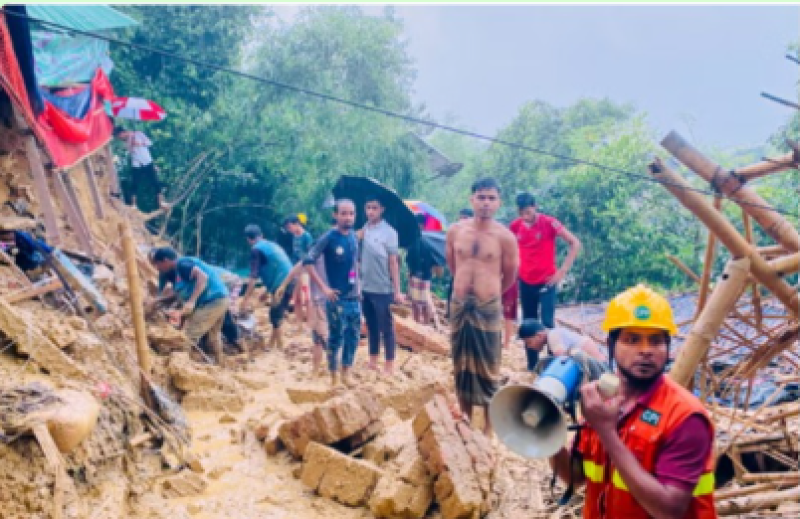
Deadly landslides at Rohingya Refugee Camp at Coxs Bazar killed 19 refugees.
GreenWatch Desk
The early July landslides that killed 19 Rohingya refugees in Cox’s Bazar were not isolated tragedies. They were the latest, and most violent, manifestation of a crisis shaped by overcrowded camps, deforested hillsides, shrinking humanitarian budgets, and a global climate system destabilised by what experts warn may be a record breaking El Niño. Together, these forces have turned the world’s largest refugee settlement into a landscape where every monsoon threatens to become a mass casualty event.
Between July 4 and July 9, the Rohingya Coordination Platform recorded 286 weather related incidents across the camps, including 95 landslides that displaced 4,307 people and damaged thousands of shelters and essential facilities. The death toll climbed rapidly: first eight people on July 6, then nine more on July 7, and finally the catastrophic collapse in Camp 5 on July 8 that killed seven students and a teacher. UNICEF mourned the deaths of four girls in the same period, calling the back-to-back emergencies “a terrible reminder of the severe risks the monsoon season poses to children and families living in extremely vulnerable conditions.” These losses are not random. They are structural.
When the Rohingya arrived en masse in 2017, fleeing military persecution in Myanmar, Bangladesh responded with urgency — carving shelters into steep, deforested hills to accommodate more than a million people. But the emergency design became permanent by default. As one civil engineer working in water, sanitation, and hygiene explained, “the camps were made by cutting hills and without planned drainage systems.” Years later, the consequences are deadly. The shelters — bamboo frames wrapped in tarpaulin — cling precariously to slopes that have lost their natural vegetation. Without roots to hold the soil, the hillsides behave like loose sand under heavy rain. The engineer added that sustainable landslide prevention work, especially brickwork and slope stabilisation, has become nearly impossible due to funding cuts and restrictions on permanent construction. Bangladesh’s government fears that durable structures may signal long term settlement, a political red line. The result is a fragile environment where even moderate rainfall can trigger cascading failures: collapsing slopes, falling trees, blocked drainage channels, and mudflows that sweep through shelters at night while families sleep.
The statistics are stark, but the human stories are devastating. One Rohingya father, who arrived in Bangladesh in August 2024, lost two daughters and two grandchildren on July 6. Because new arrivals are not allocated formal shelters, he had built a makeshift home on the edge of a hill — one of the few spaces available. “I didn’t know the hill would collapse like this,” he said. His tragedy underscores a growing pattern: newly arrived refugees are forced into the most dangerous parts of the camps. Another refugee, Ali Ahmed, told Reuters that his parents and younger brother were buried alive while sleeping. “We fled Myanmar in 2017 to escape persecution. Now I’ve lost my family here too,” he said. His grief captures the cruel irony of displacement: the search for safety can lead to new forms of danger.
Aid workers say that even after landslides, many refugees refuse relocation. The fear of losing their shelter — a scarce and precious asset — outweighs the fear of environmental risk. One humanitarian worker described seeing a half-collapsed house leaning into another in Camp 18, yet being unable to convince residents to move. Temporary relocation sites, often learning centres or child friendly spaces, lack privacy, adequate sanitation, and basic services. Families worry about overcrowding, gender-based risks, and the indignity of communal living. As one aid worker put it, “We repeatedly raise awareness, but we can’t move many people who are at risk.”
The humanitarian system supporting the Rohingya camps is under severe strain. The Shelter and Camp Coordination and Camp Management appeal is only 42 percent funded, leaving a US$73.9 million gap. The disaster risk management plan faces another US$23.2 million shortfall. These cuts have halted critical projects, including the reconstruction of 50,000 shelters and the rollout of semi-permanent and two story shelter models approved in late 2024. The forest department and local communities have also objected to permanent structures, citing concerns about deforestation and long-term settlement. Human Rights Watch argues that shelter safety must be treated as a human rights issue, not a political concession. “Every monsoon is becoming increasingly deadly,” said Meenakshi Ganguly, HRW’s deputy Asia director. “These are not simply natural disasters, but a predictable outcome of policies that put refugees’ lives at risk.” The Rohingya Coordination Platform has called for immediate funding for slope stabilisation, drainage, watershed management, access improvements, and technical capacity — all essential to prevent further deaths before the monsoon ends in October.
Children make up more than half of the Rohingya population, and they are disproportionately affected by extreme weather. The July landslides destroyed learning centres, damaged water and sanitation facilities, and disrupted education for thousands. Save the Children warned that the deaths of students in the July 8 landslide are “a devastating reminder of the dangers children in the Rohingya camps face when extreme weather strikes.” Continued rainfall threatens further landslides, worsens shelter conditions, and increases exposure to dengue, cholera, and diarrhoea. UNICEF emphasised that children must continue to access critical services — healthcare, clean water, psychosocial support, and education — even during emergencies. But with damaged infrastructure and shrinking budgets, maintaining these services is becoming increasingly difficult.
The July disasters unfolded against the backdrop of what experts warn may be the strongest El Niño on record. Tim Stockdale of the European Centre for Medium Range Weather Forecasts said he expects the event “to break records,” raising global concerns about droughts, floods, and extreme weather. Bangladesh is already feeling the effects. Senior meteorologist Dr. Md. Bajlur Rashid noted that June rainfall was 40 percent below normal, increasing drought risk — yet rainfall is also becoming more erratic, arriving in fewer but more intense downpours. These bursts of heavy rain are precisely the conditions that trigger landslides in Cox’s Bazar. El Niño is also expected to worsen heatwaves, groundwater stress, drinking water shortages, and electricity demand. For a refugee population living in exposed shelters with limited water access, these pressures compound existing vulnerabilities. Climate specialists warn that Bangladesh’s challenge will be balancing drought preparedness with flood management — a complex task even for stable environments, let alone densely populated refugee camps built on unstable terrain.
Renewed fighting in Myanmar’s Rakhine State between the military and the Arakan Army has already pushed 152,000 new arrivals into Bangladesh since late 2023. Planning figures for 2025 anticipated only 50,000. The government has not yet approved UNHCR’s request for additional land, forcing new arrivals into already congested areas. Bangladeshi authorities are monitoring the border amid reports of people gathering near the frontier. If more refugees flee, the pressure on the camps — and the risks — will intensify.
The July landslides are a warning. Without urgent action, more lives will be lost. Human Rights Watch, UNICEF, Save the Children, and the Rohingya Coordination Platform all converge on the same priorities: fund safer shelter models and allow disaster resistant construction; expand relocation sites and improve privacy and sanitation; stabilise slopes and restore drainage systems; increase anticipatory action and early warning systems; provide additional land to reduce overcrowding; rebuild learning centres and protect children’s access to education; and strengthen climate resilience in the face of extreme El Niño impacts. As Ganguly noted, “Concerned governments need to act instead of waiting for the next landslide to sweep away another Rohingya family.” The monsoon season has just set in. The climate system is becoming more volatile. And the refugee population continues to grow. Without decisive intervention, the tragedies of early July may be only a prelude to what lies ahead.
From the GreenWatch Print Edition, July 2026.