

- A New Arms Race is Threatening to Take-off—Now in Outer Space |
- Equality ‘ends at doors of Security Council’, Kenya’s Ruto at UNGA |
- কলাপাড়ায় প্রাথমিক শিক্ষায় হ-য-ব-র-ল |
- BDRCS and IFRC scale up dengue response to reach 300,000 people |
- World leaders approve new declaration to tackle rising sea levels |
Climate Change Vanish Sacred Ice in Kashmir, Loss of Livelihoods feared
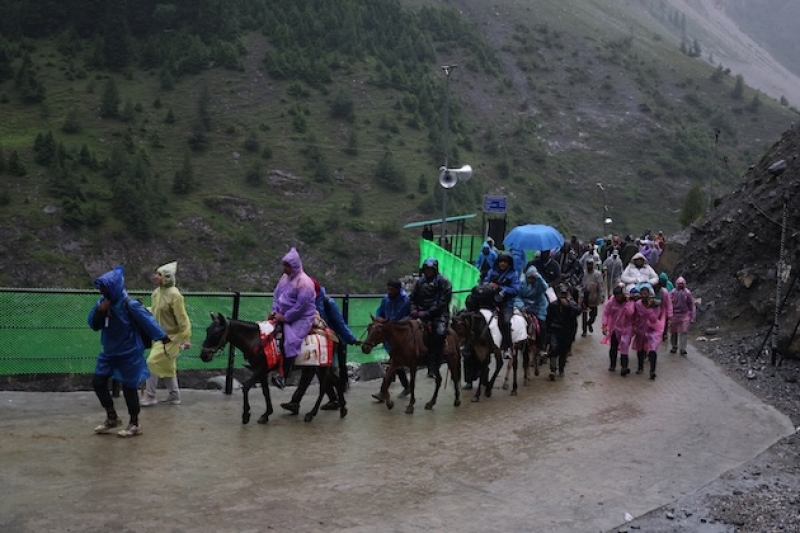
Pilgrims, accompanied by pony operators and porters, continue their journey along the Baltal route during rain on the annual Amarnath Yatra in Jammu and Kashmir in July 2026. Credit- Umar Manzoor Shah-IPS
By Umar Manzoor Shah
SRINAGAR, India, Aug 4 2026 (IPS) - Every summer, before dawn breaks over the Himalayas, Bashir Ahmad leads his horses onto the narrow mountain trail that winds toward the Amarnath cave shrine. For decades, the annual Hindu pilgrimage has been the most important season of the year for his family. The money earned over two months pays for food, school fees, winter supplies, and the upkeep of his animals through the long snowbound months.
This July, however, Ahmad watched pilgrims descend the mountain with tears in their eyes. Many had reached the cave only to discover that the sacred ice formation they had journeyed hundreds of kilometres to see was almost completely melted.
“They come expecting to see Baba Barfani,” said Ahmad, referring to the naturally formed ice stalagmite revered by millions of Hindus as an earthly manifestation of Lord Shiva.
“When they hear it has melted, many decide not to continue, or they return quickly. If fewer pilgrims come, we lose everything.”
For centuries, the Amarnath cave, hidden among the rugged peaks of Kashmir, has stood as one of Hinduism’s most sacred pilgrimage sites. Each year, water dripping from the cave’s limestone ceiling freezes into an ice column that devotees worship as the Shivling.
This year, however, the ice formation melted by more than 90 percent within five to six days of the 57-day pilgrimage that began on July 3. What pilgrims found instead was little more than water dripping onto exposed rock.
The rapid disappearance has exposed how climate change is threatening the fragile economy that supports thousands of Muslim families living along the pilgrimage routes.
For generations, Kashmir’s Muslims have formed the backbone of the Amarnath pilgrimage. Pony handlers transport elderly pilgrims over steep mountain paths. Porters carry luggage and children across dangerous terrain. Tent operators build temporary camps at high altitude. Shopkeepers sell tea, raincoats, walking sticks, medicines, and food.
Many depend almost entirely on the pilgrimage for their yearly income.
“Our entire year depends on these weeks,” said Mushtaq Ahmad, who operates temporary accommodation near the route.
“Politics, security, or bad weather can already affect business. Now the climate has become another uncertainty, and this one is impossible to predict.”
Scientists say the melting reflects broader changes occurring across the Himalayas, one of the world’s fastest warming mountain systems.
“The region has experienced increasingly erratic winters, reduced snowfall, prolonged dry spells, and rising temperatures. Without sufficient snow accumulating during winter, the cave receives less natural insulation, making it increasingly difficult for the ice formation to survive through the summer pilgrimage,” says Delhi-based earth scientist Zahid Shafiq.
He also pointed to local factors that may be accelerating melting inside the cave itself.
“Thousands of pilgrims enter the enclosed shrine every day during the Yatra. Their collective body heat, combined with emissions from diesel generators, community kitchens, and expanding infrastructure projects in the region, can alter the cave’s delicate microclimate,” Shafiq told IPS.
Indigenousrights focus
The result has been a dramatic shortening of the Shivling’s lifespan. Historical records indicate that the ice formation remained visible through much of the pilgrimage until recent years. It disappeared after 29 days in 2018, survived only 28 days in 2022, and lasted just seven days in 2024. This year’s disappearance within less than a week is the fastest known collapse.
For pilgrims, meanwhile, the loss is deeply upsetting.
Ramesh Kumar, who travelled from the northern Indian state of Uttar Pradesh, spent two days trekking through difficult mountain terrain after preparing physically and financially for months.
“We kept chanting all the way. When we finally entered the cave, there was almost nothing left. It felt heartbreaking,” he said.
Although the Shri Amarnathji Shrine Board [a governing body managing the affairs of the pilgrimage] has stressed that the pilgrimage remains spiritually significant regardless of the presence of the ice formation, many devotees consider witnessing the natural Shivling the defining moment of the journey.
As images of the melted shrine spread across social media, uncertainty has begun affecting travel plans for future pilgrims.
For those working on the mountain, fewer visitors mean immediate financial consequences.
Along the winding trails from the pilgrimage route, horses usually carry thousands of pilgrims each day. Owners spend heavily before the pilgrimage begins, paying registration fees, veterinary examinations, transportation expenses, and expensive fodder for their animals.
Those investments become difficult to recover if visitor numbers decline. “We borrow money every year to prepare. If pilgrims stop coming halfway through the season, the debts remain but the earnings disappear,” Ahmad said.
Weeks before the pilgrimage, workers haul iron frames, bedding, blankets, cooking equipment, and supplies high into the mountains. These seasonal settlements require substantial investment before the first pilgrim arrives.
“We expected people for nearly two months. Nobody imagined the main attraction would disappear so early,” Mushtaq, who operates temporary accommodation, told IPS.
Twenty-two-year-old university student Aamir, who runs a tea stall near the upper stretches of the route during his summer break, said sales dropped sharply after news spread about the melted Shivling.
“We stocked everything expecting thousands of customers every day. Instead, many people come down quickly after visiting the cave. They are not stopping to buy tea or food anymore,” he said.
The crisis has revived difficult questions about balancing religious tourism with environmental protection.
Jammu and Kashmir Chief Minister Omar Abdullah recently acknowledged that while authorities regulate pilgrim numbers under Supreme Court guidelines, the melting itself reflects broader environmental changes beyond immediate government control.
Environmental groups argue that stricter limits on daily pilgrim numbers and greater caution toward infrastructure projects such as tunnels and proposed ropeways are necessary to protect the fragile Himalayan ecosystem.
Reducing visitor numbers could ease pressure on the environment. At the same time, fewer pilgrims would directly reduce incomes for thousands of Kashmiris whose livelihoods depend on the annual pilgrimage.
“The pilgrimage has long represented something rare in Kashmir, a region often associated internationally with political conflict. Every summer, Muslim workers guide, feed, transport, and care for Hindu pilgrims undertaking one of their faith’s holiest journeys,” says Sunil Kumar Pandith, an author who is writing a book on the historical significance of the pilgrimage.
For pilgrims, the melting Shivling raises painful questions about the future of a sacred tradition rooted in nature itself.
For workers like Bashir Ahmad, it threatens the financial foundation of entire households.
Standing beside his horses as another group of pilgrims descended the mountain, Ahmad said he worried less about this season than the years ahead.
“If this keeps happening,” he said, “people may stop coming altogether. Then what will become of us?”
In the mountains of Kashmir, where faith and survival have long travelled the same narrow paths, the disappearing ice is seen as a warning that climate change is already transforming lives, traditions, and livelihoods once thought as permanent as the Himalayan peaks themselves.
IPS UN Bureau Report