

- Nearly Half of Bangladesh’s Families Are in Debt: BBS |
- Bangladesh Seeks Details on Execution of Two Nationals |
- Former Bangladesh Air Force Chief Arrested in Qatar |
- PM stresses discipline, professionalism, public trust in armed forces |
What happens if the Strait of Hormuz crisis never ends?
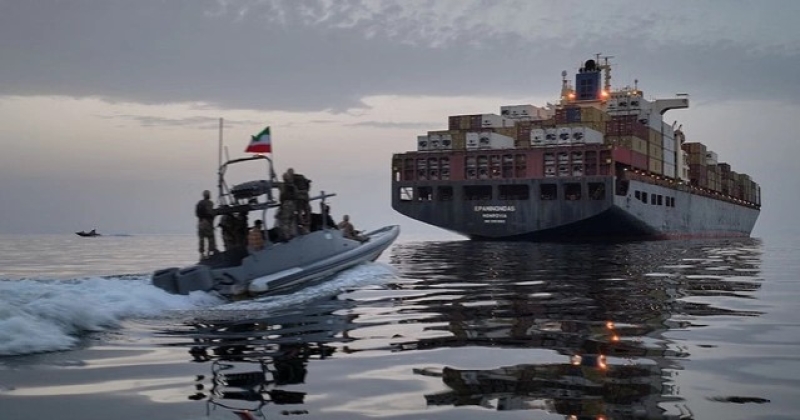
An Iranian speedboat approaches the cargo ship during what state media described as the seizure of one of two vessels accused of violations in the Strait of Hormuz. Agency
For months, governments, companies, and financial markets viewed the disruption in the Strait of Hormuz as a short-term crisis that would eventually be resolved through diplomacy or a reduction in military tensions.
Moody’s Ratings is now warning the world may need to think differently.
In a new report, the ratings agency said the disruption to one of the world’s most important energy shipping routes is increasingly looking less like a short-term shock and more like a structural risk that could reshape global trade, energy markets and economic planning well beyond 2026.
“Global shipping routes are being structurally rewired,” Moody’s said. The agency said countries are increasingly turning to non-Gulf suppliers, alternative pipeline routes and regional trade systems to reduce reliance on the Strait.
The warning marks a shift in tone from earlier assessments that viewed the crisis mainly as a temporary supply disruption, reports Gulf News.
“We now have a single, central scenario which assumes a prolonged and significant disruption to the Strait of Hormuz through autumn,” Moody’s said.
Strait still vital to the world
The Strait of Hormuz handles around one-fifth of global crude oil and liquefied natural gas flows, making it one of the world’s most critical trade chokepoints.
But shipping through the route has fallen by more than 90 per cent from pre-conflict levels as insurers raise premiums, shipping companies avoid the area and concerns over sea mines continue to disrupt navigation.
The conflict itself may dominate headlines, but Moody’s said the larger issue is what happens if the disruption simply drags on for months.
That could mean permanently higher shipping costs, more expensive energy, slower trade flows and new supply chain strategies as companies and governments adjust to prolonged instability in the Gulf.
Higher oil prices now a norm?
Moody’s now expects Brent crude prices to remain between $90 and $110 a barrel for much of this year, significantly above earlier expectations.
For consumers, that could mean prolonged pressure on fuel prices, airfares, transport costs and inflation. “Persistently higher energy prices will lead to increases in inflation and production costs, limiting household purchasing power,” Moody’s said.
The agency warned that even if a ceasefire or political agreement is reached, a return to normal conditions would still take time because shipping backlogs, tanker repositioning and insurance systems would need months to stabilise.
The report also suggested that some changes triggered by the crisis may not reverse at all. “Some structural shifts in supply chain design, risk premiums and defense spending will probably be permanent,” Moody’s said.
Airlines, manufacturing risks
Industries that rely heavily on fuel and transport are among the sectors most exposed if elevated oil prices continue.
Moody’s identified airlines, chemicals and building materials companies as facing the “most acute pressure” because of high operating costs and limited ability to pass rising expenses onto customers.
Consumer sectors including retail, hospitality and manufacturing could also come under strain if households reduce spending in response to higher living costs.
“Airlines, building products and chemicals face the most acute pressure,” Moody’s said. At the same time, some sectors could benefit from the changing environment.
Energy producers outside the Gulf region and aerospace and defence companies are expected to gain from higher oil prices and increased geopolitical tensions.
Asia faces the biggest challenge
The report said Asian economies remain among the most vulnerable because of their dependence on Middle Eastern energy imports.
India was identified as one of the most exposed major economies because around 46 per cent of its crude oil imports come from the Middle East.
Japan and South Korea were also described as highly vulnerable despite holding large emergency reserves, while China could face pressure on industrial profitability even with state-controlled pricing and large stockpiles.
“At sustained Brent prices of $90–$110/bbl, we estimate real GDP growth reductions of 0.2–0.8 percentage point for several major economies,” Moody’s said.
Crisis world may have to adapt to
Perhaps the biggest message from the Moody’s report is that the global economy may no longer be waiting for the Strait of Hormuz crisis to end quickly.
Instead, governments, businesses and investors are increasingly preparing for the possibility that disruption, higher costs and geopolitical risk in one of the world’s most important trade routes could become part of the global economic landscape for the foreseeable future. - Agencies