

- Global trade reaches record $35 trillion despite conflicts |
- Attack on Riyadh airport kills 12, injures over 300: Saudi |
- Dhaka ranks 6th most polluted city |
- El Niño Could Threaten 347 Million Children Worldwide |
- PM Assures Support for Waste-to-Fuel Technology |
Russian Strikes on Kyiv Kill 21 in Major Assault
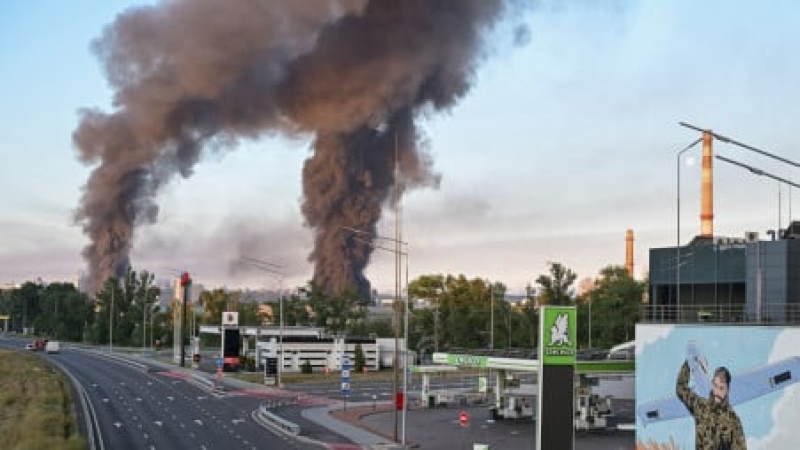
At least 21 people were killed and more than 90 injured after Russia launched one of its largest missile and drone attacks on Kyiv early Thursday, Ukrainian officials said.
The overnight assault involved hundreds of drones and dozens of missiles, causing widespread destruction across the capital. Multiple explosions rocked central Kyiv throughout the night as thousands of residents rushed to bomb shelters and underground metro stations. Thick smoke rose across the city skyline.
Officials said around 130 buildings were damaged, including residential complexes, research facilities and public infrastructure, making it one of the most destructive attacks on the capital in recent months.
Ukrainian President Volodymyr Zelenskyy cut short his visit to Ireland and returned to Kyiv following the attack.
He later visited one of the hardest-hit sites on the city’s left bank, where a nine-storey residential building was partially destroyed.
Zelenskyy said delays in promised military aid, particularly air defence systems, had worsened the scale of destruction.
“If our partners had delivered on their promises in a timely manner, more homes and lives could have been saved,” he said.
In his nightly address, Zelenskyy said rescue teams were still searching through the rubble for survivors and warned that strengthening air defences must be a top priority at next week’s NATO summit in Turkey.
Ukraine’s air force said Russia launched 74 missiles and 496 drones overnight. Air Force spokesperson Yuri Ihnat said the number of ballistic missiles was unusually high, while interception rates were lower than usual due to shortages of key air defence systems.
Russia’s Defence Ministry said the strikes targeted military, energy and airport facilities in Kyiv and other locations using long-range precision weapons and drones.
Moscow described the attacks as retaliation for recent Ukrainian drone strikes on Russian territory.
Ukraine, which has intensified strikes on Russian energy infrastructure in recent weeks, said it targeted an oil refinery overnight in Russia’s Nizhny Novgorod region.
The Kremlin said President Vladimir Putin had been briefed on the operation and that Russia would continue pressing toward its military objectives.
Kyiv Mayor Vitali Klitschko declared Friday a day of mourning for the victims.
He said damage was reported across much of the city, with several residential buildings suffering severe destruction.
Among the damaged facilities was the National Institute of Biochemistry, where laboratories and offices were heavily damaged.
“This is a catastrophe for medical and biological science in Ukraine,” biologist Yurii Danylovych said.
The attack also prompted security responses in neighbouring countries. Poland briefly scrambled fighter jets as a precaution, while Finland temporarily imposed aviation restrictions in parts of its eastern airspace.
The latest strike came as pressure mounted for stronger international action against Moscow.
EU foreign policy chief Kaja Kallas called for additional sanctions targeting Russia’s military-industrial sector.
“The more Moscow attacks civilians, the more sanctions must follow,” she said.
United Nations Secretary-General António Guterres also condemned the attacks, describing them as part of a deadly pattern of strikes on densely populated areas.
Despite ongoing diplomatic efforts, including renewed calls for peace talks, the war continues to intensify with no immediate breakthrough in sight.