

- PM Seeks Japan’s Help to Build Technology, Innovation Hubs |
- Bangladesh Plans Bonded Warehouse Reforms to Diversify Exports |
- Dhaka ranks 4th among world's most polluted cities this morning |
- Lula re-elected Brazilian president in runoff |
- PM arrives in Tokyo on four-day state visit to Japan |
Sudan War Nears 1,000 Days as Hunger and Violence Soar
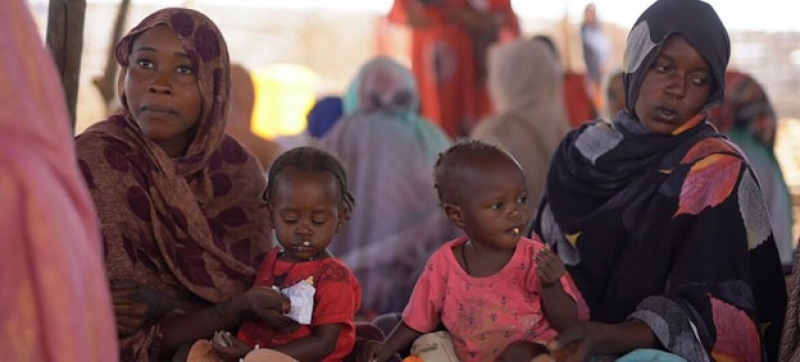
Two malnourished children receive food supplements at a health centre in Tawila, North Darfur, Sudan.
As Sudan approaches 1,000 days of civil war, late December and early January saw a brutal escalation of violence, with drone strikes hitting areas at the centre of the country’s deepening hunger crisis.
While the Rapid Support Forces (RSF) advance across western and southern Sudan, and the Sudanese Armed Forces (SAF) tighten control over the east and the capital, civilians face a high risk of being caught in the crossfire. Thousands have been displaced directly by the violence, humanitarian access remains severely constrained, and most civilians are unable to access basic essential services.
In late December, the International Rescue Committee (IRC) released its annual Emergency Watchlist report, outlining humanitarian crises in 20 countries and identifying those at greatest risk of deteriorating conditions in 2026. For the third consecutive year, Sudan topped the list, with the IRC describing the situation as the “largest humanitarian crisis ever recorded”, as well as the world’s largest and fastest-growing displacement crisis.
“This crisis is entirely man-made,” said Eatizaz Yousif, IRC country director for Sudan. “The ongoing conflict has decimated livelihoods, displaced millions, and blocked life-saving aid from reaching those in desperate need.” According to IRC estimates, roughly 150,000 Sudanese civilians were killed in 2025—a figure expected to rise in the new year as fighting intensifies and collapsing emergency services struggle to meet rapidly growing needs.
The first week of 2026 has been particularly turbulent for besieged civilians. Between January 1 and 3, multiple drone strikes hit Dilling in South Kordofan, causing numerous civilian deaths and injuries and triggering widespread panic among residents.
On January 3, drone strikes targeted a market and a medical clinic in the villages of Al Zurg and Ghurair in North Darfur—described by the United Nations as the “epicentre of Sudan’s hunger crisis”—causing extensive damage. On the same day, two drone attacks struck the Kulbus locality in West Darfur, displacing more than 600 civilians.
According to the International Organization for Migration (IOM), more than 1,000 civilians were forced from their homes between December 31 and January 4, fleeing to South Kordofan due to violence. On January 6, brutal clashes between warring parties caused over 2,000 civilians to flee North Kordofan in a single day.
Conditions for displaced civilians in North Darfur remain extremely dire. The IRC has highlighted widespread lack of access to basic services, as around 400,000 families fleeing violence in neighbouring El Fasher have arrived in Tawila, overwhelming already stretched humanitarian capacity. Many are living in makeshift shelters without adequate food, clean water, or healthcare. IRC teams have also reported more than 170 young children in Tawila separated from their families, underscoring severe protection risks.
“The sight of these small children arriving alone, without knowing the whereabouts or fate of the rest of their families, is harrowing,” said Arjan Hehenkamp, the IRC’s Darfur crisis lead. “Extremely disturbing reports and satellite imagery confirm that people are unable to flee El Fasher to safer areas like Tawila, meaning they are trapped, detained, or worse.”
On December 29, the United Nations Children’s Fund (UNICEF) conducted a nutritional assessment in Um Baru locality in North Darfur—one of the regions hardest hit by conflict and food insecurity—and found that 53 percent of nearly 500 children screened showed signs of acute malnutrition, many of them under the age of five. Eighteen percent were suffering from severe acute malnutrition, a condition that can be fatal within weeks if left untreated.
“When severe acute malnutrition reaches this level, time becomes the most critical factor,” said UNICEF Executive Director Catherine Russell. “Children in Um Baru are fighting for their lives and need immediate help. Every day without safe and unhindered access increases the risk of children growing weaker, and of death and suffering from entirely preventable causes.”
According to estimates by the Integrated Food Security Phase Classification (IPC), about 21.2 million people across Sudan—nearly half the population—are experiencing high levels of food insecurity. More than 3.7 million children under five, along with pregnant and lactating women, urgently require treatment for acute malnutrition. Famine was officially declared in El Fasher and Kadugli in November, with experts warning it could spread to 20 additional localities across Darfur and Kordofan.
In late December, the Food and Agriculture Organization (FAO) announced a large-scale seed distribution campaign to support winter cultivation and address Sudan’s worsening hunger crisis. Launched in Khartoum in November, the initiative aims to strengthen local food production and reach more than 134,000 households—around 670,000 people—across ten states.
Targeted households will receive a range of vegetable seeds, including eggplant, green pepper, jute mallow, okra, onion, pumpkin, rocket, snake cucumber, tomato, and zucchini. The campaign seeks to restore dietary diversity, improve nutrition, and revive livelihoods—critical in a country where nearly 80 percent of the population depends on agriculture for food and income.
Meanwhile, the UN and its partners continue working on the ground to support vulnerable civilians. In Khartoum, the United Nations Development Programme (UNDP) is removing debris, distributing medicines, creating short-term employment opportunities, and providing psychosocial support.
In late December, UNDP and the UN Secretary-General’s Peacebuilding Fund launched a programme titled Strengthening Capacities for Peace and Social Cohesion in Kassala and Red Sea States, in partnership with UNICEF. The initiative aims to promote gender equality, social cohesion, youth engagement, equitable governance, and sustainable livelihoods.
“During the war, many of us felt hopeless, but being part of this group gave me purpose,” said Khawla, a youth ambassador from Kadugli trained under the programme. “When I see young people listening, asking questions, and beginning to believe peace is possible, I know our work matters. It’s not just about awareness—it’s about restoring trust and rebuilding our communities from the ground up.”