

- ECNEC Approves 8 Projects Worth Tk 2,266 Crore |
- No Plan to Drop Bangla, History from Honours: Milon |
- Global turmoil shadows Bonn climate talks |
- Dhaka's air quality recorded ‘moderate’ Tuesday morning |
- Court seeks Interpol red notices for 2 fugitives in Tonu killing |
US Launches ‘Most Intense’ Strikes as Iran Vows Response
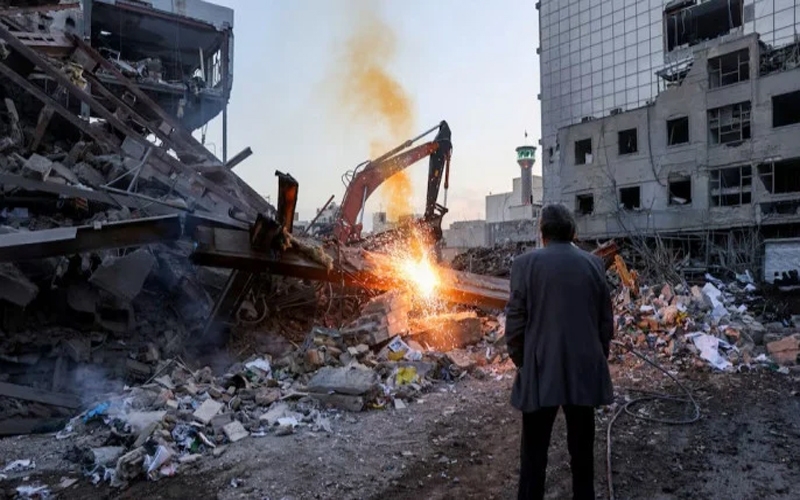
Aftermath of an Israeli and the U.S. strike on a police station, amid the U.S.-Israel conflict with Iran, in Tehran, Iran, March 2, 2026.
The United States has launched what it described as the most intense round of strikes against Iran since the conflict began, as Tehran warned it would retaliate with more powerful missiles.
Speaking at a press briefing at the The Pentagon, US Defence Secretary Pete Hegseth said the latest phase of the campaign, dubbed Operation Epic Fury, would involve the largest deployment of fighter jets and bombers so far.
“Today will be our most intense day of strikes inside Iran — the most fighters, the most bombers and the most strikes,” he said, adding that the operation aims to destroy Iran’s missile stockpiles and launch systems, weaken its naval forces and prevent the country from developing nuclear weapons.
Hegseth claimed US forces were significantly weakening Iran’s military capabilities. He said the number of missiles fired by Iran in a 24-hour period had dropped to the lowest level since the war began.
Chairman of the Joint Chiefs of Staff Dan Caine said ballistic missile attacks had fallen by about 90 percent since the early days of the conflict, while drone attacks had declined by 83 percent.
However, the Islamic Revolutionary Guard Corps rejected US claims that Iran’s missile programme had been crippled. Iranian officials said the country was now deploying larger numbers of missiles with warheads weighing more than one tonne.
Iran has continued counterattacks on Israeli and US-linked targets across the Middle East, including sites in Bahrain, Kuwait, the United Arab Emirates and Saudi Arabia. Reports said one person was killed in Manama and two others in central Israel during the attacks.
Iranian authorities also reported heavy overnight bombardment near Risalat Square in Tehran, where at least 40 people were killed in what witnesses described as some of the most powerful strikes since the war began.
Residents in Tehran said the air raids caused severe damage to buildings and left many people unable to sleep amid continuous explosions.
The conflict has also spread to Lebanon, where Israeli forces and fighters from the Iran-backed group Hezbollah have continued exchanging fire. Reports indicate that nearly 500 people have been killed in Israeli attacks in Lebanon over the past week.
Amid rising tensions, US officials said the military was considering escorting commercial vessels through the strategic Strait of Hormuz to ensure the safety of global shipping routes.
Earlier, US President Donald Trump said the war was progressing “very far ahead of schedule,” though he gave few details about when the conflict might end.
Meanwhile, the United Kingdom has prepared a naval support vessel, RFA Lyme Bay, in case it is needed to assist operations in the eastern Mediterranean as the crisis continues to escalate.