

- 8 More Die With Measles Symptoms in Bangladesh |
- Hasina wasn't brought to India by its Air Force or Army: Dinesh Trivedi |
- Bangladesh Scales Up Disaster Preparedness Amid Rising Risks |
- Tarique Calls for Deeper Cooperation in Bay of Bengal |
- Dhaka Third Most Polluted City in World on Saturday |
Govt. to take tough stance against money laundering: PM
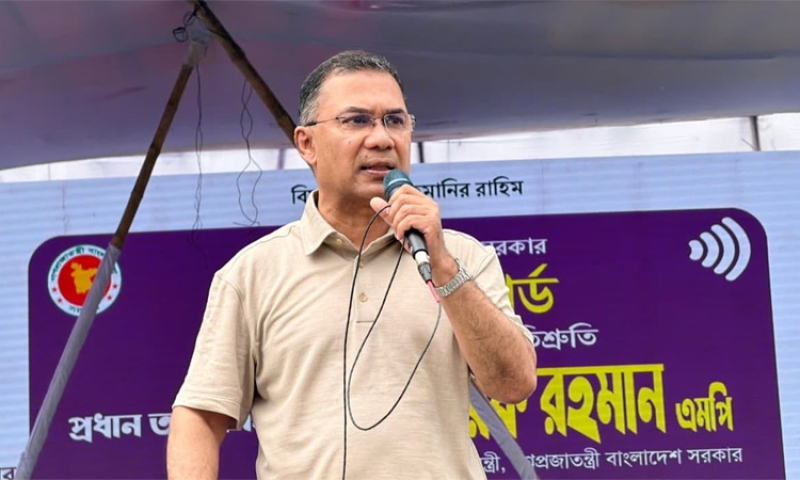
Prime Minister Tarique Rahman on Wednesday said his government would adopt a zero-tolerance approach to money laundering, pledging that public funds would be used for the welfare of citizens instead of being siphoned abroad.
“The people's money will not be allowed to be laundered abroad in any way. It will be spent on improving the lives and living standards of our people,” he said while addressing a Family Card distribution programme at Victoria High School ground in Sreemangal.
The premier said some quarters were trying to create confusion over how the government would finance welfare initiatives such as the Family Card and Farmer Card programmes.
“For more than a decade, the people's money was laundered out of the country. We will not allow that to happen anymore,” he said, urging all concerned to remain vigilant against illicit financial outflows.
Addressing thousands of tea workers and local residents gathered at the venue, Tarique Rahman sought public support for the government's efforts to improve livelihoods and said the administration was committed to ensuring that national resources benefit ordinary citizens.
Highlighting the role of the BNP, he described the party as one rooted in public support, saying its greatest strength has always been the people. He added that whenever given the opportunity through elections, citizens had entrusted the party with governing the country.
Recalling former prime minister Begum Khaleda Zia, Tarique Rahman praised her commitment to Bangladesh, saying she remained with the people during difficult political periods and considered the country her first and last address.
“We are soldiers of Khaleda Zia. Our mission is to change the destiny of the people of Bangladesh,” he said, calling on citizens to work together to build a prosperous nation.
The prime minister also reiterated his government's commitment to expanding social protection programmes, saying the Family Card initiative was designed to empower women and strengthen household financial security.
He recalled promising during the election campaign in Sylhet that female tea garden workers would receive Family Cards if the BNP formed the government and said he was pleased that the pledge had now been fulfilled.
According to the prime minister, the government aims to extend Family Cards to nearly all women working in tea gardens within the next year and eventually to households across the country, with particular emphasis on female heads of families.
He stressed that women’s economic participation was essential for national development, saying Bangladesh could not move forward unless women were empowered alongside men.
Tarique Rahman also announced that eligible female tea garden workers would receive housing assistance of Tk 200,000 each. During the programme, he handed cheques to three beneficiaries on stage and said the remaining recipients would receive the grants through the administration.
Calling for greater unity and productivity, he urged citizens to adopt the principles of “work first” and “Bangladesh for everyone” in advancing the country's development.
After the ceremony, the prime minister planted saplings of jam and krishnachura trees.
The event, organised by the Ministry of Social Welfare, was chaired by Social Welfare and Women and Children Affairs Minister Professor AZM Zahid Hossain. State Minister for Social Welfare Farzana Sharmin, Moulvibazar District BNP Convener Faizul Karim Nayan, Moulvibazar-4 MP Mujibur Rahman Chowdhury, Additional Secretary Kamal Uddin Biswas and Family Card beneficiaries Shiuli Rani Das and Wajeda Begum also addressed the gathering.
The programme marked Tarique Rahman's first visit to Sreemangal in more than two decades. It began with recitations from the Holy Quran and other religious scriptures, followed by the national anthem and the BNP party song.
During the event, the prime minister personally distributed Family Cards to ten female heads of households and formally launched the third phase of the Family Card programme. He also inaugurated housing grants for tea workers, scholarships for their children and financial assistance for persons with disabilities.