

- Bangladesh to Introduce New Law to Curb Extortion, IGP Says |
- UN Marks 81 Years of Global Cooperation and Peace |
- Dhaka's air 5th worst in the world this morning |
- Around 7,500 Bangladeshis imprisoned in Saudi Arabia: Shama Obaed |
- Bangladesh Outperforms India in Global Hunger Index 2026 |
Corruption Hits BD's Haor Embankments, Farmers Fear Crop Loss
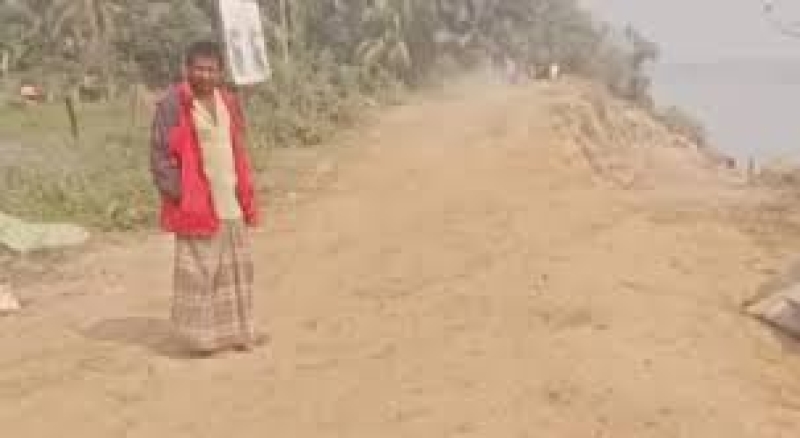
Allegations of bribery, document forgery and abuse of power have surfaced around haor embankment projects in Sunamganj district, raising fears that corruption could undermine flood protection works critical to the country’s boro rice harvest.
Farmers in Shalla upazila accuse officials and politically connected individuals of turning publicly funded embankment schemes into a money-making operation, using irregular project implementation committees (PICs) to siphon off crores of taka meant to protect haor wetlands from early floods.
At the heart of the allegations is a pattern of deliberate exclusion. Under government rules, PICs must be formed with five to seven members drawn from landowners and genuine beneficiary farmers in the project area.
Illegal topsoil extraction threatens ‘Gaillar Haor’, croplands in Sunamganj
Instead, farmers say, committees have been stacked with non-farmers through political influence and large-scale financial transactions, allowing control over project funds with little accountability.
“They have reduced embankment construction to a business,” said one local farmer, adding, “The committees are just tools for looting.”
Complaints filed with the administration allege widespread irregularities across multiple projects, including those numbered 108, 109, 118, 14, 33, 18, 119, 70 and 22.
In each case, farmers claim individuals with no land in the project areas were appointed to PICs, while rightful landowners were sidelined.
One of the most contentious cases involves project No. 108 under the Kalinikota Haor sub-project, covering embankment repairs from the Hawar canal to Sapuria Para.
Khondkar Habib, a farmer whose ancestral and recorded land lies directly beneath the embankment, said corruption was evident even after official inspections.
“Despite submitting all documents on time, our names were excluded from the list published on January 2,” Habib said.
“The entire embankment runs over our land, and soil must be taken from our property. Even after seeing everything on the ground, public health engineer Rashedul Islam approved a committee of non-farmers. We are hearing this was done in exchange for a large amount of money,” he said.
Allegations of financial misconduct extend beyond individual projects.
A member of the upazila-level PIC implementation committee accused senior officials of facilitating transactions rather than enforcing oversight.
“Our signatures were taken before meetings even began,” the committee member said, adding, “Money was exchanged from projects 25 and 93.
Even after informing the UNO, the projects were not suspended. From projects 45 and 98 alone, Tk 300,000 was taken, along with money from several others, by PDB committee members and public health engineer Md Rashedul Islam.”
Further inquiries have revealed allegations of document forgery and criminal backgrounds among committee leaders.
The chairman of PIC No. 70, Pradip Chandra Das, is facing an ongoing case at Dhaka’s Uttara East Police Station.
Farmers allege he secured his position by forging land ownership records for property he had already sold.
Despite policy provisions prioritising local participation, residents say several projects include committee members from neighbouring upazilas, a move they believe weakens accountability and encourages substandard work.
“Outsiders take the money and leave,” said another farmer. “If the embankment collapses and our crops are destroyed, we will suffer, not them.”
Local leaders of the Haor Bachao Andolon say the scale of alleged corruption this year surpasses previous records.
They warn that haor agriculture depends on a single annual crop, making embankment failure potentially catastrophic.
Victims have submitted written complaints seeking cancellation and reconstitution of the disputed committees to the Shalla upazila nirbahi officer (UNO) and the chairman of the upazila Kabita committee.
Copies have also been sent to the district administration and senior officials of the Bangladesh Water Development Board.
Attempts to contact the officials accused of wrongdoing were unsuccessful.
Piyas Chandra Das, Shalla Upazila Nirbahi Officer (UNO) said the allegations are under review and that action will be taken if evidence is found.
With embankment work deadlines approaching, farmers say delays in addressing corruption could leave both public funds and crops dangerously exposed, reports UNB.