

- Enforced Disappearances, Extrajudicial Killings ‘Almost Nil’: Minister |
- PM accords reception to winners of international Quran competition |
- 300,000 displaced people in Gaza seek safe shelter: UNDP |
- Climate change made deadly Nepal glacier and rock collapse more likely |
- Building damaged in Israeli strikes collapses in Gaza, killing 21 |
Chinese Scientists Develop AI Model for Cyclone Forecasting
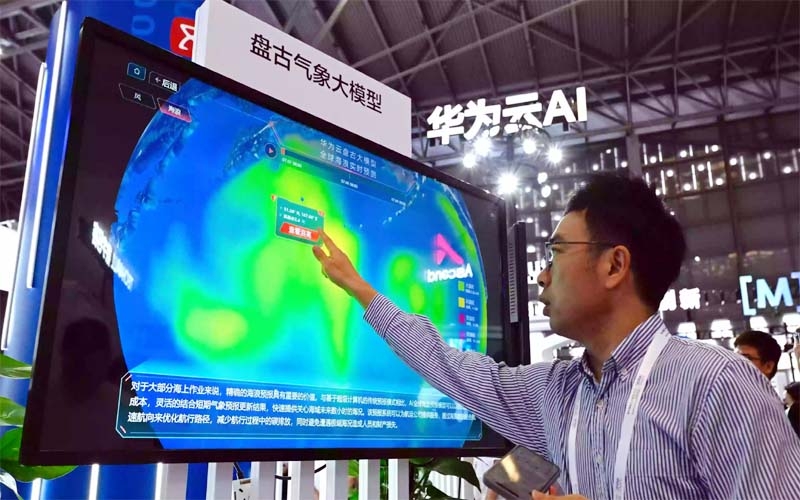
Researchers from the Institute of Oceanology at the Chinese Academy of Sciences published this study in the journal, Proceedings of the National Academy of Sciences.
Chinese scientists have introduced an advanced artificial
intelligence (AI) model designed to predict the rapid intensification of
tropical cyclones, offering a promising new tool to enhance global disaster
preparedness.
Recently, researchers from the Institute of Oceanology at the Chinese Academy of Sciences published their findings in Proceedings of the National Academy of Sciences.
The rapid intensification of tropical cyclones—characterized by a sharp increase in storm strength over a short period—has long been one of the most difficult and unpredictable weather events to forecast. Traditional forecasting methods, such as numerical weather prediction and statistical models, often fail to capture the complex environmental and structural factors that drive these intense storms.
While AI has been explored as a means to improve predictions, previous models struggled with high false alarm rates and limited reliability. To overcome these challenges, the Chinese team developed a new AI model that integrates satellite, atmospheric, and oceanic data.
When tested on tropical cyclone data from the Northwest Pacific between 2020 and 2021, the new model achieved an accuracy rate of 92.3%, significantly reducing false alarms to 8.9%. This marked a nearly 12% improvement in forecasting accuracy and a threefold reduction in false alarms compared to existing methods.
"This study addresses the critical issues of low accuracy and high false alarm rates in rapid intensification forecasting," said Li Xiaofeng, the study's lead author. "Our method not only improves predictions but also strengthens global defenses against the devastating impacts of these extreme events."