

- Inflation Falls to 9.16% in June as Food Prices Ease |
- Nine Killed in Landslides at Rohingya Camps |
- Govt Unveils Farm Reform Plan to Boost Food Security |
- England defeat Mexico 3-2 to reach World Cup quarter-finals |
- Haaland knocks Brazil out of World Cup as Norway reach quarters |
Bangladesh Can Back Both SAARC, BIMSTEC: Shama Obaed
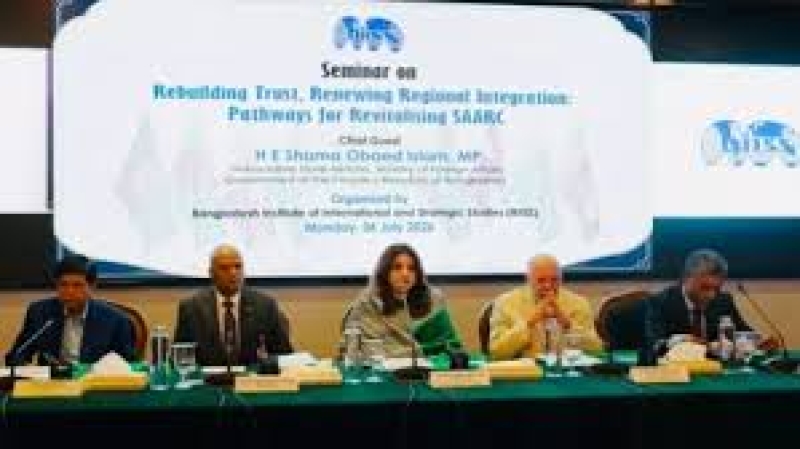
State Minister for Foreign Affairs Shama Obaed Islam on Monday said Bangladesh does not need to choose between SAARC and BIMSTEC, stressing that the two regional platforms should complement each other rather than compete.
Speaking as the chief guest at a seminar in Dhaka, she said the South Asian Association for Regional Cooperation (SAARC) and the Bay of Bengal Initiative for Multi-Sectoral Technical and Economic Cooperation (BIMSTEC) serve different but complementary purposes in advancing regional connectivity, stability and economic development.
“BIMSTEC connects South Asia with the Bay of Bengal and Southeast Asia, while SAARC represents the broadest framework of South Asian regional cooperation, including countries that are not part of BIMSTEC,” she said.
The seminar, titled "Rebuilding Trust, Renewing Regional Integration: Pathways for Revitalising SAARC," was organised by the Bangladesh Institute of International and Strategic Studies (BIISS).
The minister said Bangladesh supports both organisations because they promote the country's national interests through enhanced regional cooperation, connectivity, prosperity and stability.
She said sub-regional initiatives should strengthen, rather than undermine, SAARC.
"These initiatives should become building blocks for broader regional cooperation instead of drawing momentum away from SAARC," she said.
Reviving SAARC
Shama Obaed said Bangladesh favours keeping SAARC active at an "optimal functional level" until conditions become favourable for a full political and summit-level revival.
She explained that the approach involves maintaining regular technical and official meetings, strengthening specialised regional institutions, promoting practical cooperation and delivering tangible benefits for the people of South Asia.
The minister also advocated flexible, project-based cooperation, allowing willing member states to move forward with joint initiatives while keeping the door open for others to join later.
She said she had held separate discussions with representatives of all SAARC member states and found encouraging support for revitalising the regional organisation.
"It's time to translate our intentions into concrete action," she said.
Inclusive Regional Cooperation
The minister said SAARC should remain an inclusive regional platform and should not be paralysed by bilateral political disputes.
She said the organisation provides smaller member states with a collective voice while enabling larger countries to demonstrate constructive regional leadership.
"Our approach to SAARC is both hopeful and realistic. We do not expect full political normalisation overnight, but we also reject the notion that nothing can be achieved. Considerable progress is possible through practical, technical and people-centred cooperation," she said.
She added that Bangladesh remains committed to preserving SAARC, strengthening existing mechanisms and rebuilding confidence among member states.
Map Issue Raised
During the seminar, a representative of the Indian High Commission raised an objection to a map displayed during the keynote presentation, saying Jammu and Kashmir had been inaccurately represented.
Keynote speaker and former ambassador Tariq A. Karim responded that the map was intended solely for representational purposes and did not depict actual political boundaries. The concern was formally acknowledged.
Politics and Energy Key to Revival
In his keynote address, Tariq Karim said reviving SAARC requires both political commitment and adequate resources.
He compared the regional body to a vehicle with a functioning engine but lacking the political will and energy needed to move forward.
"Politics must function effectively, and the necessary resources must be available if SAARC is to regain momentum," he said.
Former Additional Foreign Secretary Md Shamsul Haque and Dhaka University Professor Dr Niloy Ranjan Biswas joined the discussion as panelists, while BIISS Director General Major General A. S. M. Ridwanur Rahman delivered the welcome and closing remarks.
The seminar was attended by senior government officials, diplomats, academics, researchers, military officers, representatives of regional and international organisations, students and policy experts.